

How To Draw A Human Face From The Side
On December 1, 2016, I asked myself the question: With only i month of exercise, can I learn how to describe realistic portraits with just pencil and paper?
On December 24, 2016, later 26 hours of practice, I constitute out that the reply was yeah.
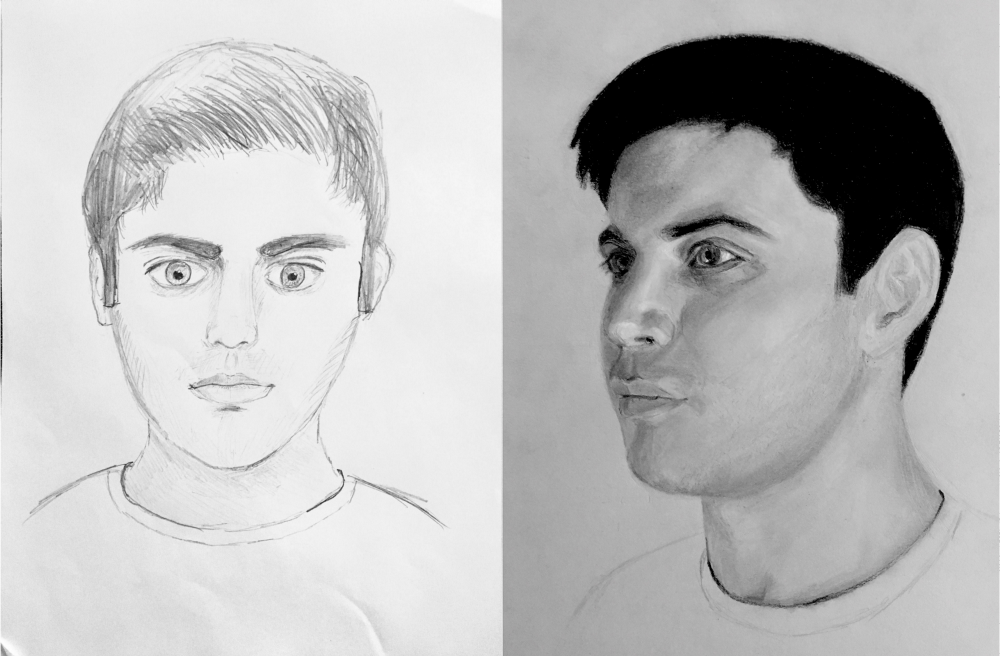
During the month of December, I documented my entire learning process in a series of 31 daily blog posts, which are compiled here into a unmarried narrative. In this article, you tin can relive my month of insights, frustrations, learning hacks, and triumphs, as I strive towards monthly mastery.
New calendar month, new claiming.
For the month of December, my goal is to draw a realistic self-portrait with merely pencil and newspaper. Along the way, in order to larn the fundamentals of drawing and portraiture, I volition also depict many other faces, which will hopefully keep this month's posts more than varied and interesting.
This new challenge starts today, Dec 1, 2016, and, by December 31, I hope to be a master of portrait drawing.
My starting betoken
I've had strong artistic tendencies since I was a kid, but I've never invested much in my fine fine art skills. Instead, I've channeled my artistic impulses mainly through music, film, and computer-aided design.
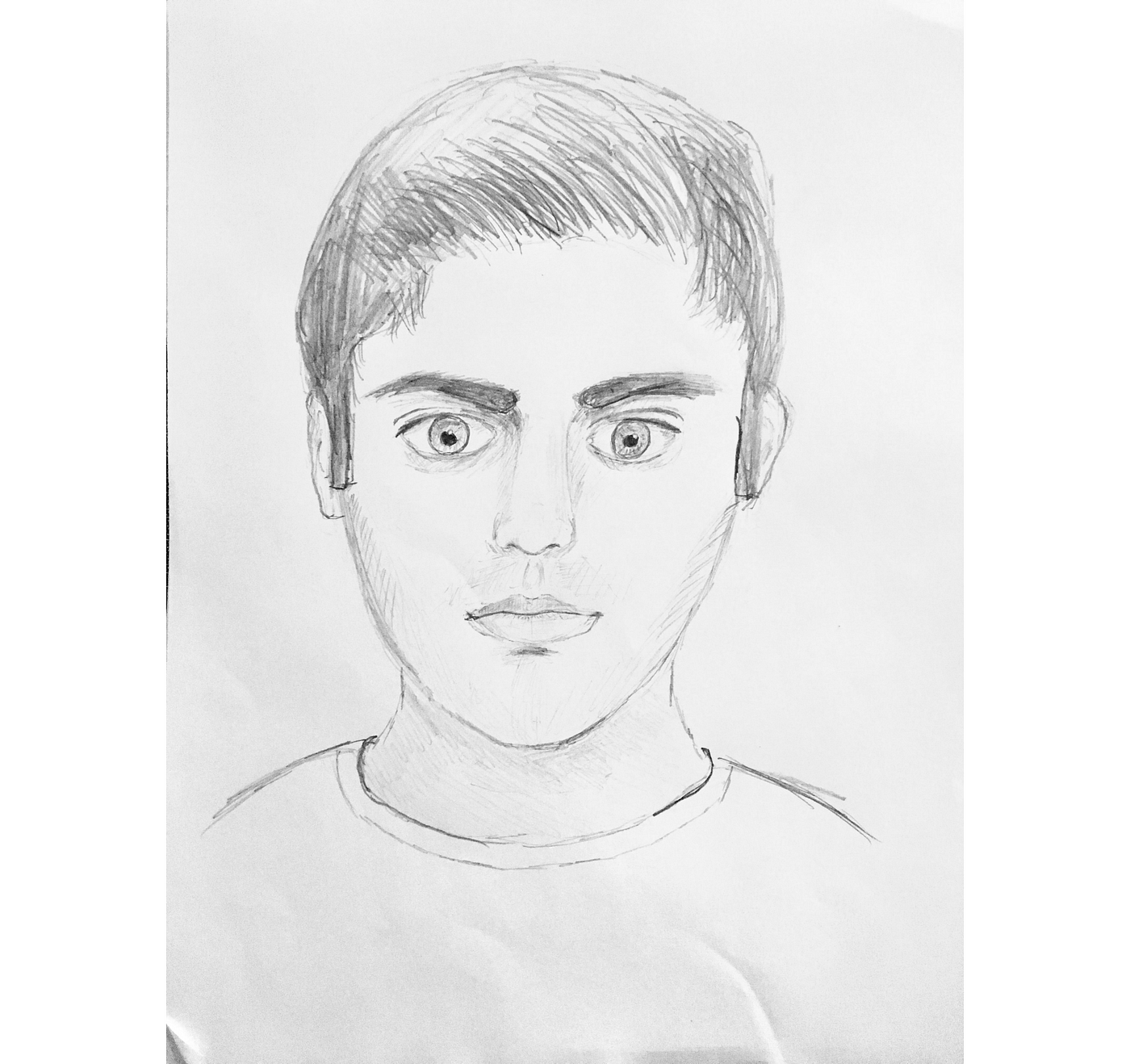
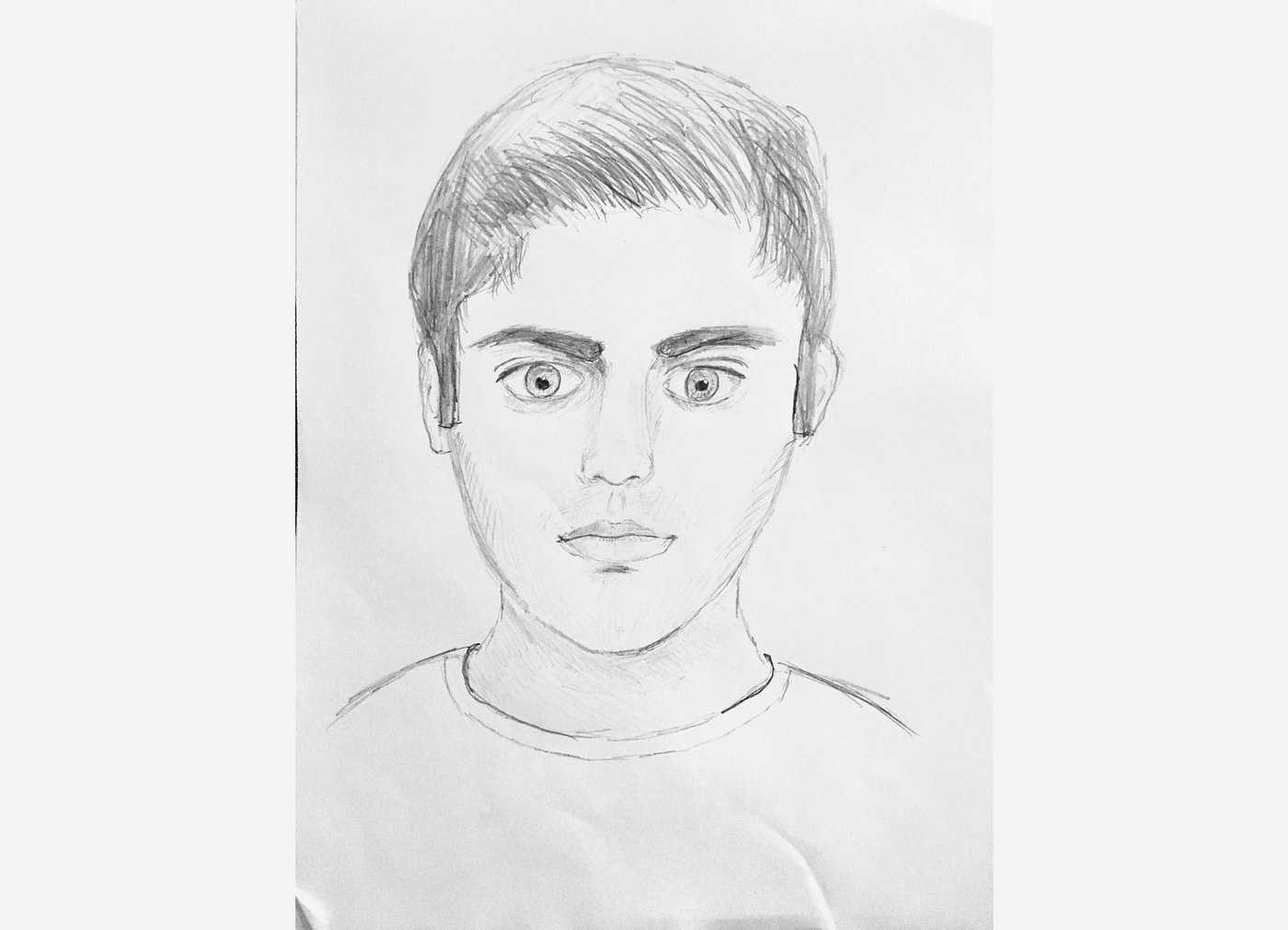
Thus, to prepare a baseline for this calendar month's challenge, I've drawn a earlier self-portrait with my current drawing skills. Although information technology's not the absolute worst affair e'er fatigued, information technology sadly doesn't look very much like me.
Measuring success
Measuring success for this claiming is certainly more subjective than last month (where I successfully memorized a deck of cards in less than 2 minutes).
In this case, the best I tin practice is show a photo that demonstrates the level of cartoon I'm aiming to achieve…
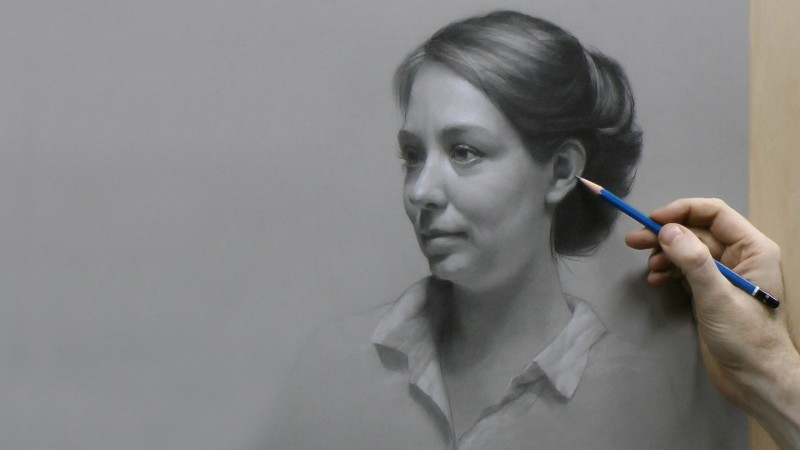
This portrait is the case drawn in the Vitruvian Studio Portrait Cartoon Class, which is the class I'll be following this calendar month.
Clearly, at that place are major differences in realism between my starting drawing and this instance portrait. So, if I tin match the level of this example (which will be, of course, a subjective, but hopefully honest judgement), I will consider this challenge a success.
With my goal set, information technology's time to start drawing…

In my life, I've created a fair flake of (what I'll phone call) art. Nevertheless, I've done then, not by relying on well-adult fine fine art skills, but instead, by cheating my way through the creative process.
Basically, I've used everything at my disposal (except for fine arts skills) to create artistically.
You can decide if this is cheating or not, but either way, this calendar month is going to be dissimilar. This month, I am actually going to invest in my fine art skills. This month, I'chiliad going to take a pencil and paper, and nothing else, and brand it happen.
However, earlier I make it happen, I idea it would be fun to share some of my previous works.
ane. Lego Portraits (with the help of Photoshop)
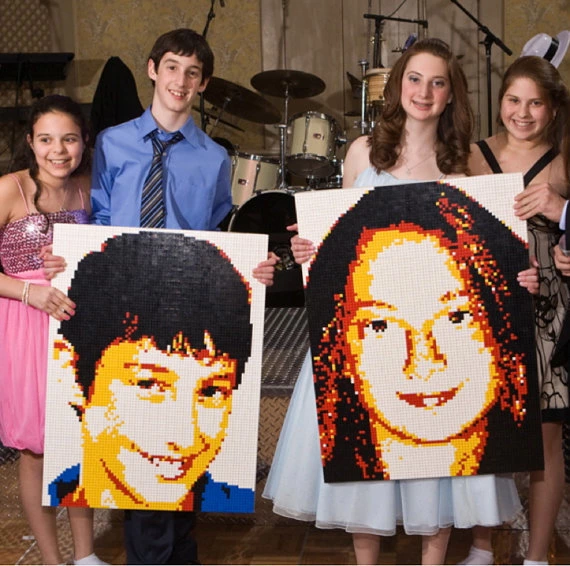
During high school, whenever I was tasked with making someone a gift, I usually opted to construct a custom Warhol-inspired portrait out of Legos.
Here are ii portraits that I made for my cousins Adam and Marissa.
And some other 1 I made for my grandparents.
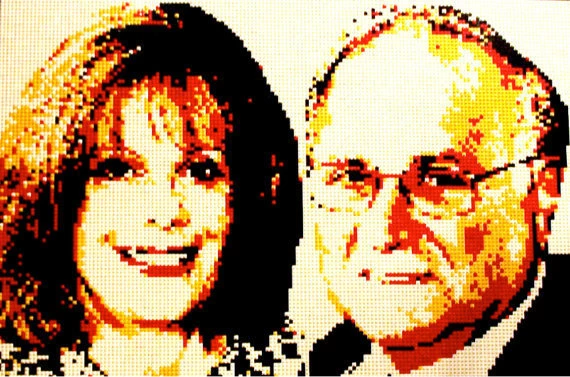
While these pieces may look similar they required some corporeality of artistic genius to pull off (do they?), that's actually not the case. Instead, these pieces just required some clever computational assay, planning in Photoshop, and executional patience (while glueing and placing each Lego piece).
The figurer was the real artistic champion here.
2. Apocryphal paintings (using optical tricks)
I've also experimented using optical tools (like mirrors and lens) to mechanically create. Although, I oasis't invested enough fourth dimension to produce annihilation worth sharing.
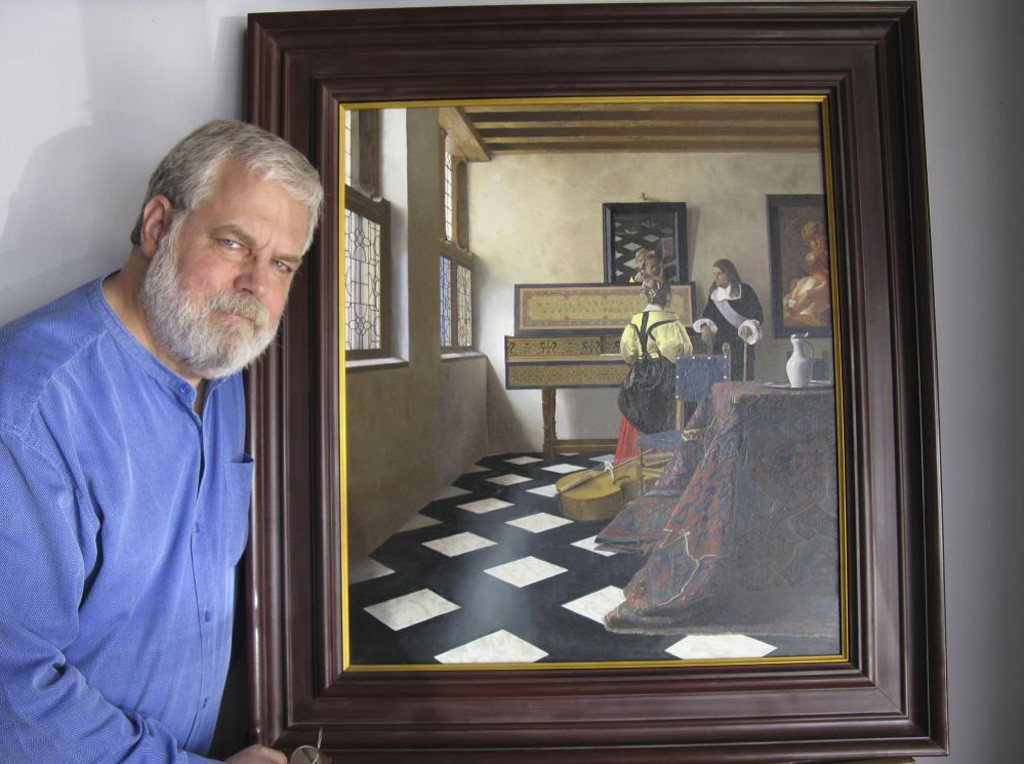
Tim Jenison, on the other hand, does have something worth sharing. Without any creative preparation, he painted a nearly-exact replica of a Vermeer painting solely using optical techniques.
Tim'southward journeying is documented in the Penn and Teller-produced moving-picture show "Tim's Vermeer", which I highly recommend you bank check out.
Here's Tim's final painting.
This month I'1000 only using pencil and paper
While engineering-aided fine art withal should probably count equally art (in some chapters), this month, I'one thousand committed to creating using just the tools shown beneath: 9 black pencils, 1 white pencil, a few different erasers, and a grey slice of paper (which I'll explicate another time).
It'due south going to be hard, but that's the point.
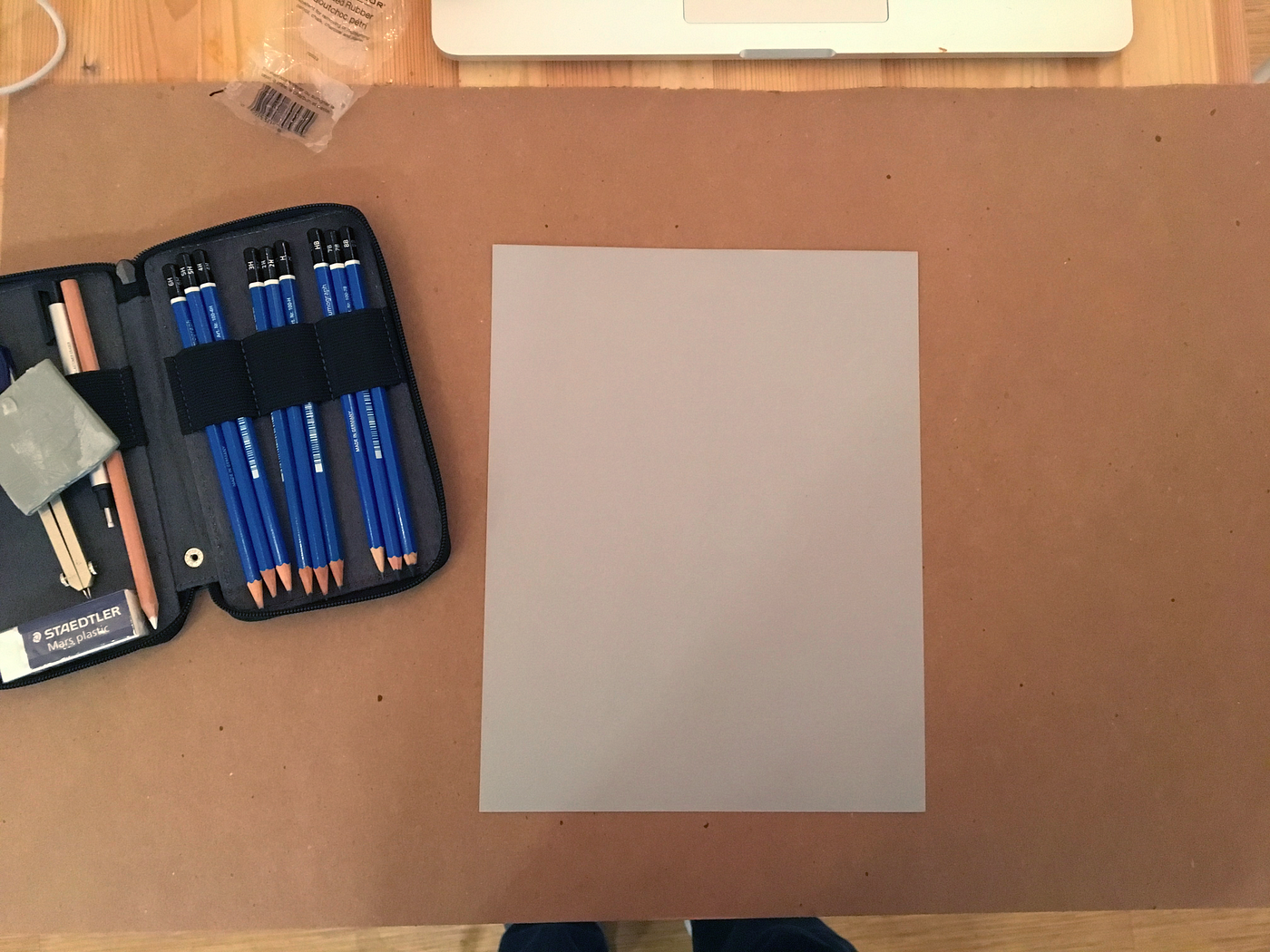
This month, to learn how to draw portraits, I'll be following the Portrait Drawing video form from Vitruvian Studio.
Today, I spent two.5 hours starting the course and showtime my first portrait.
Selecting who to draw
For my outset piece, rather than cartoon the model from the course, I've chosen to depict Derren Brown, who originally inspired me to pursuit portrait cartoon.
Derren is a British illusionist, who I've been following for a while now, and who, I recently learned, casually paints portraits on the side.
Hither are a few things he'due south casually painted.
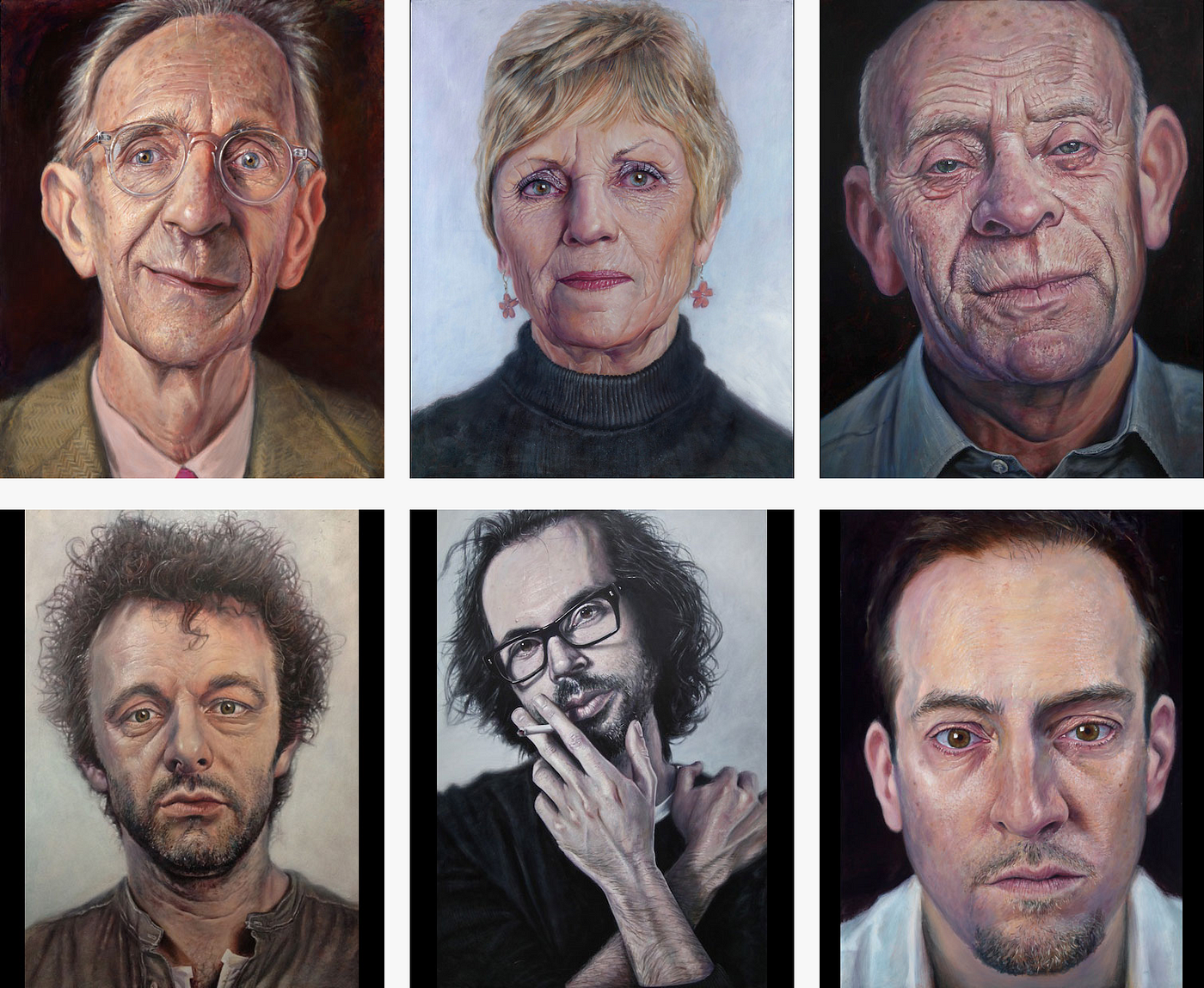
After seeing these, I decided I besides would like to exist the kind of person that casually paints impressively practiced portraits on the side.
For now, earlier I get to the painting, I'll start off by mastering the cartoon part of program.
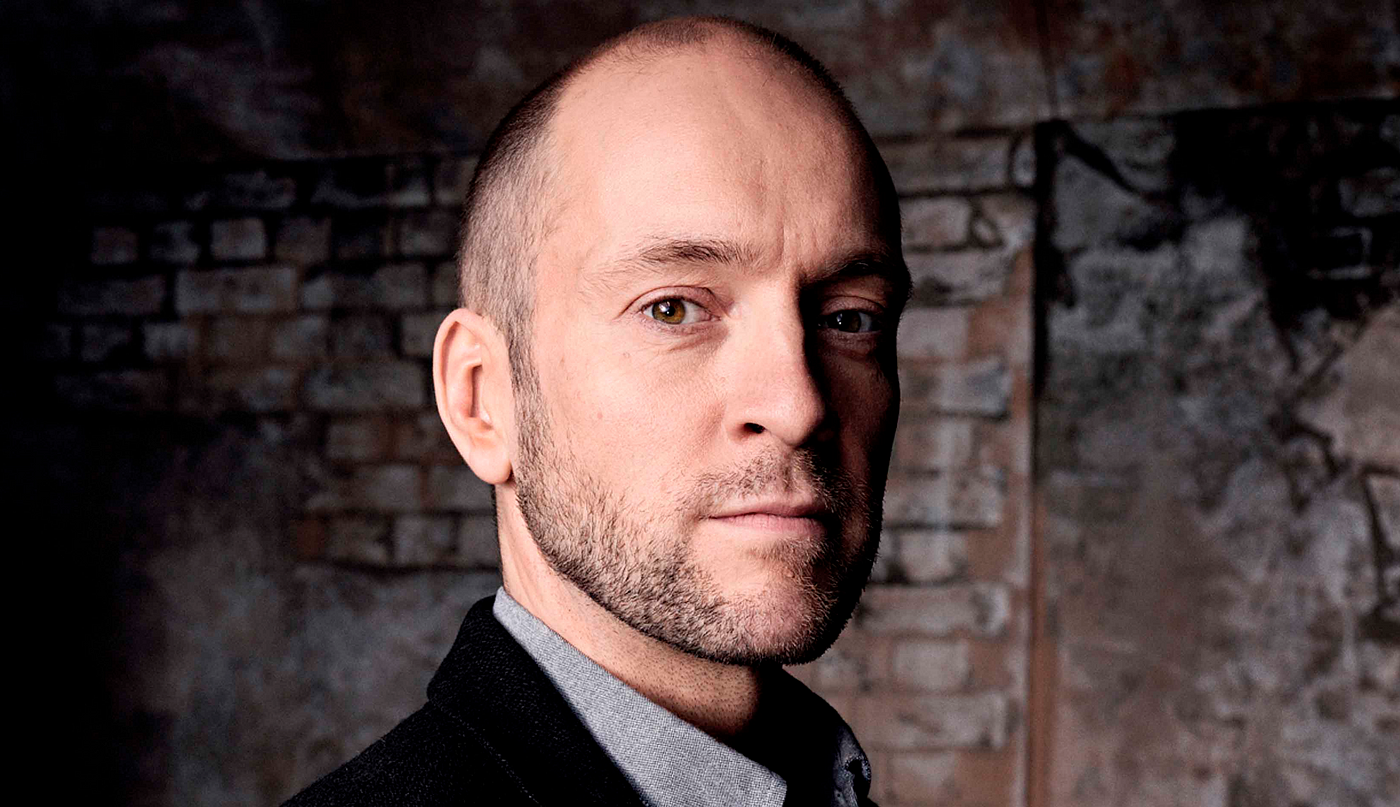
This is the motion picture of Derren I'm drawing.
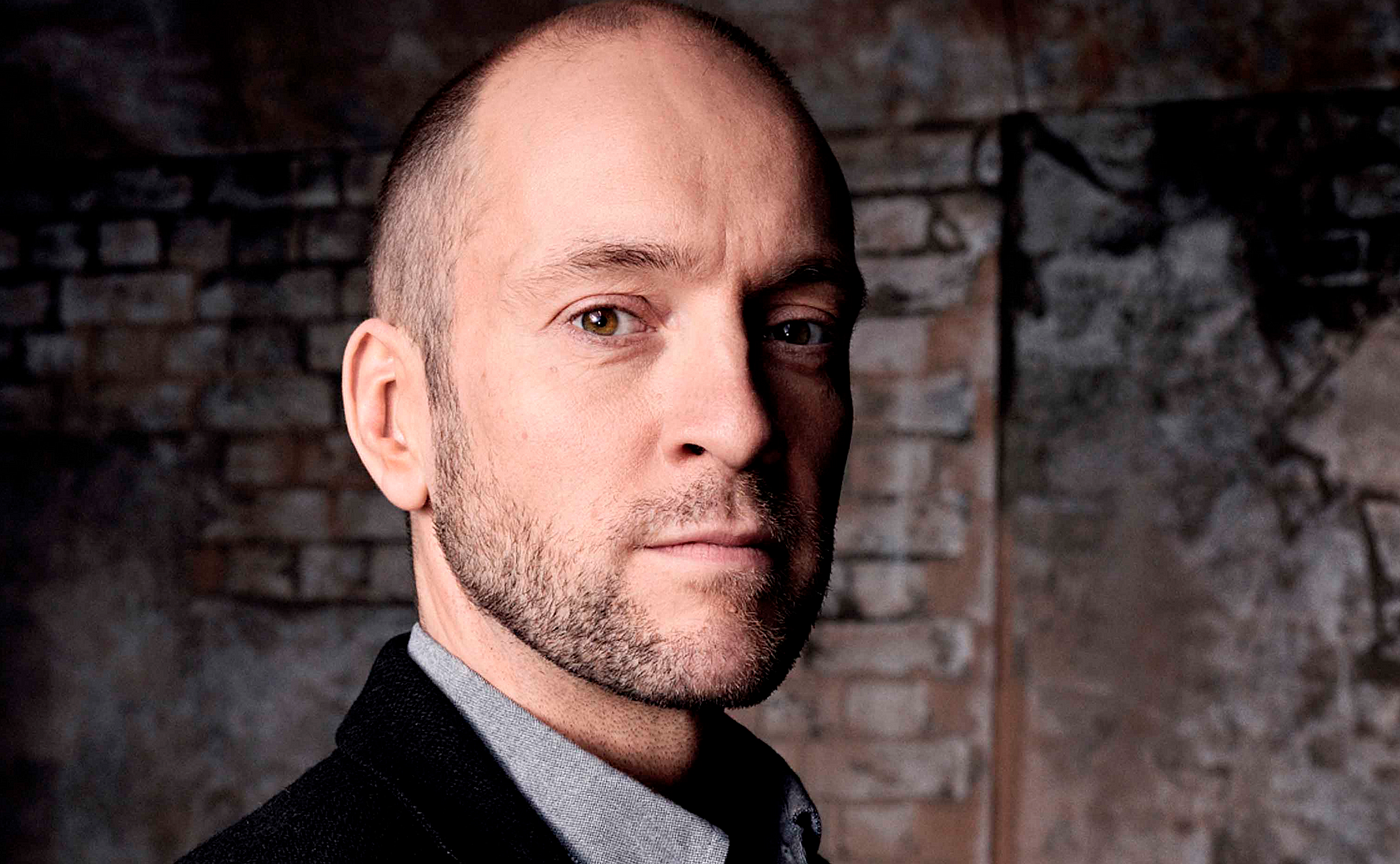
And here'due south my setup.
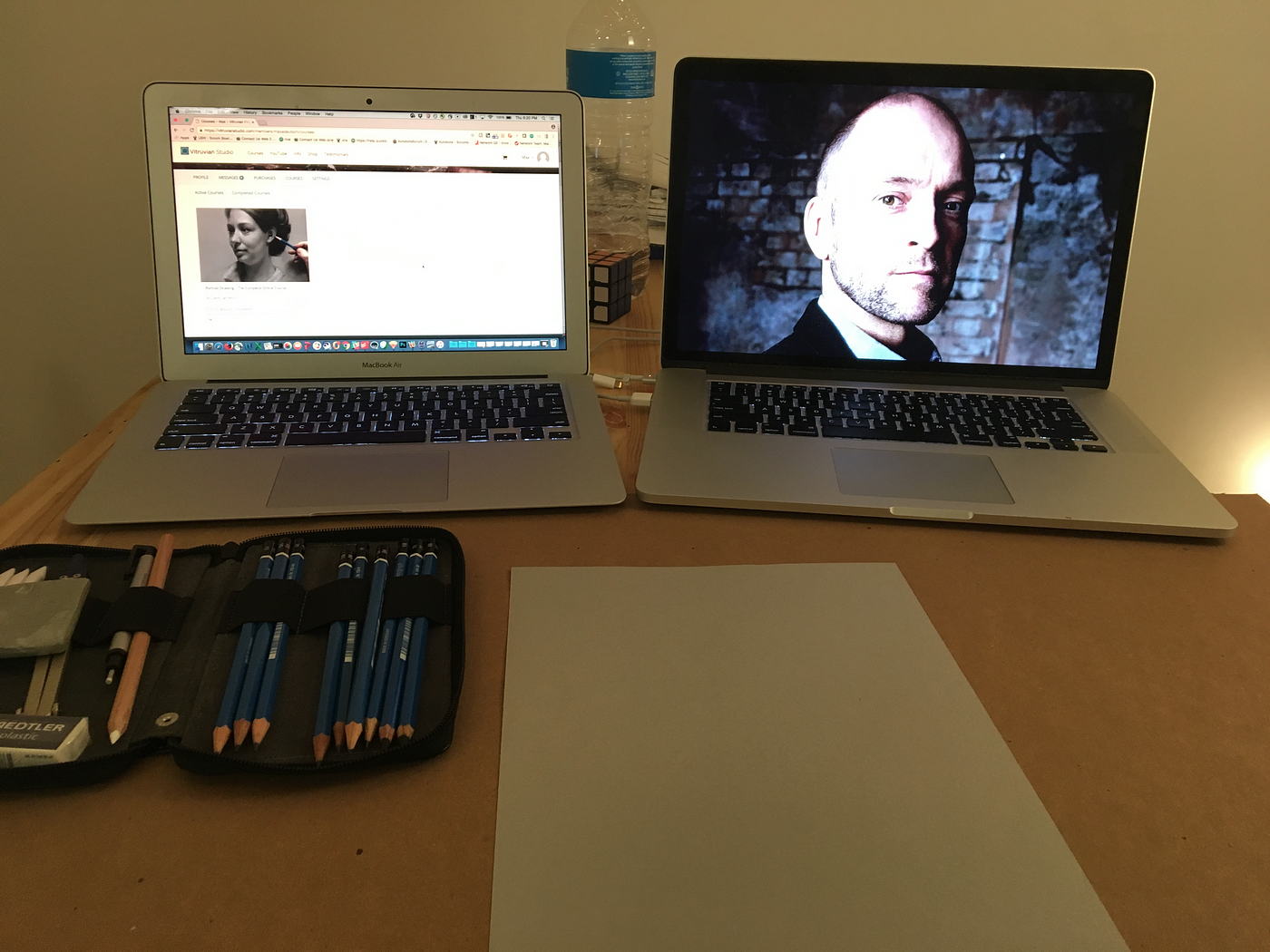
Starting the drawing
The start module of the course focuses on mapping out the portrait, which includes determining the shape of the head and locating the features.
Finding the top and bottom of the caput
I started by arbitrarily drawing two lines on the page to betoken the level of the superlative of the head and the level of the bottom of the caput.
Then, I arbitrarily marked, on the summit level, the highest point of the head, and then used the angle between this point and the bottom of the chin, to locate the bottom of the mentum on the page.
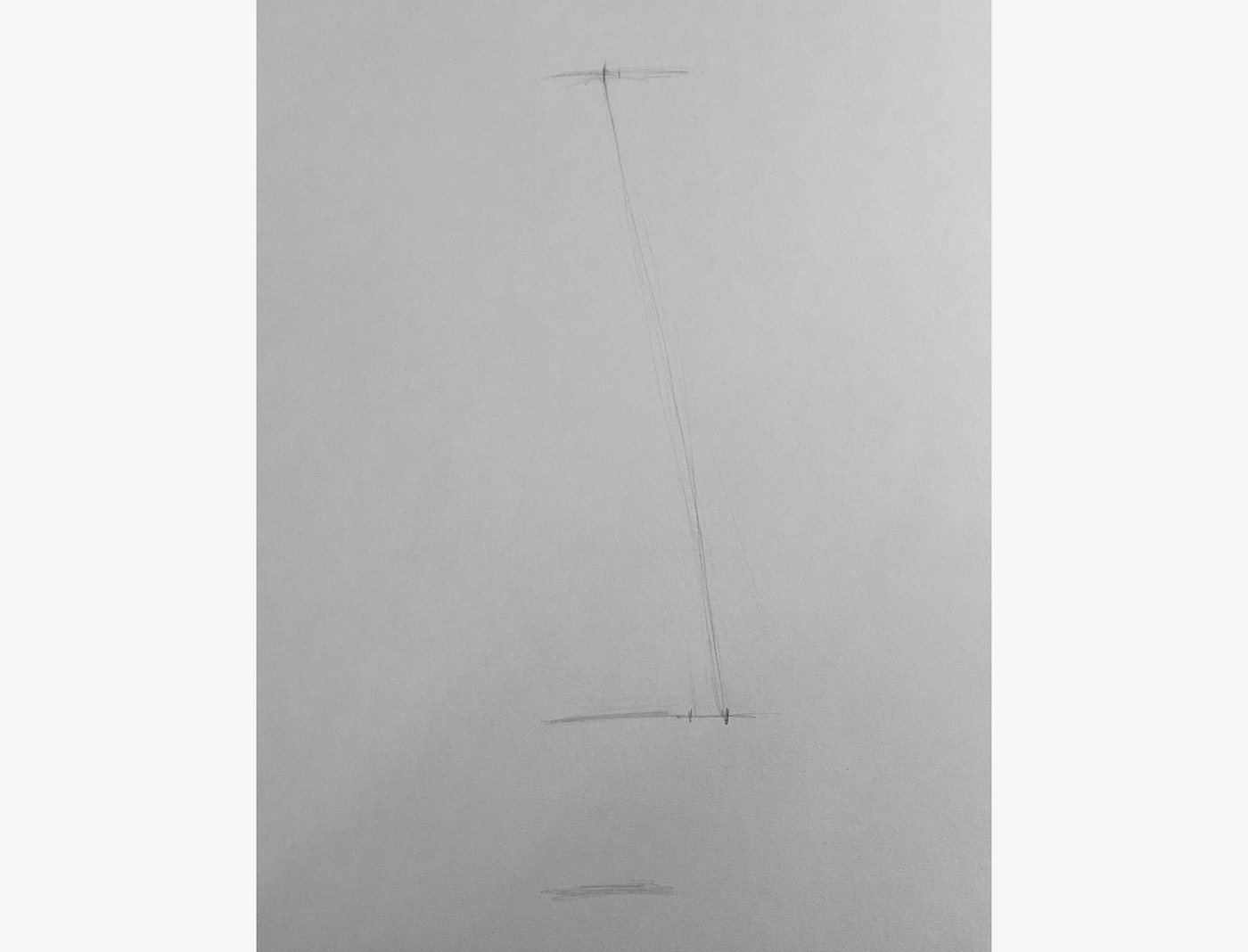
I also drew in the level of the notch of the neck. The commencement time, I drew information technology too low, and then I moved it up. I gauged this distances equally a proposition of the head length.
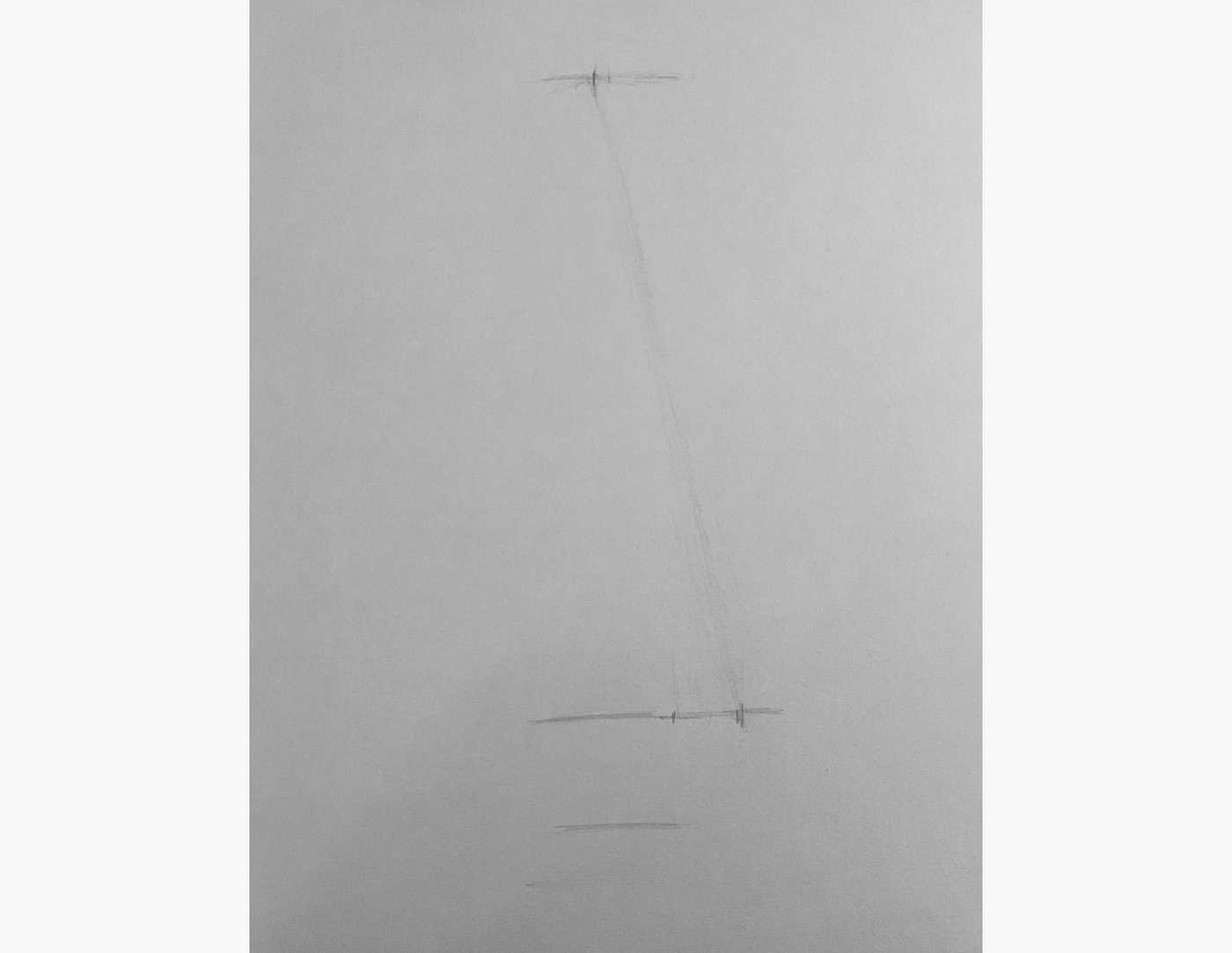
Find the leftmost and rightmost parts of the head
With the topmost and bottommost points identified, I and so needed to place the leftmost and rightmost points.
To do this, I used a new technique I learned called triangulation. To triangulate a new bespeak, I first sight (try to visualize) the angles to this new point from two existing points. And then, I draw lines from the existing points in the direction of the new point based on the sighted angles. Finally, I mark the new betoken where the lines intersect.
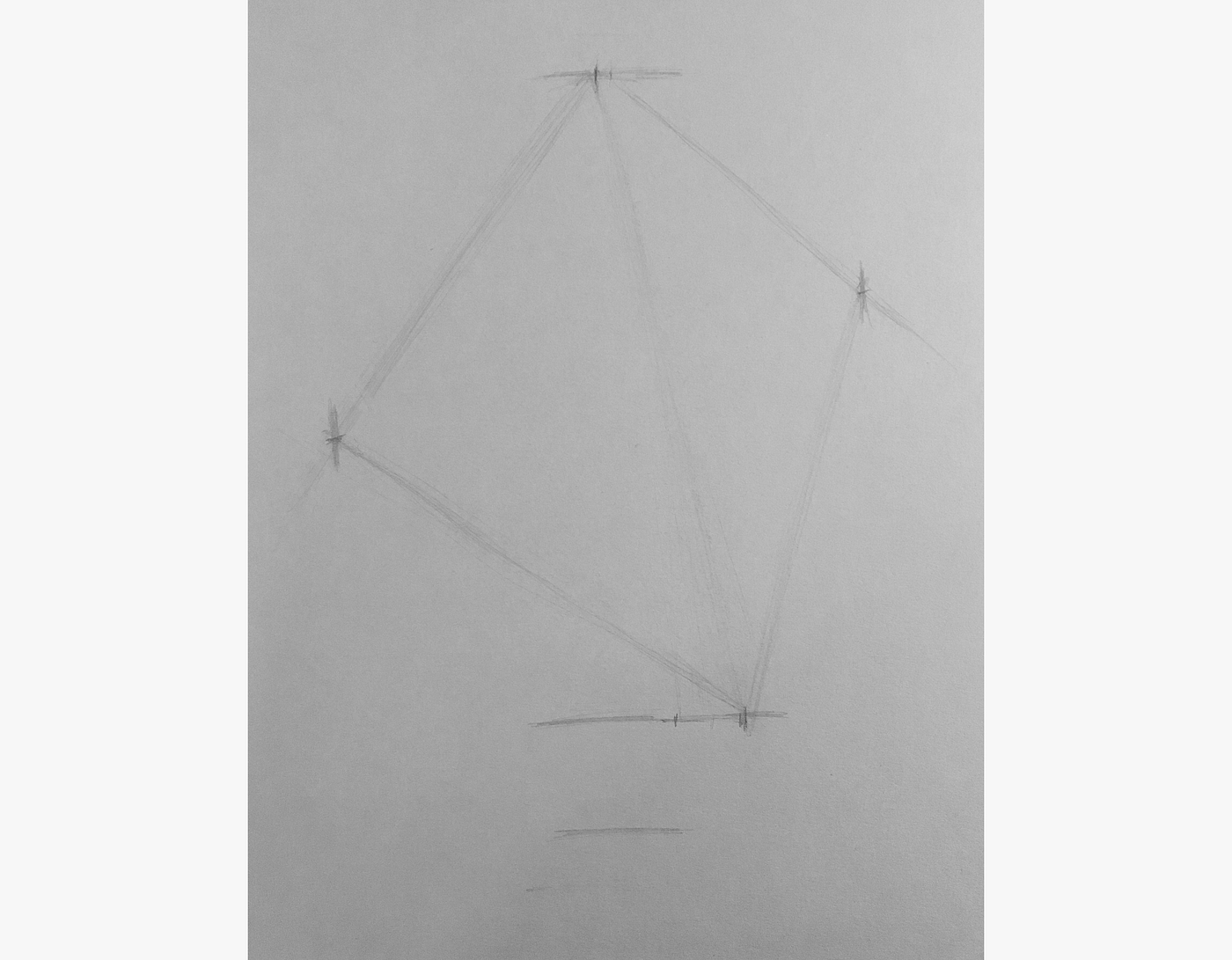
After checking the angles again, I updated these ii new points.
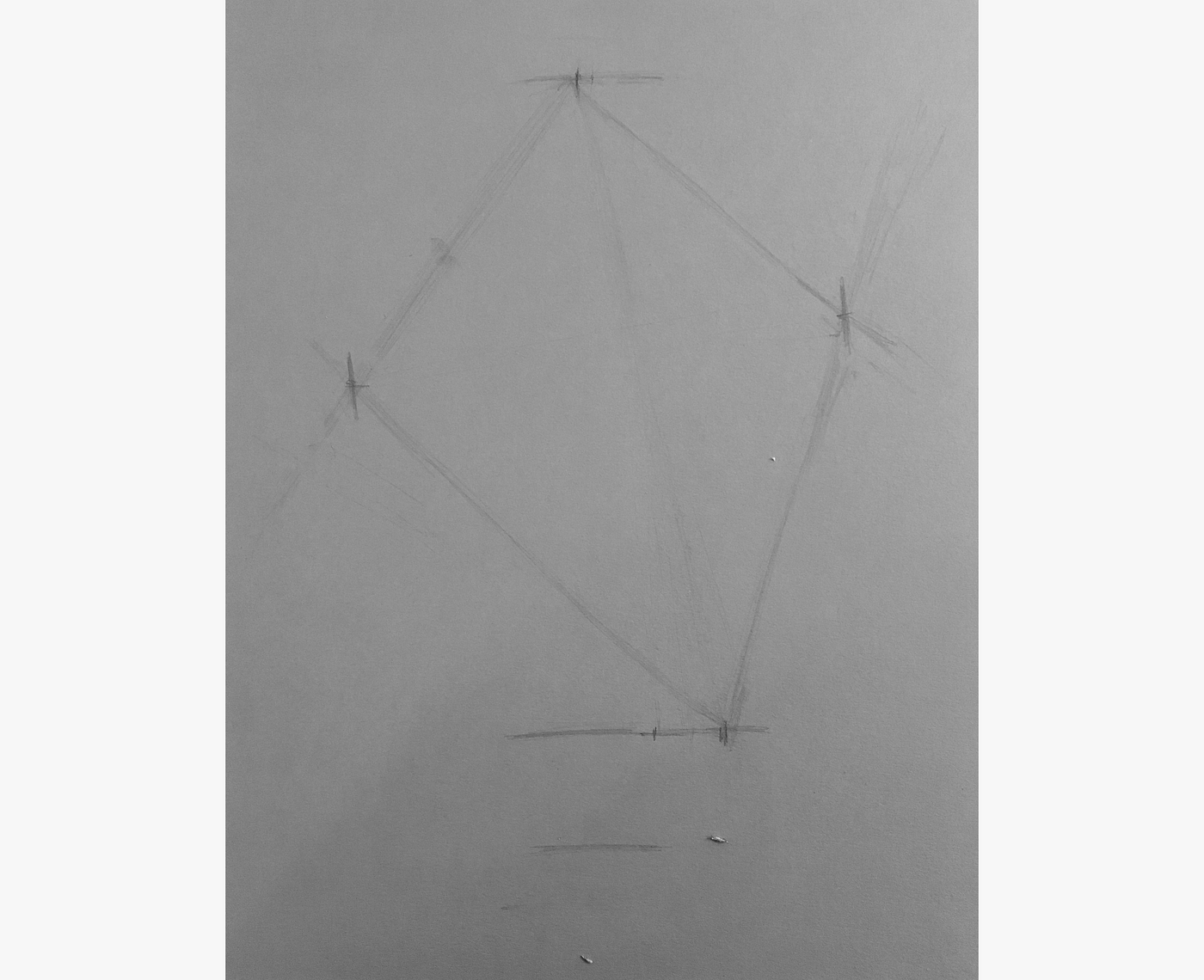
To bank check, I then sighted the angle between the two new points, ensuring this angle matches what I see on Derren's head.
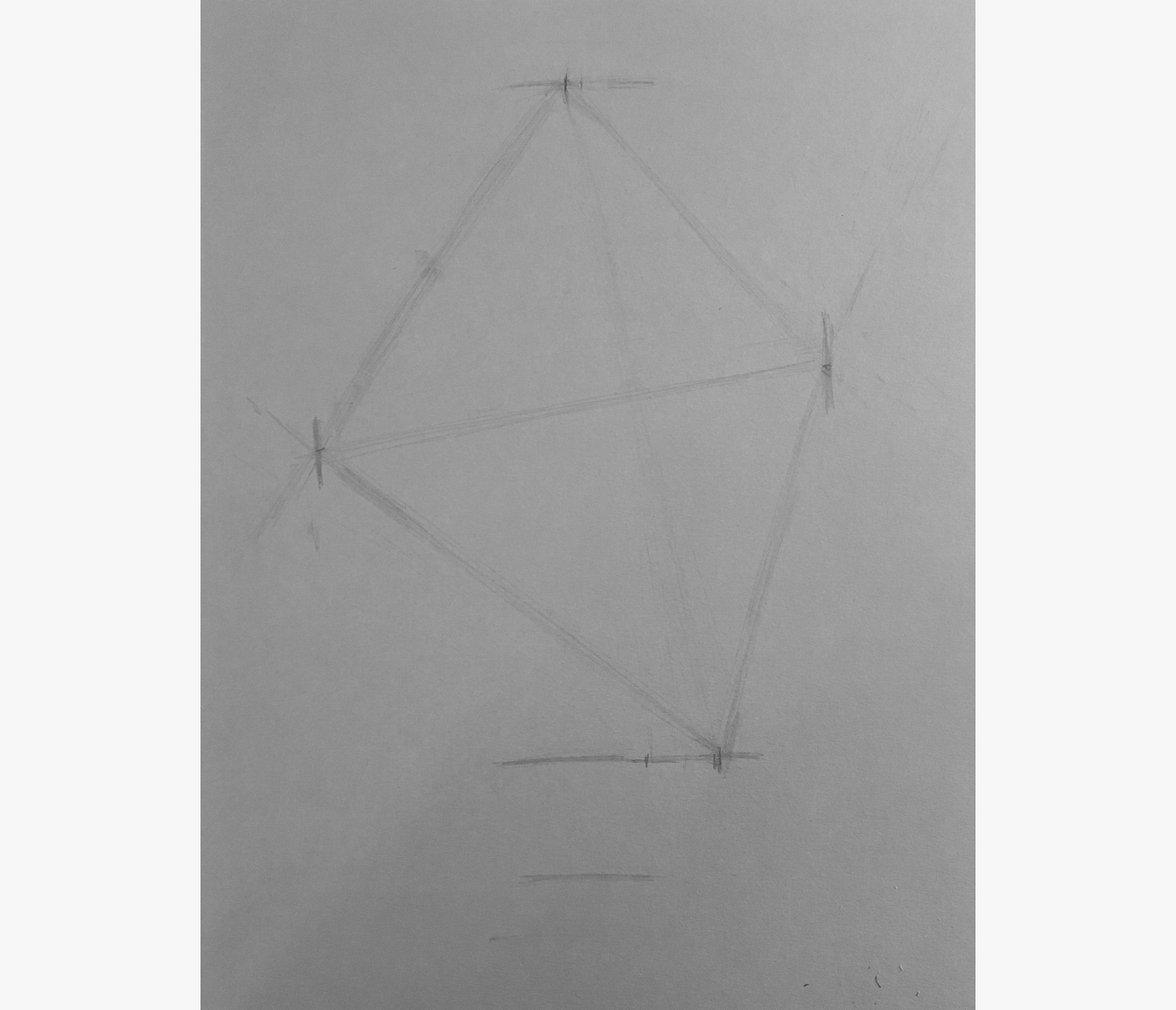
Drawing the shape of the head
With these iv outer points fatigued, the next step is to draw in the shape of the head. To do this, I continued to triangulate more than points, and depict in the necessary curves to connect them.
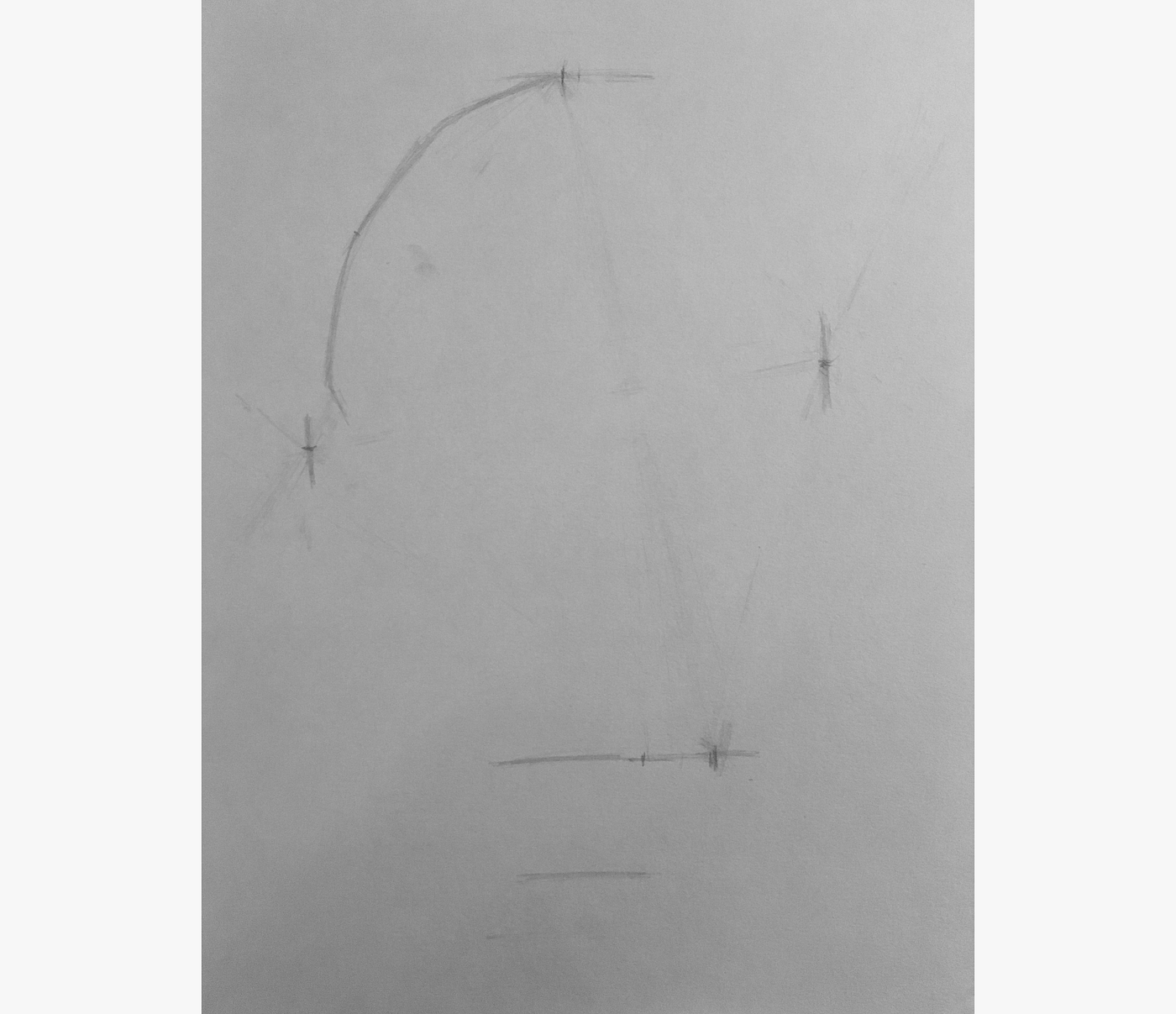
I continued in this way, until I outlined the unabridged shape of the head.
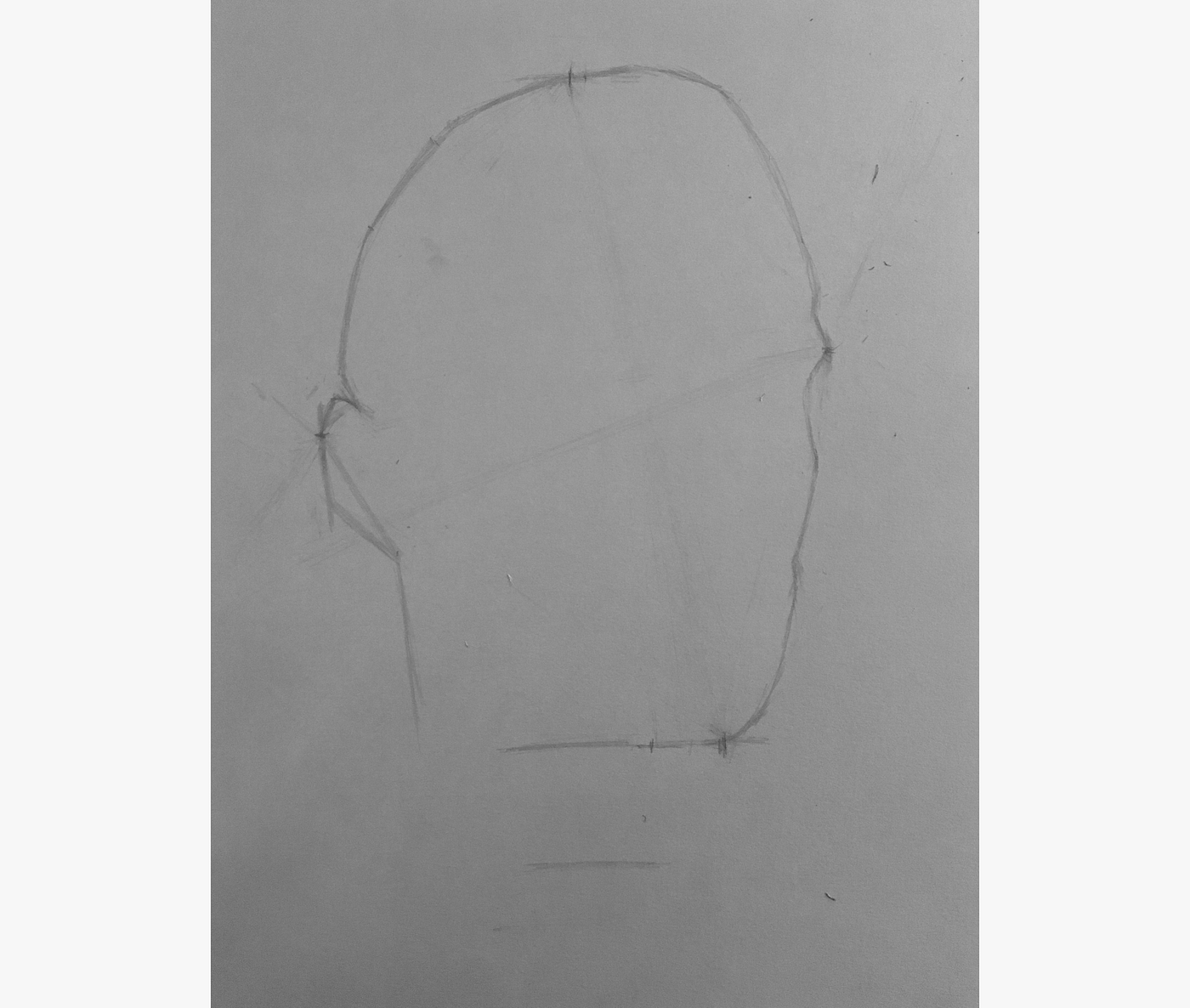
Information technology didn't look quite correct, and so I checked a bunch of angles.
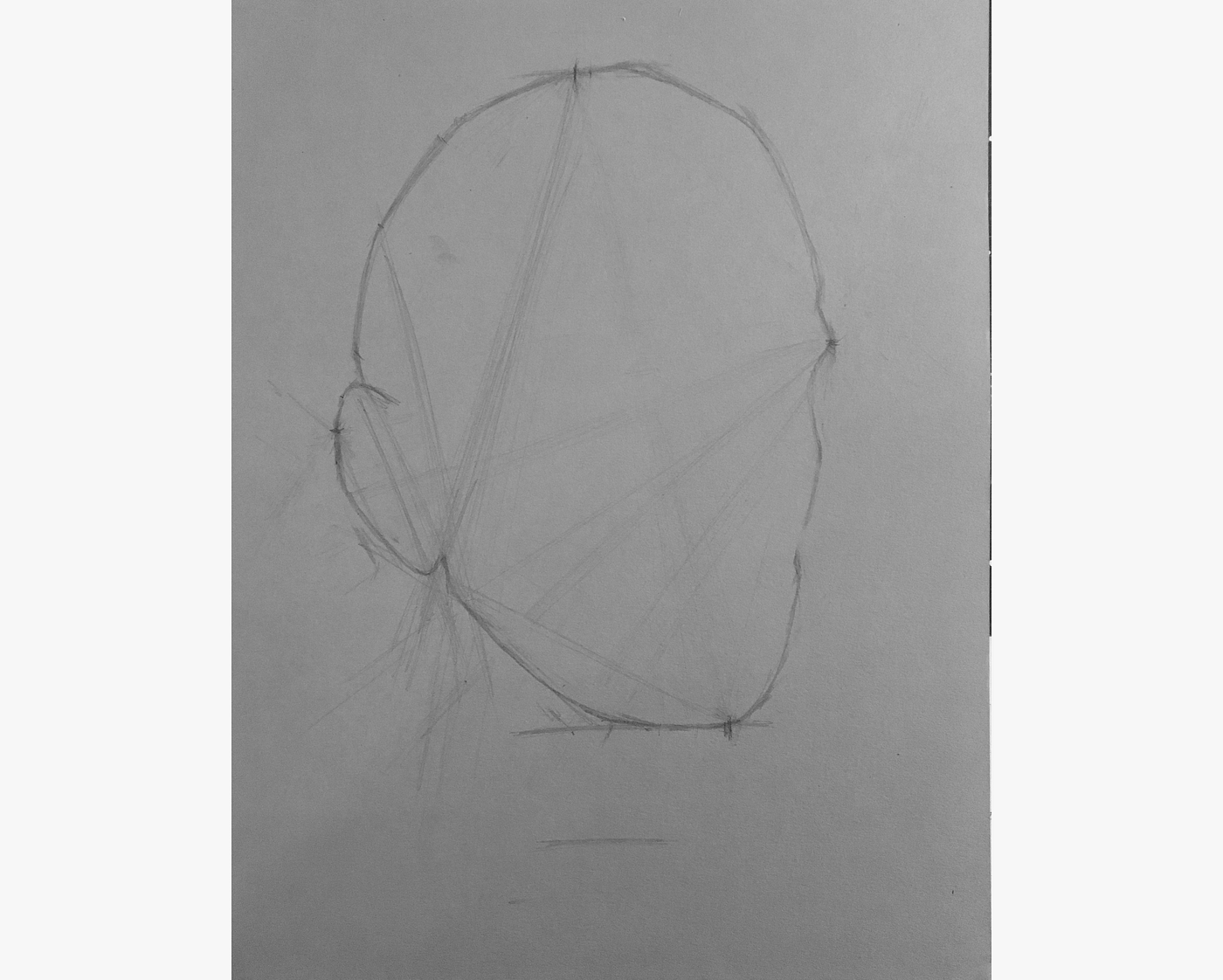
Once it seemed closer, I added in the neck and shoulders.
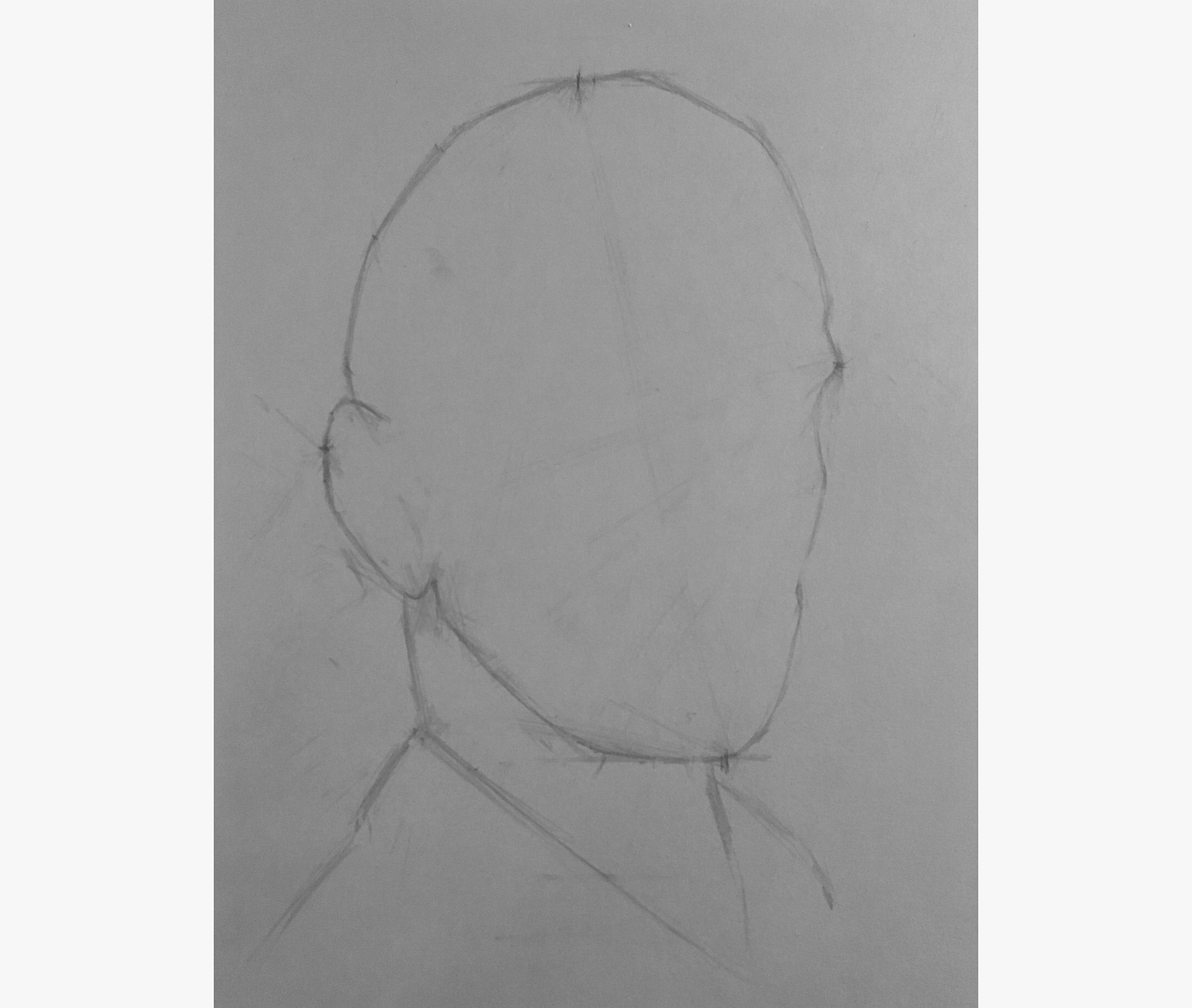
With the cervix and shoulders in place, information technology again didn't wait right. And so, I checked more angles and fabricated adjustments every bit necessary (generally to augment the jaw)
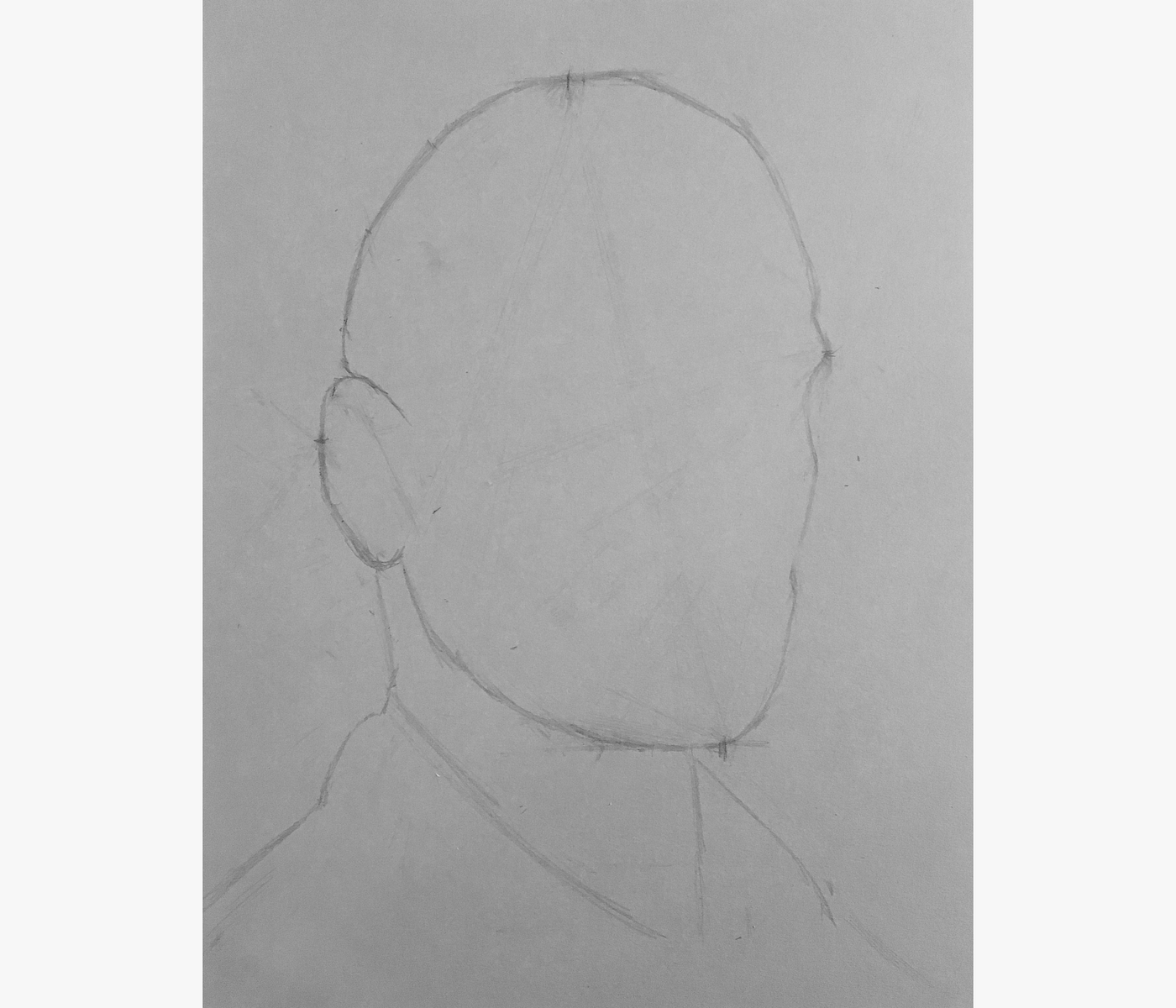
The head was now looking pretty proficient, but the neck and shoulders needed a few adjustments. I retriangulated, and adjusted the collar upward.
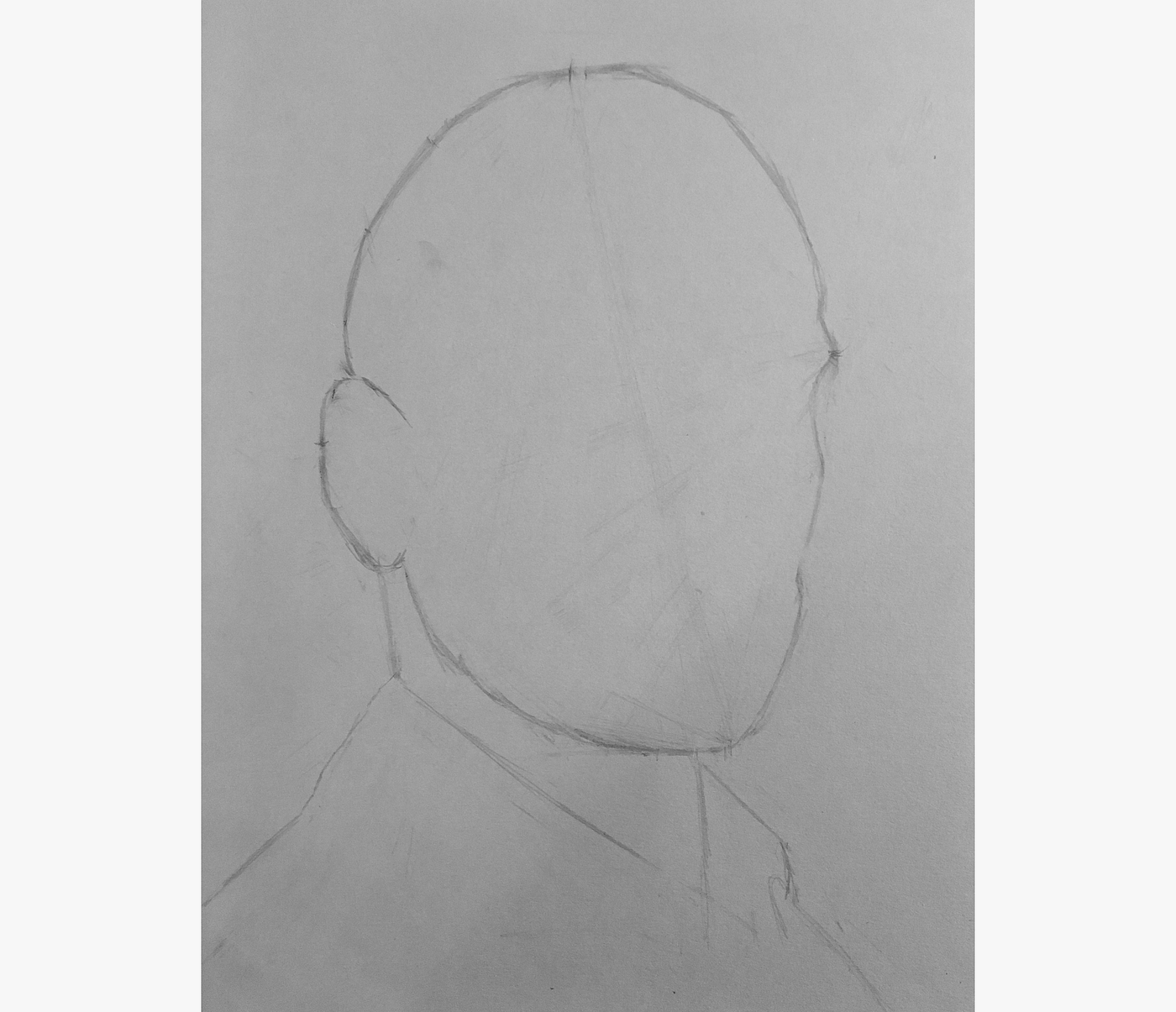
That'due south information technology for today
Getting to this point took me 2.5 hours, which was split between watching the video class and drawing my Derren portrait.
So far, the portrait doesn't expect like much, but I withal learned a bunch today. I particularly like the triangulation technique, which makes cartoon much more procedural and mathematical (a.k.a. easier for me).
Tomorrow, I'll keep following the form, and kickoff drawing in the facial features.
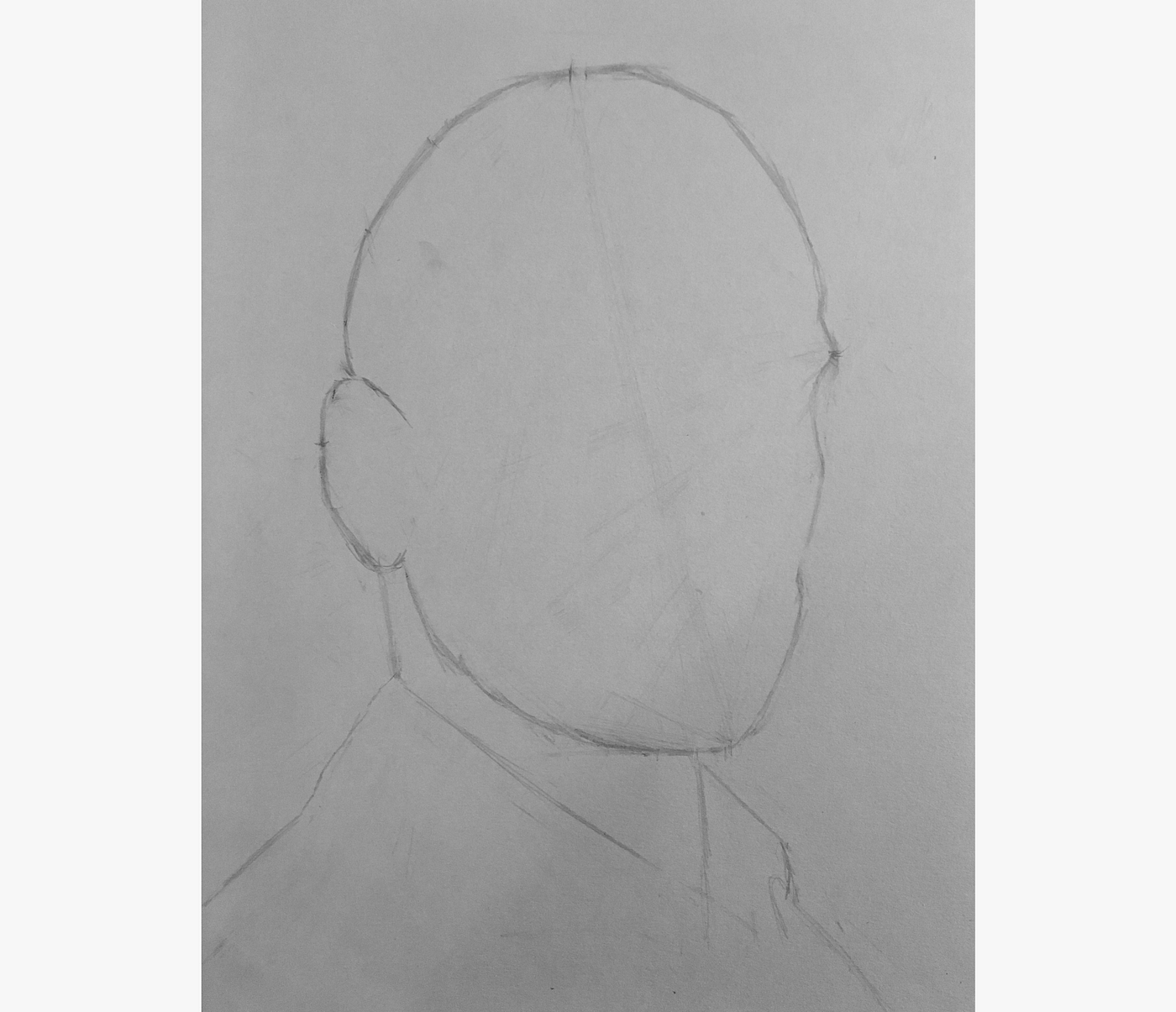
Yesterday, I started post-obit along with the Vitruvian Studio portrait form, and began drawing a portrait of Derren Brown.
Hither'due south what I accomplished yesterday.
And here's my end goal (more or less).
Today, I spent another 2.5 hours watching the class and working on the portrait.
Today'due south progress
Drawing in guides
The first thing I did today was add together construction lines to my cartoon. These construction lines are designed to human activity every bit landmarks and help me eventually identify the facial features.
First, I drew in the vertical middle line, which volition aid me laterally place the features.
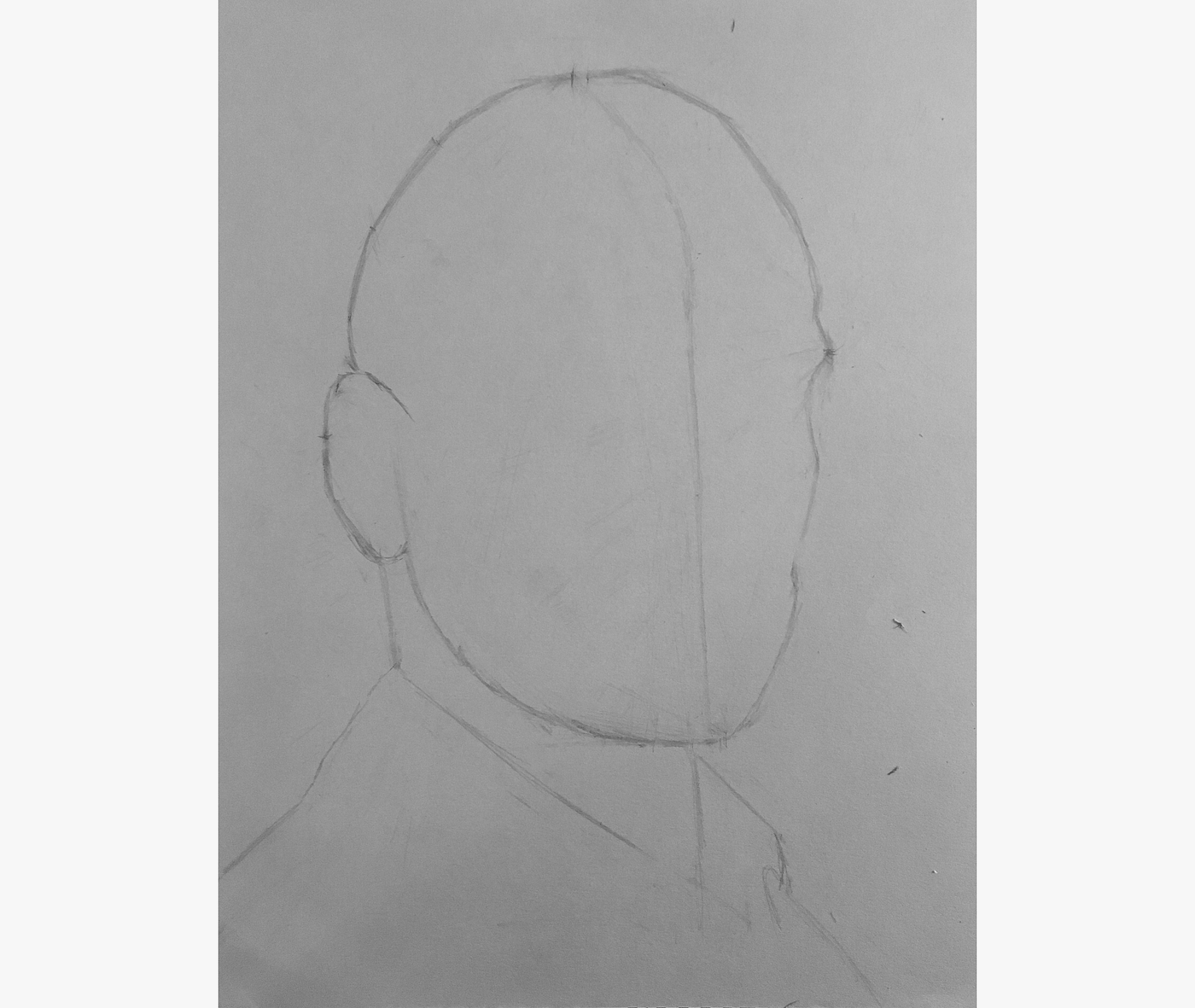
So, I marked centre level, to kickoff gauging the features' vertical placement.
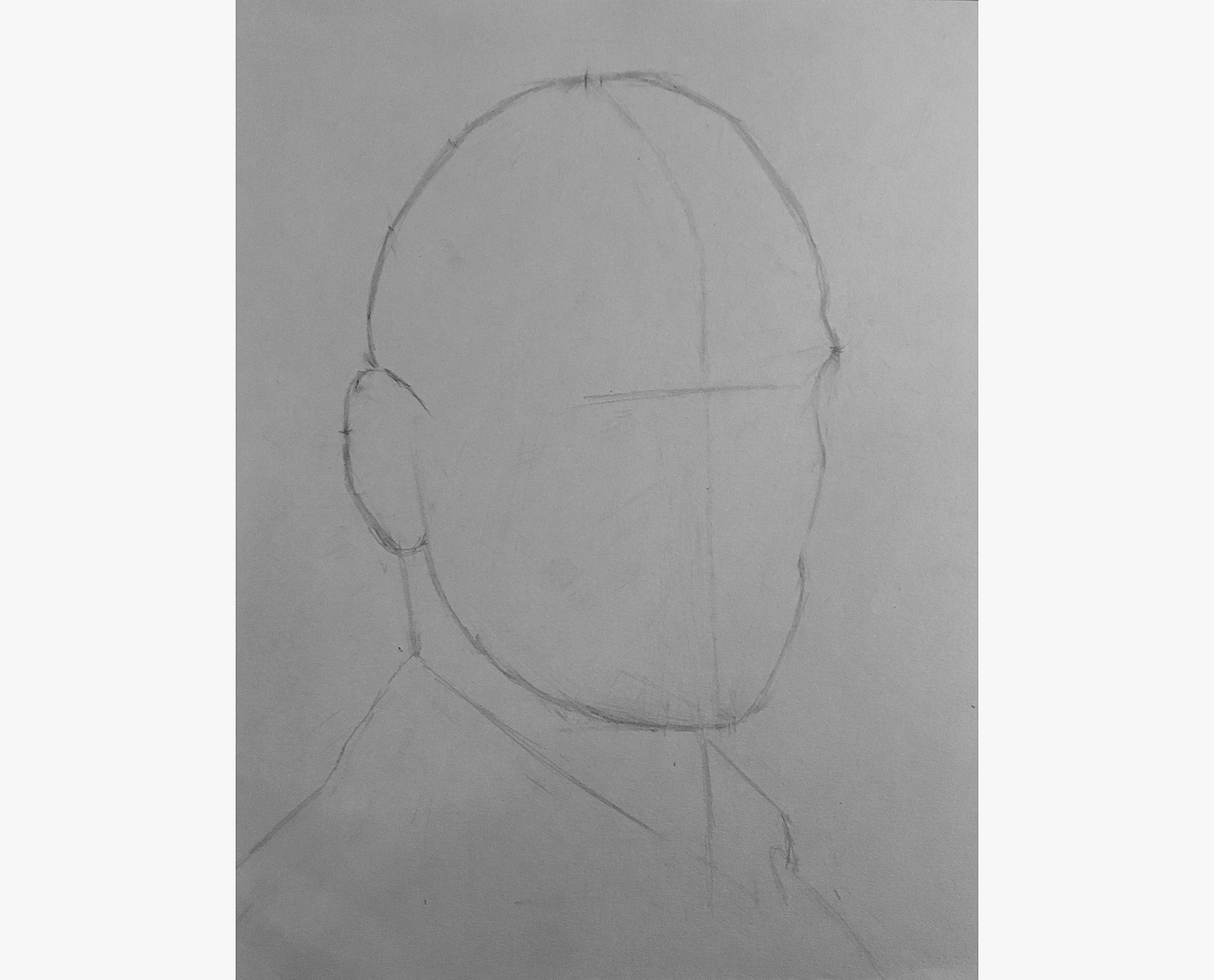
I followed upwardly with the levels of the brows, nose, and lips.
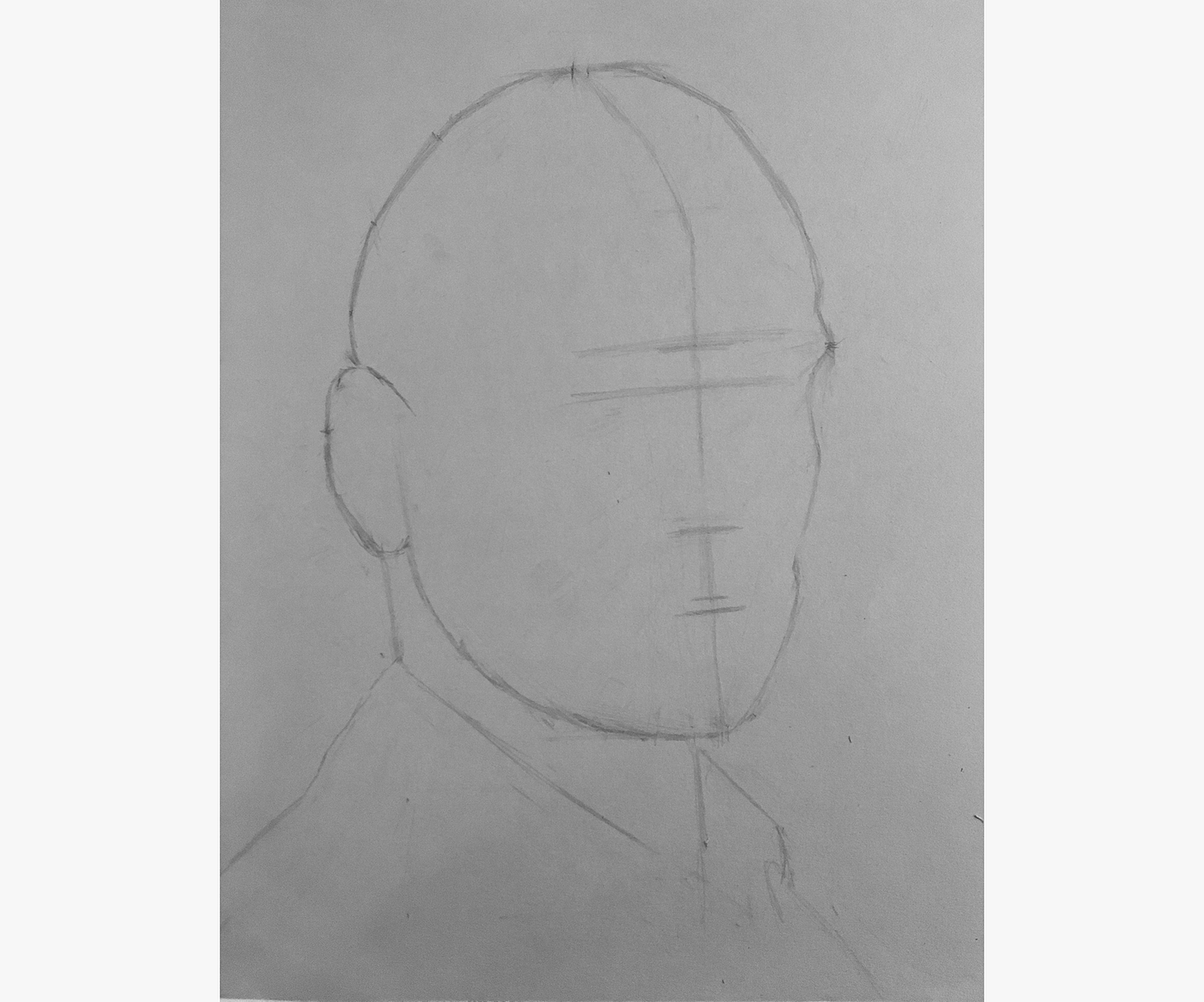
I made a bit of a mistake hither. I drew the horizontal construction lines perpendicular to the centre line (which seemed reasonable), only did non mimic the angle of the features in the actual drawing.
Then, I sighted the correct angles, and adjusted the construction lines appropriately.

Blocking in the features
With the construction lines as references, I was and so ready to offset blocking in the facial features.
I started by adjusting the centre line slightly for the nose, and mark the nose's outer boundary.
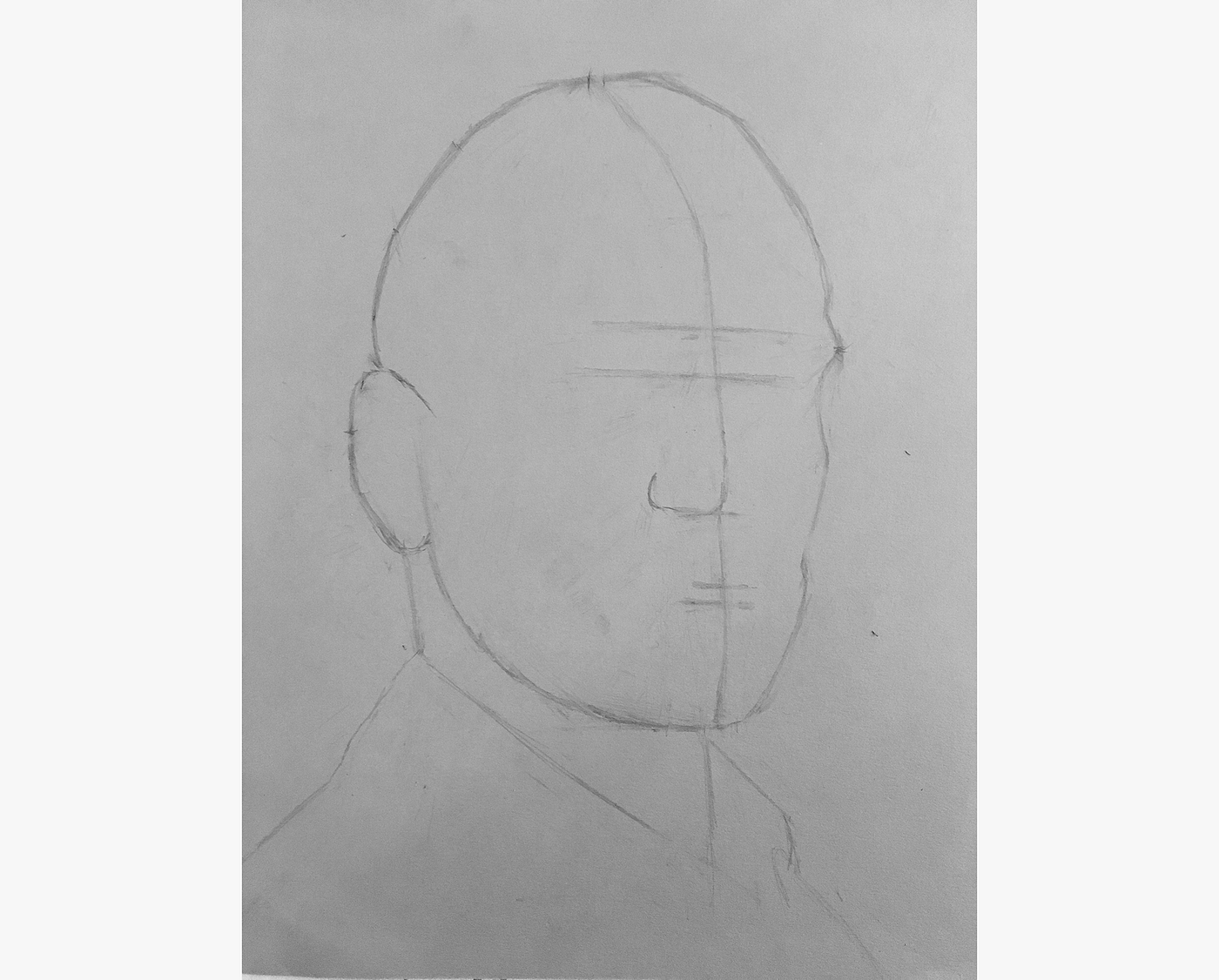
Then, I drew in shapes for the brows.
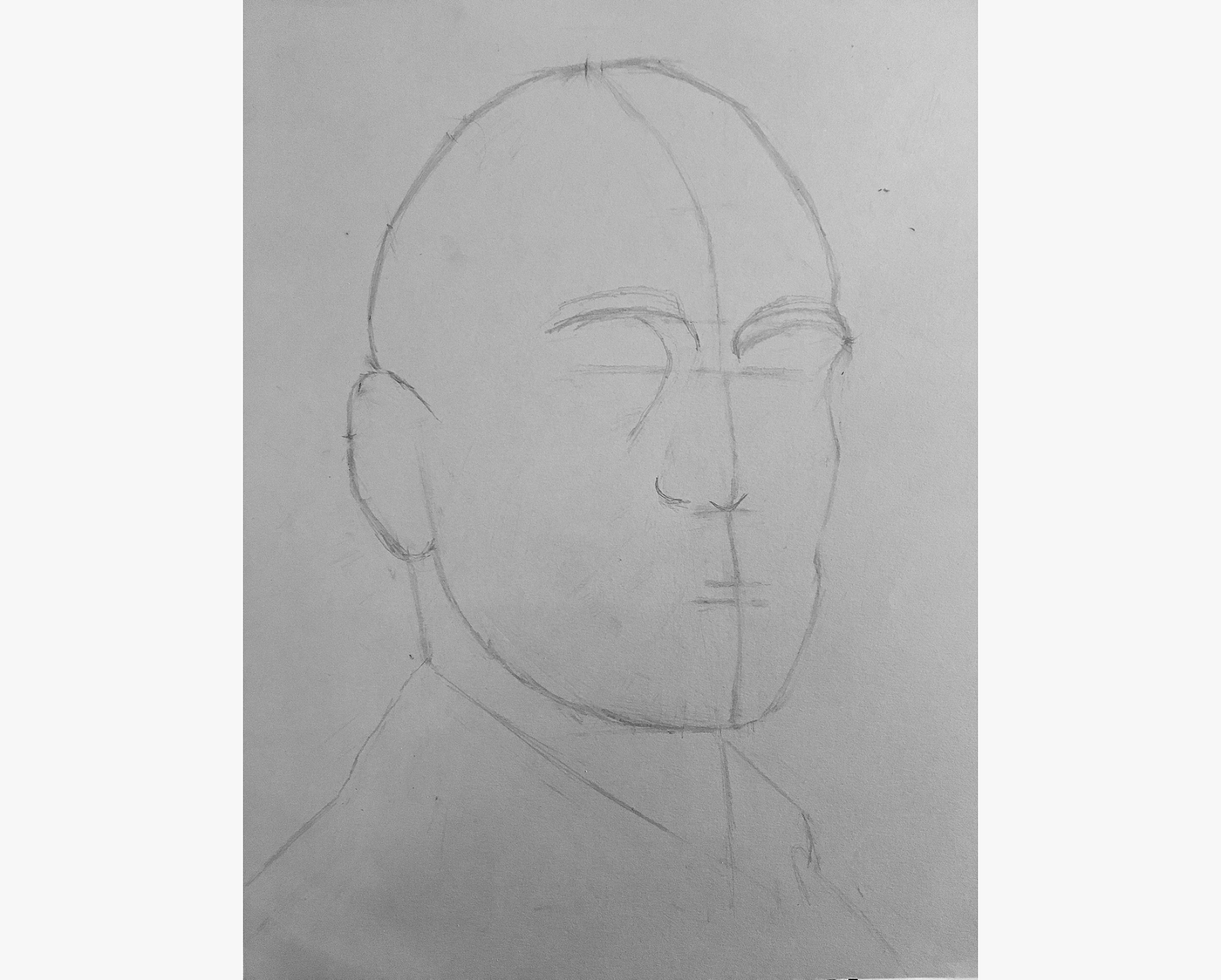
Adjacent, I included the center sockets and some more detail around the nose.
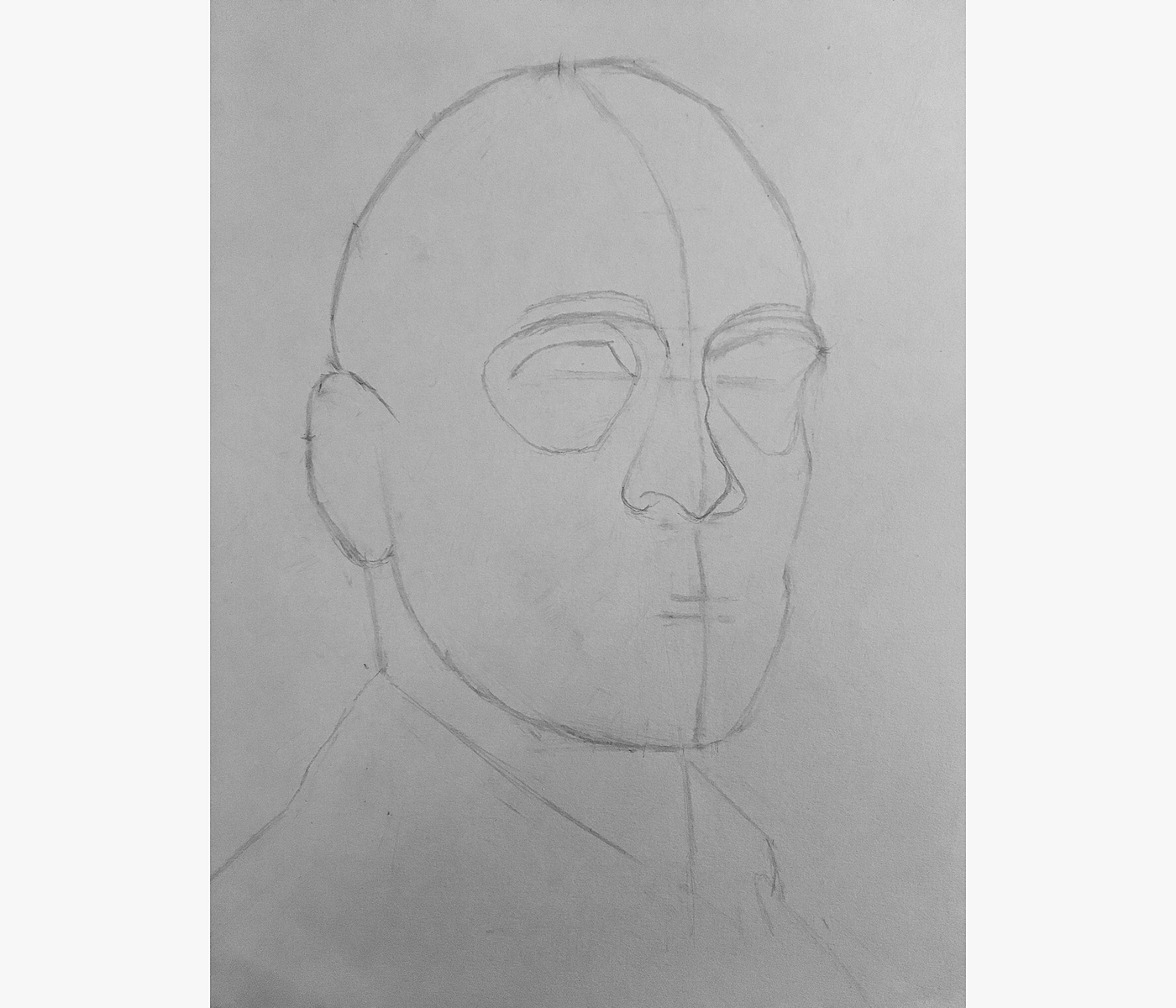
Finally, I added in shapes for the eyelids and eyes, and finished upward for the twenty-four hour period.
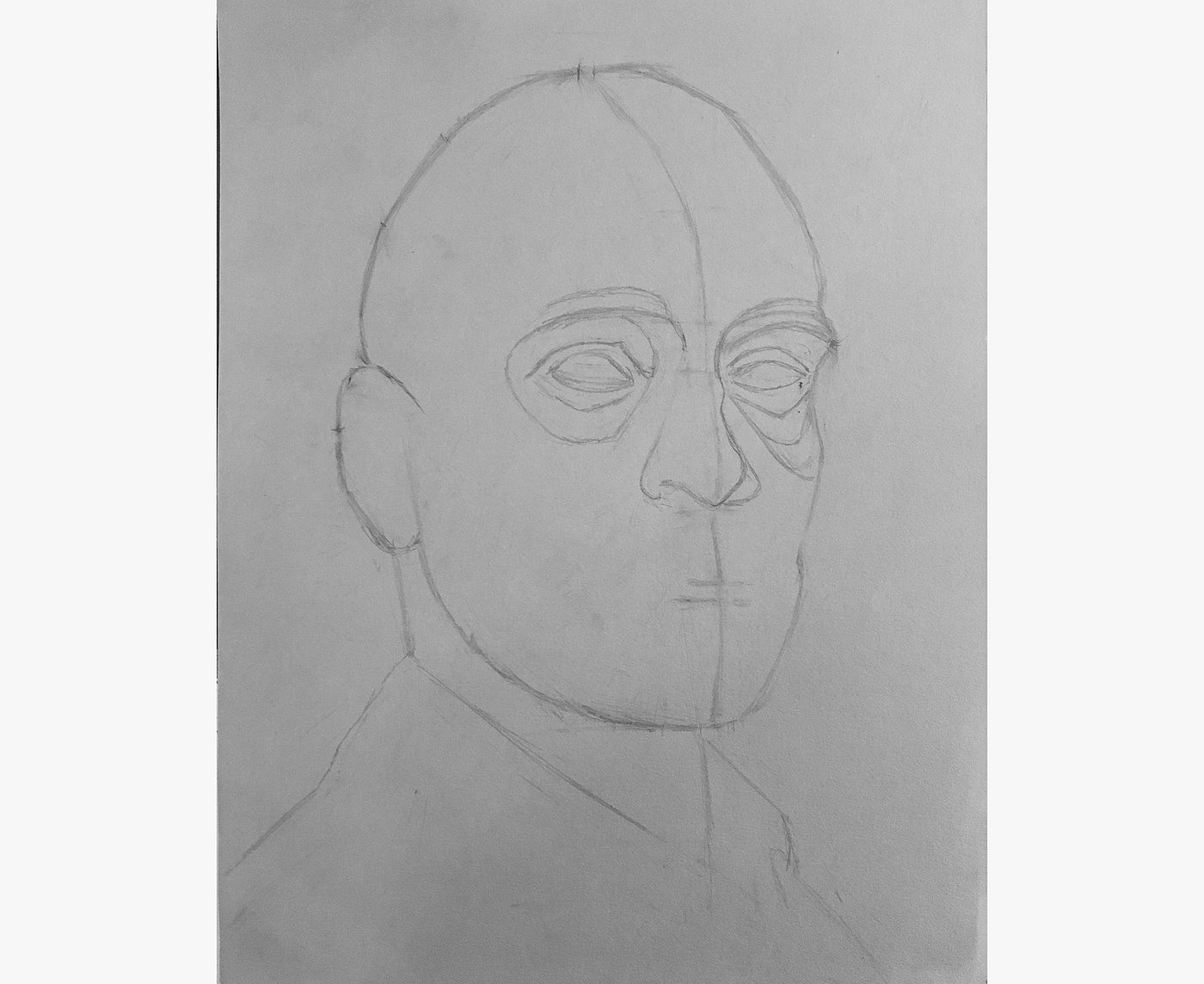
Reaching this bespeak took another 2.v hours.
Progress even so seems adequately slow on the cartoon, but I'yard making a conscious endeavour to work carefully through the blocking in phase (so I can practice what I'1000 learning, and so I can ensure the portrait is built on a strong foundation).
I'll start detailing the features tomorrow.

Today, for the third twenty-four hours in a row, I spent 2.5 hours on my Derren Brown drawing. Withal, unlike the other days, today, I experience like I made a lot of progress.
Finish blocking in the features
Picking up where I left off, I continued to cake in shapes for the features.

I added in the center line of the lips and the shadow on the olfactory organ.
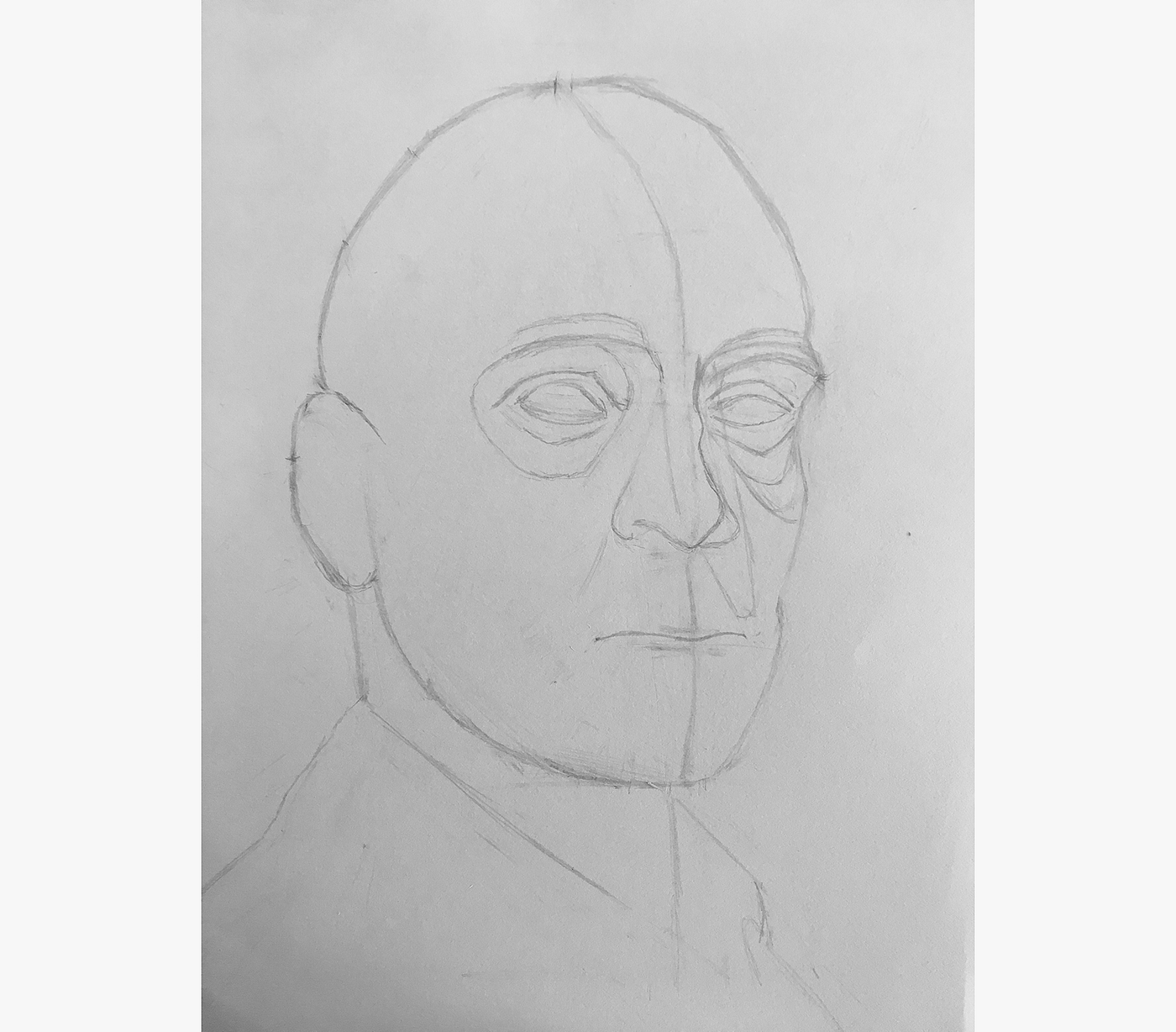
I then finished the lips and added a line for the chin.
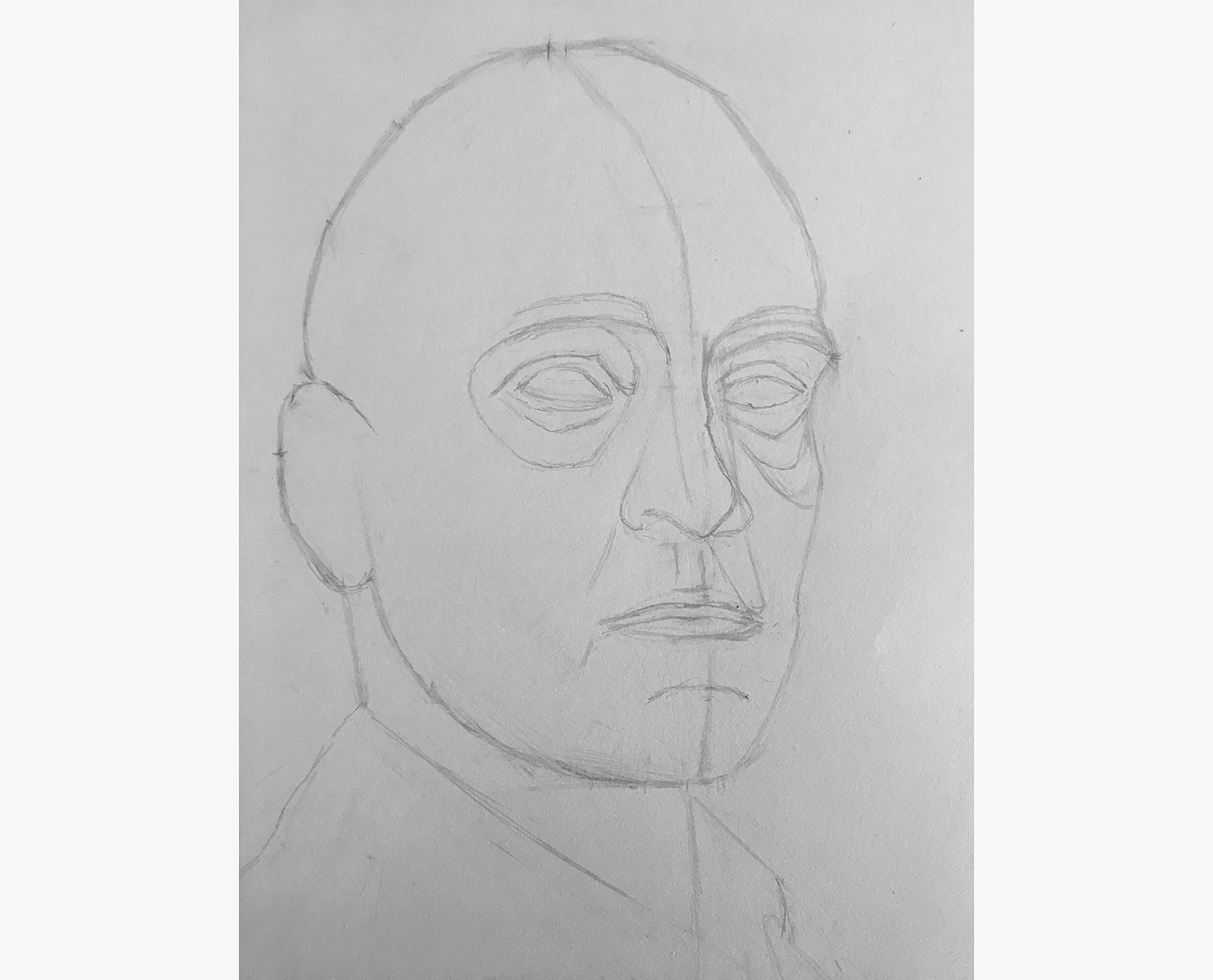
Lastly, I blocked in the chief structures of the ear and added an outline for the beard.
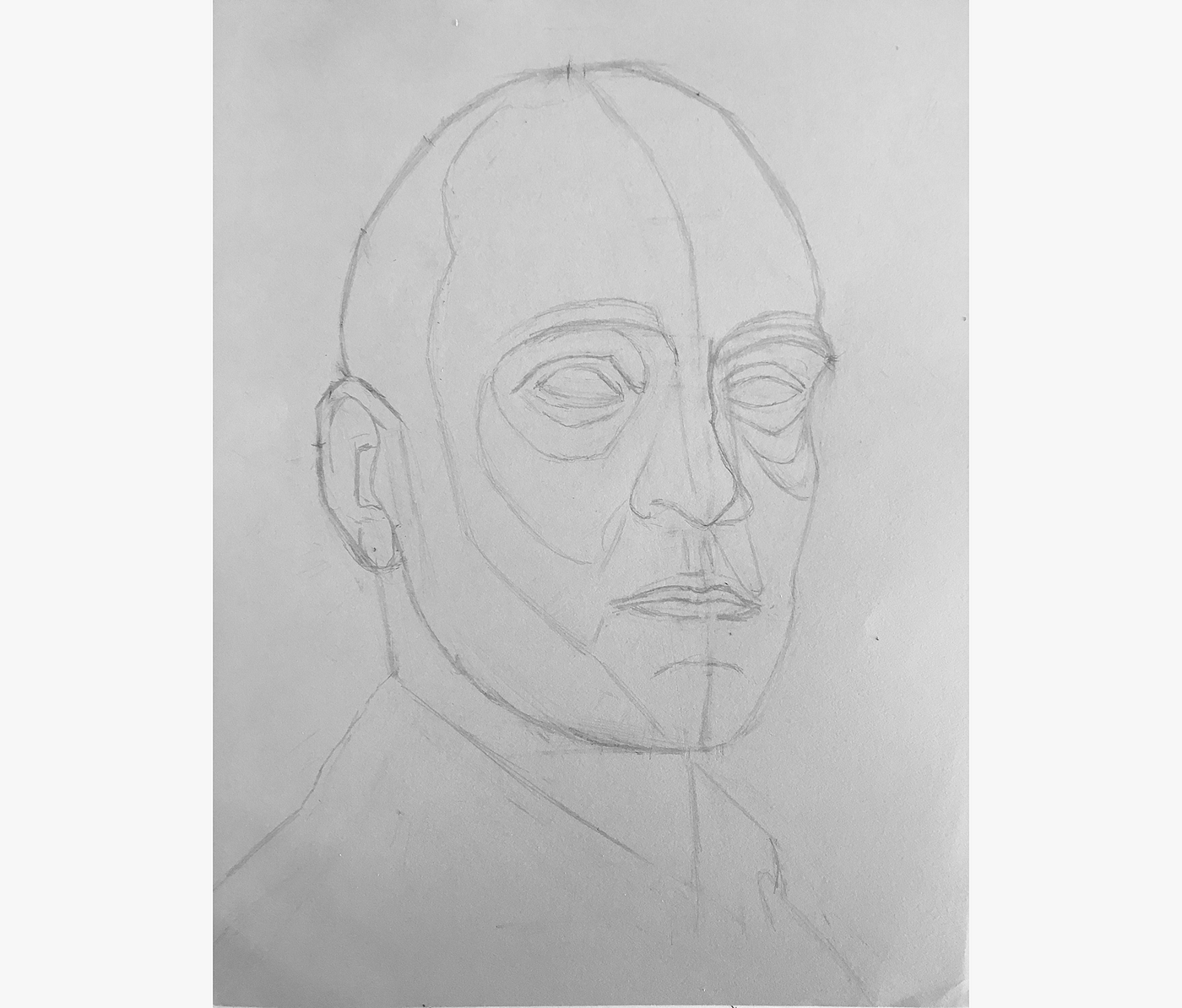
Drawing in shadow/highlight shapes
With the features in place, I next blocked in shapes for the shadows and highlights.
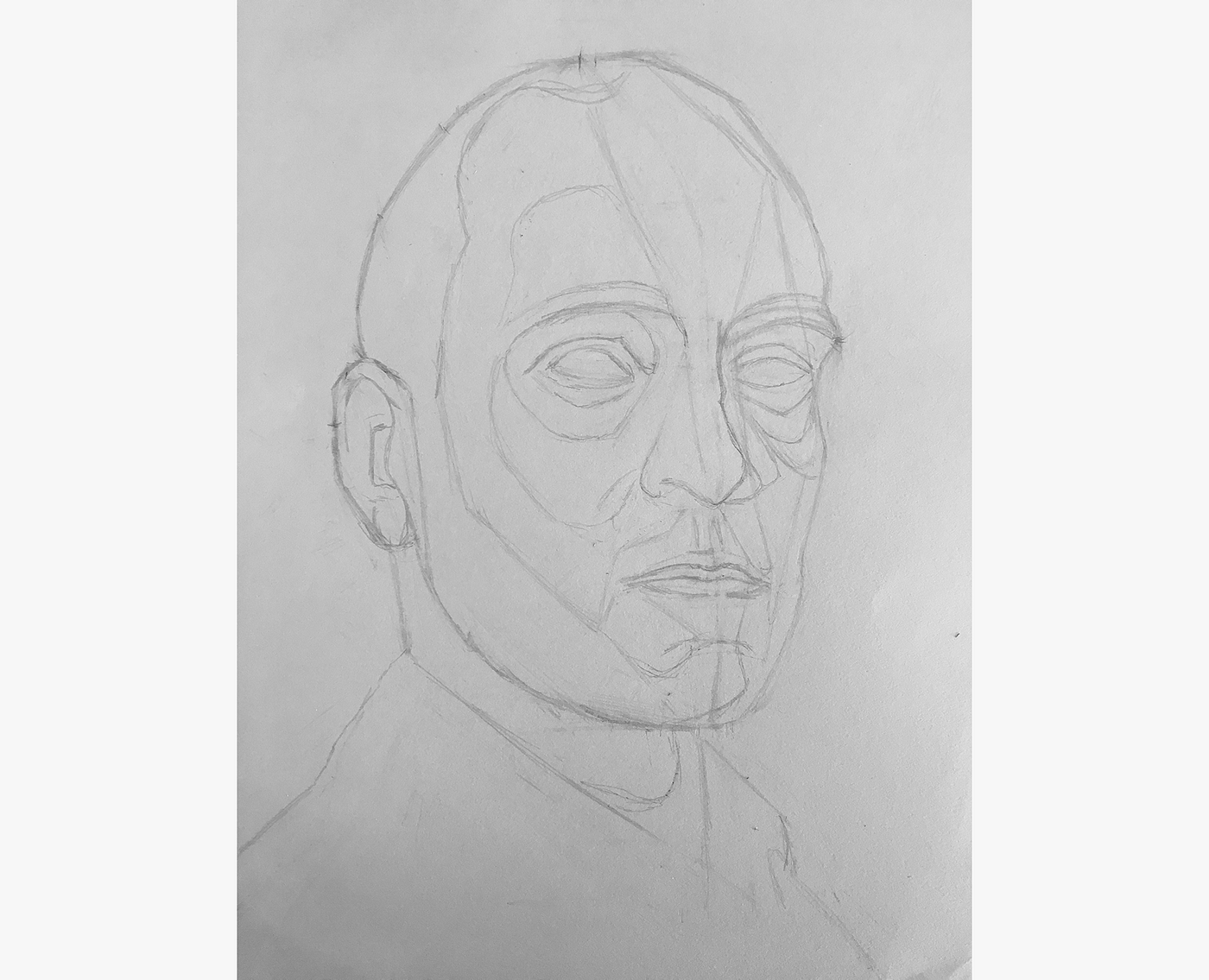
With these tonal contours in place, I darkened the shadow areas slightly, giving the portrait some roundness and three-dimensionality.
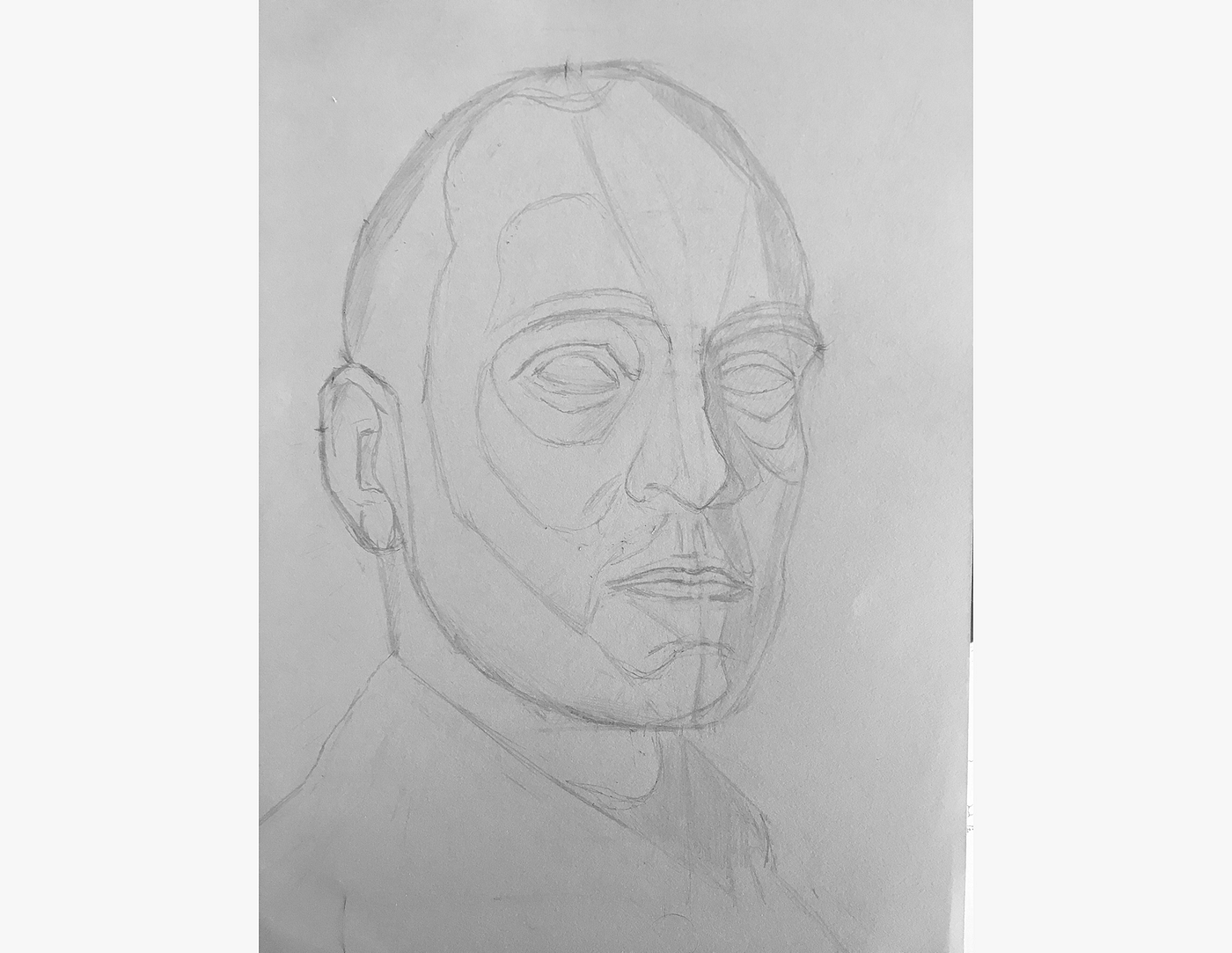
Detailing features
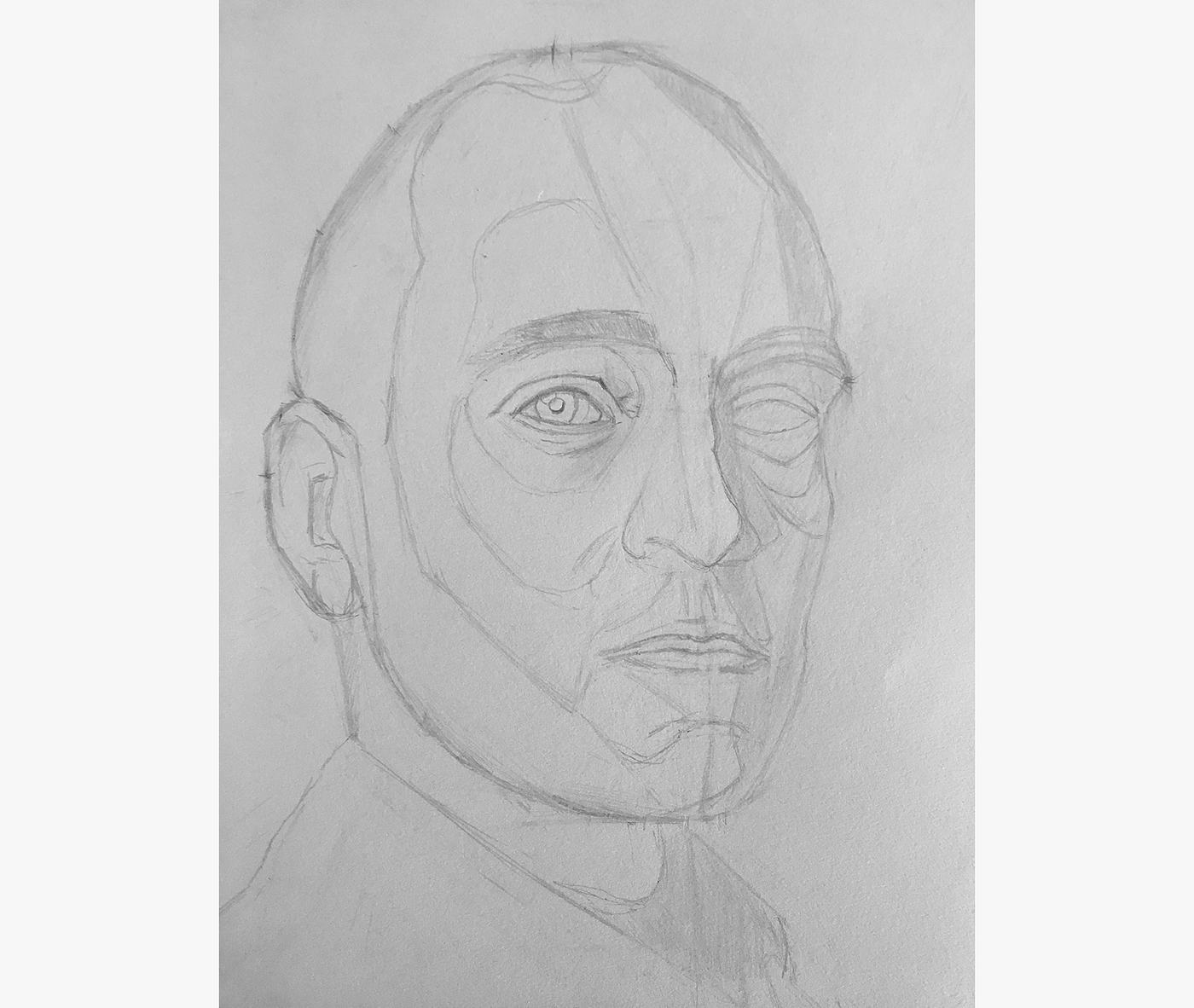
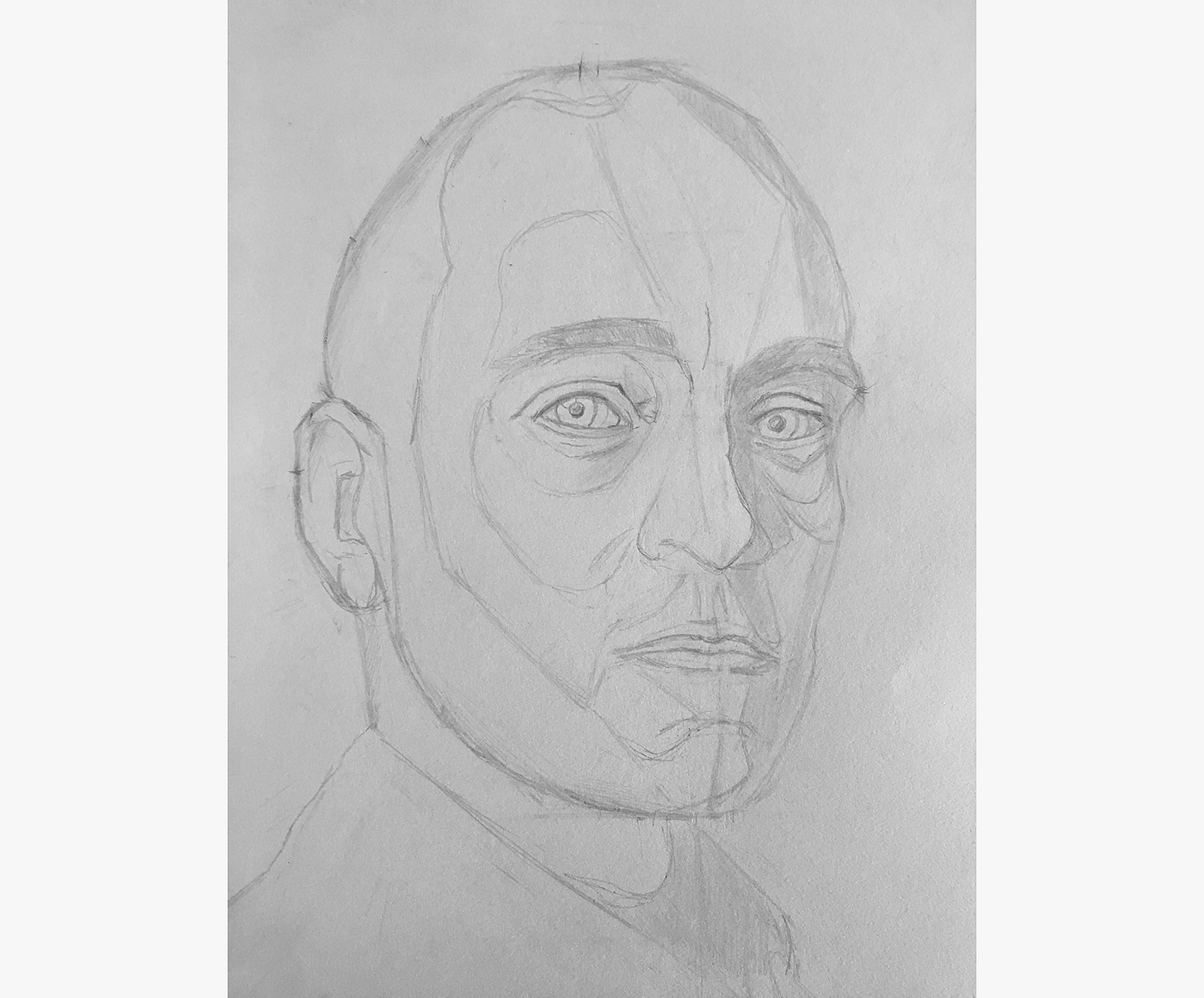
With the features and shadows blocked in, I detailed the features, starting with the optics.
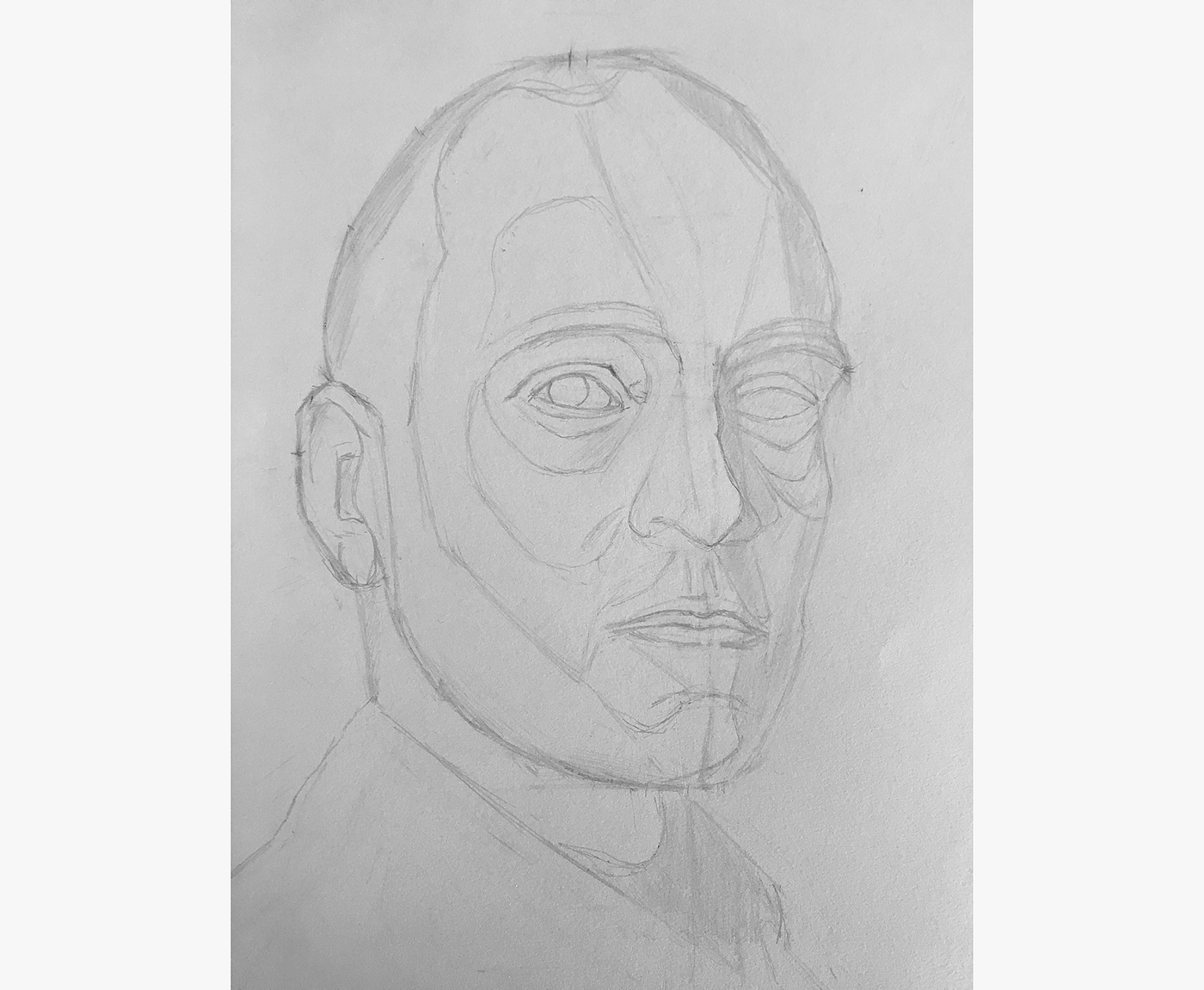
Left eye done.
Correct eye washed.
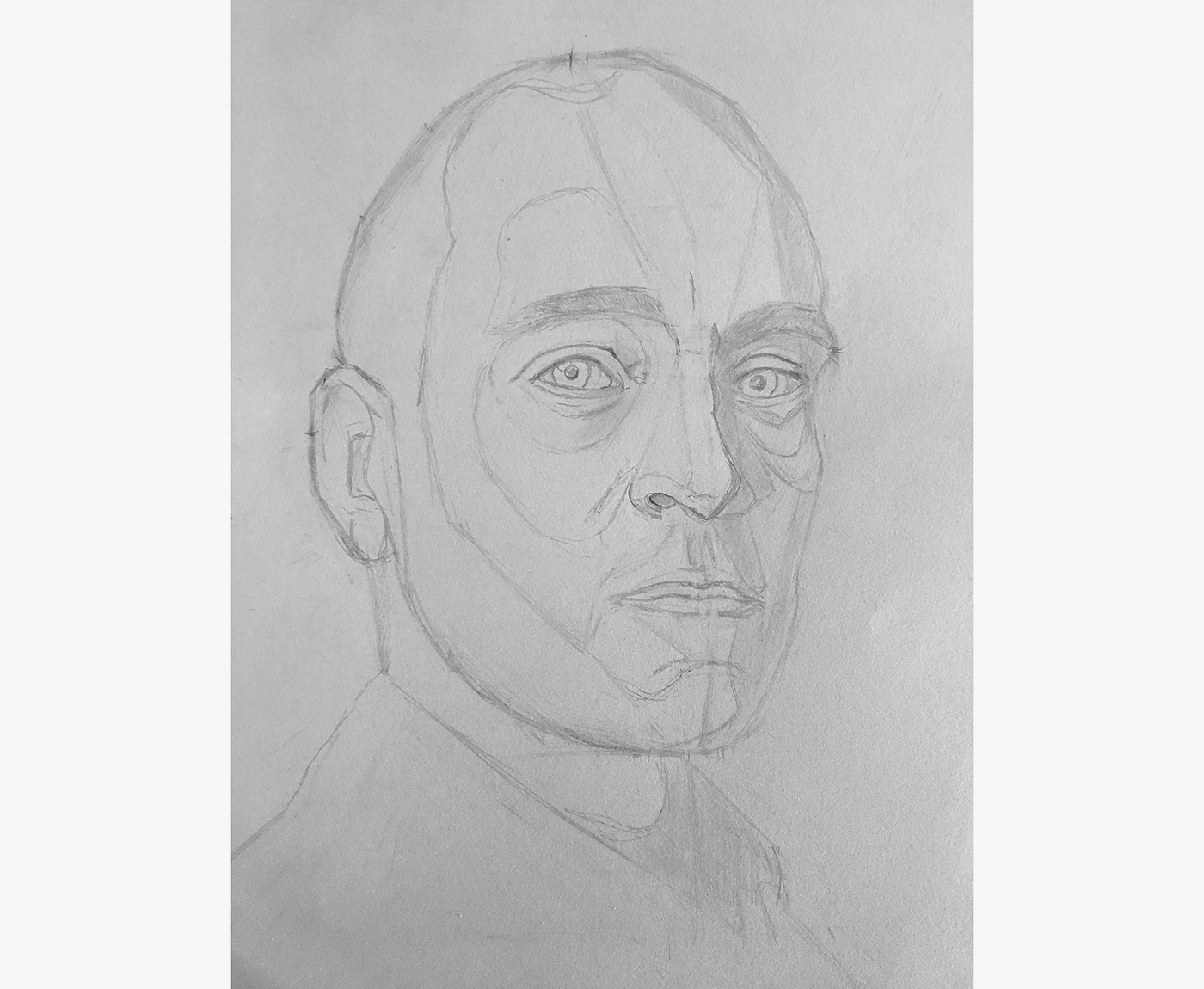
Nose done.
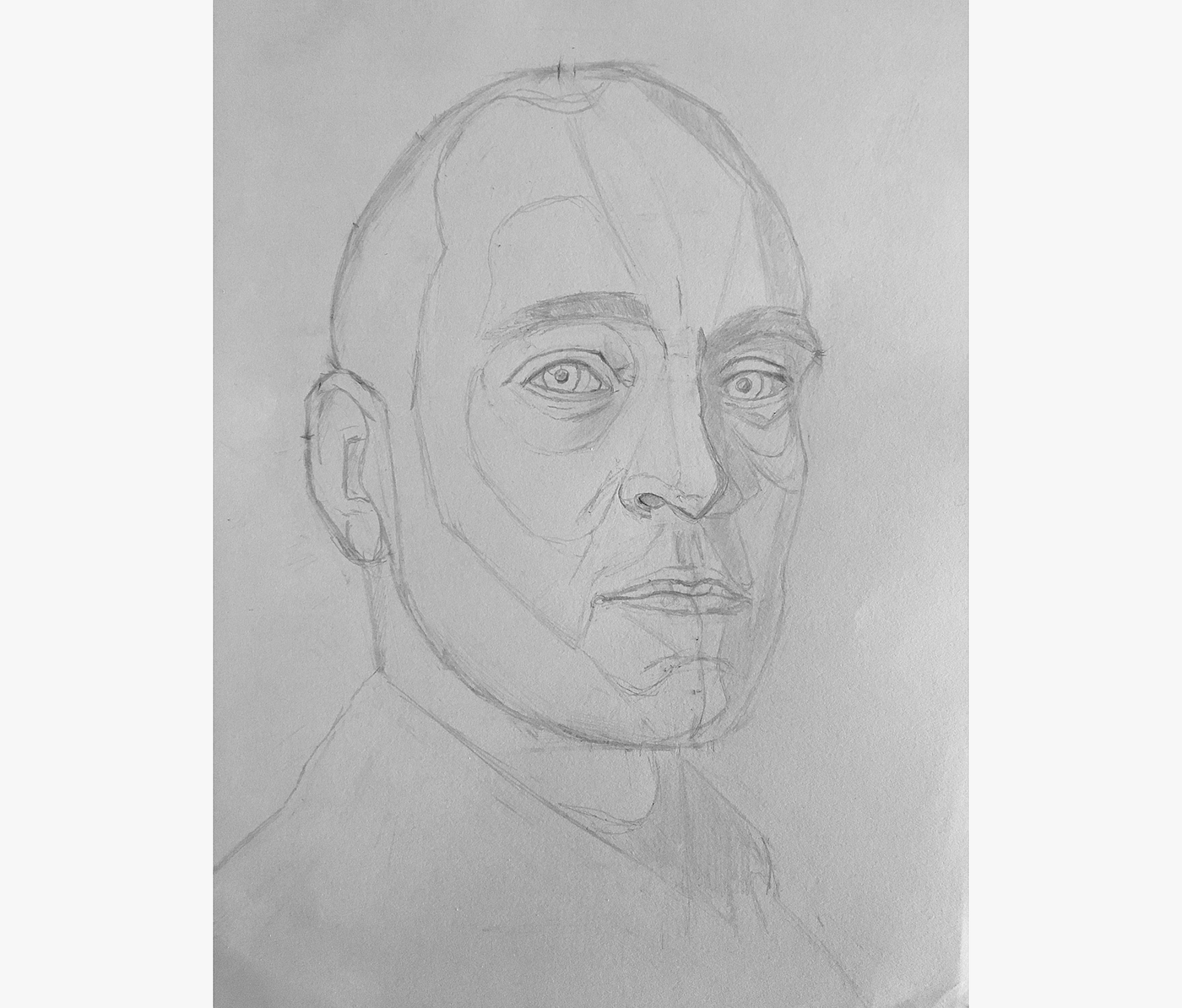
Lips done.
Finally, I finished up for the day with the ear.
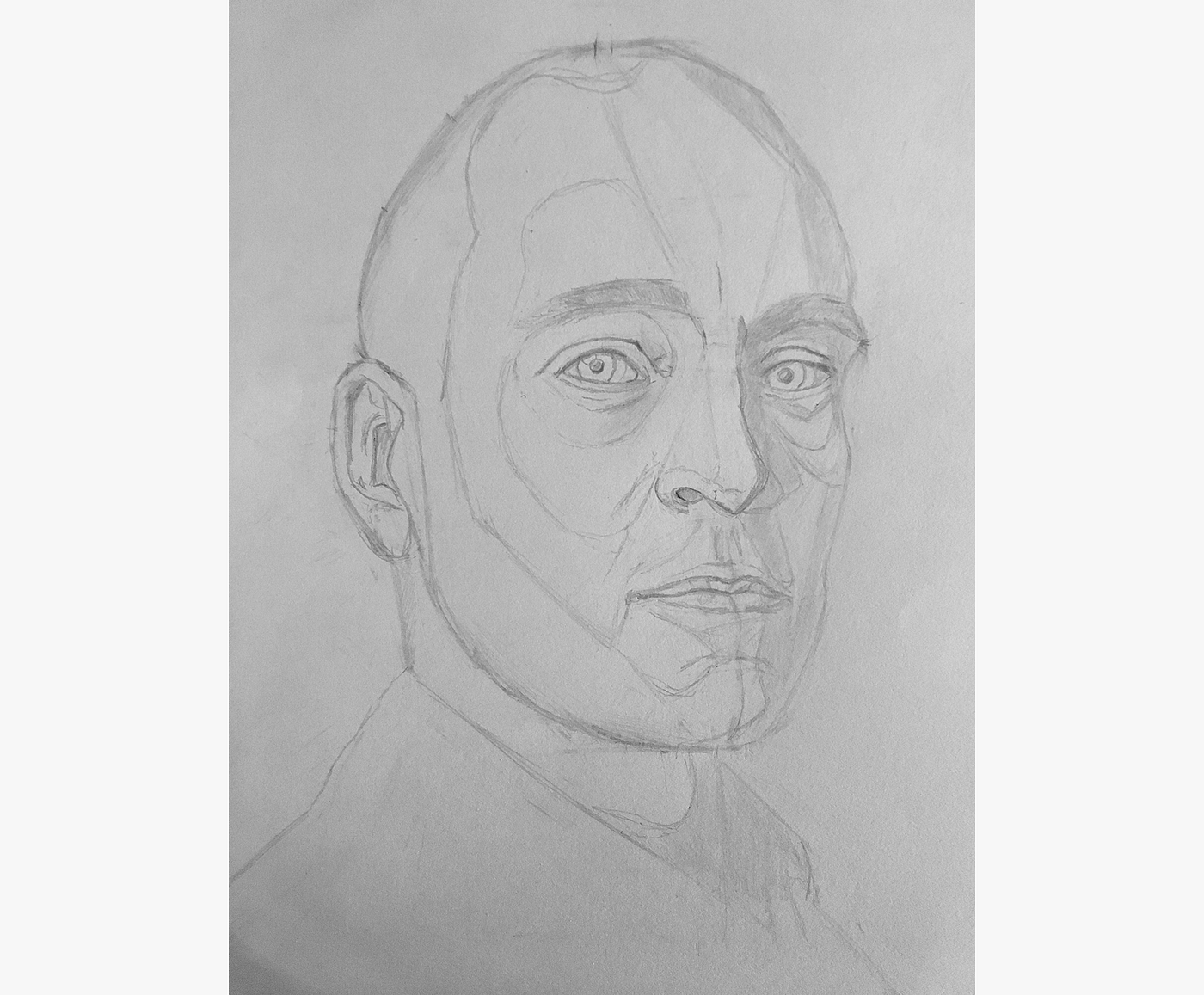
After vii.five hours of work (2.five hours over the by three days), I'm finally hopefully that this portrait will resemble Derren Brown.
Tomorrow, I'll starting calculation tonal values (i.e. shading) to the drawing.
Observation near today'southward session: Based on the output from today, it may seem similar today'south drawing was the most technically challenging. But, in fact, I establish only the opposite.
Because I spent the past two days meticulously locating and blocking in the features, it was very easy to add together the incremental detail. (Trying to draw big shapes is much harder than trying to draw lilliputian shapes. Picayune shapes are a lot easier to visually empathize and replicate)
In fact, I suspect that today was to the lowest degree consequential to the outcome of the portrait. If I mess up the shape of the caput and the location of the features, I accept very niggling risk of capturing a likeness. If the features are not quite accurately detailed, merely in the right identify, I however might take something…

Yesterday, later on 7.five hours of work, I finally finished sketching / laying out my first portrait. Today, I started calculation tonal values (a.k.a. "shading the drawing").
Before I testify today'due south progress, I want to share ii techniques I learned that brand it significantly easier to accurately add tonal values to portraits.
ane. Start with the most extreme values then meet in the middle
The human being heart is really bad at assessing tonal values in isolation — which is why your brain thinks squares A and B below are very different colors, when, in fact, they are the same.
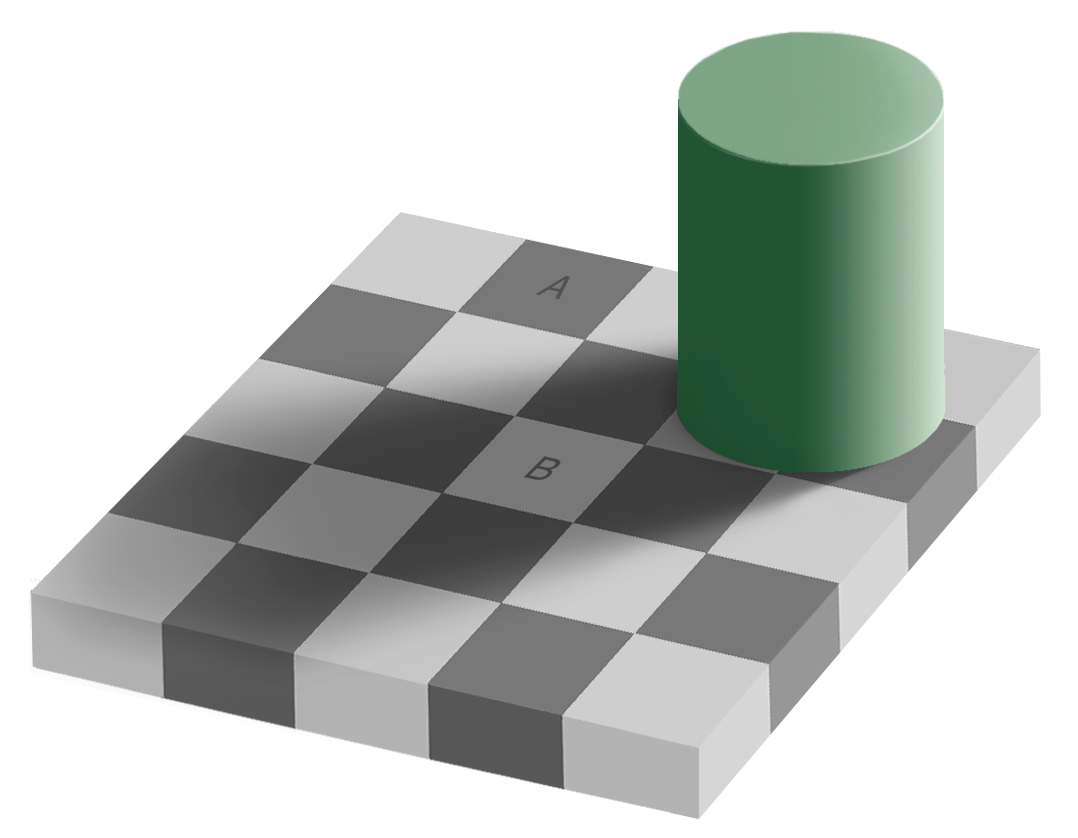
Thus, instead of relying on visual inferences, tonal values can be meliorate approximated through a unproblematic, not-and so-interpretative procedure.
Hither's how it works:
Beginning by identifying the absolute darkest and absolute lightest areas of the drawing. For the darkest areas, shade them as dark as you can/desire. For the lightest areas, highlight them as light as y'all tin/want.
This establishes the entire tonal range of the drawing, which is called the key of the drawing.
Establishing the key is straightforward, and doesn't require much visual estimation (i.e. information technology's like shooting fish in a barrel to find the lightest lights and the darkest darks).
Once the key is established, and the lightest and darkest values are in place, the intermediate values demand to be introduced. Once more, this can be washed procedurally, by identifying and shading/highlighting the areas which are slightly lighter than the darkest darks and slightly darker than the lightest lights. Continuing recursively in this way, the tonal values eventually run into in the center, and the drawing (or the relevant function of the drawing) is complete.
ii. Squint to better meet tonal shapes
When keying the drawing (and developing tonal values in general) information technology'due south of import that the shapes of the tonal areas are captured accurately.
In other words, if the highlight on the forehead is angular, drawing information technology with rounded edges wouldn't properly capture the form.
This sounds obvious, but over again, your brain and visual system can play tricks on y'all. Your brain is attempting to run into a face (via your psychologically skewed, emotions-based mental model of a face), and non but tonal blobs.
In fact, this psychological problem of misinterpreting faces is so common, there are entire drawing systems (similar drawing upside down, cartoon the negative infinite around the face, etc.) designed to gainsay these problems.
Side notation: Here's a video of Derren Brown, the subject of my portrait, when he used to have hair, experimenting with some of these culling methods of painting. It'due south a pretty cool trick.(If you're going to watch, stick it out until the end).
In order to accurately come across tonal shapes, and avoid psychological errors, I've found ane method to be surprisingly successful: squinting.
Basically, you await at the area you want to depict, squint your optics (so the image becomes blurred and your brain no longer sees a face), and place the tonal shapes you see through your eyelashes. This works super well. (I didn't invent this method, I've just validated that it works for me).
Today'due south progress
With these techniques newly-learned, I began to add tonal values to my Derren Brown portrait.
Showtime, I started with the eye.
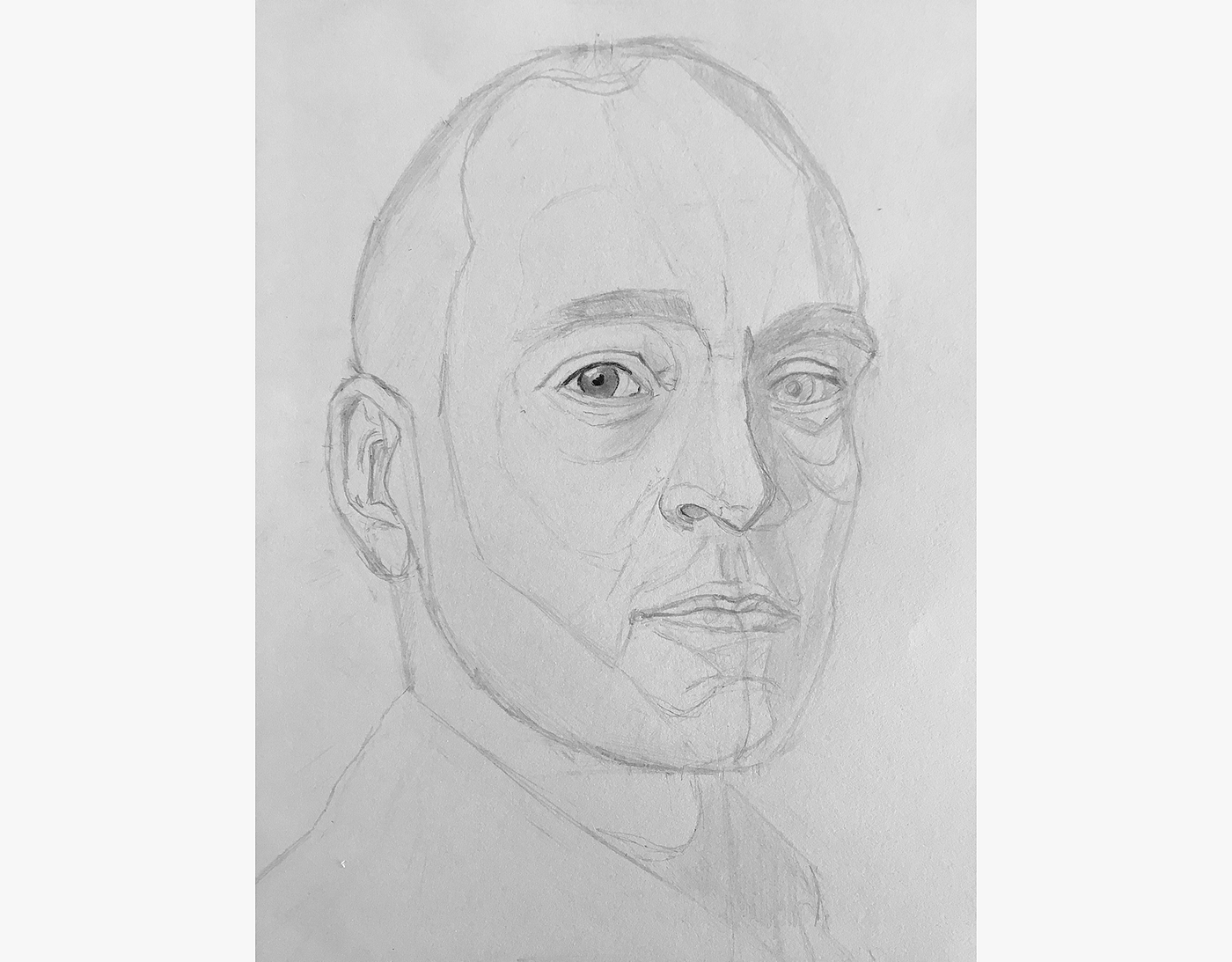
In the class, the teacher mentioned that it's proficient to offset with a small-scale area that exhibits the total range of tones.
All the same, the eye was too small to assist finer establish the key. And then, I keyed the drawing more aggressively, starting with the shadow on the olfactory organ and the highlights on the forehead and cheek.
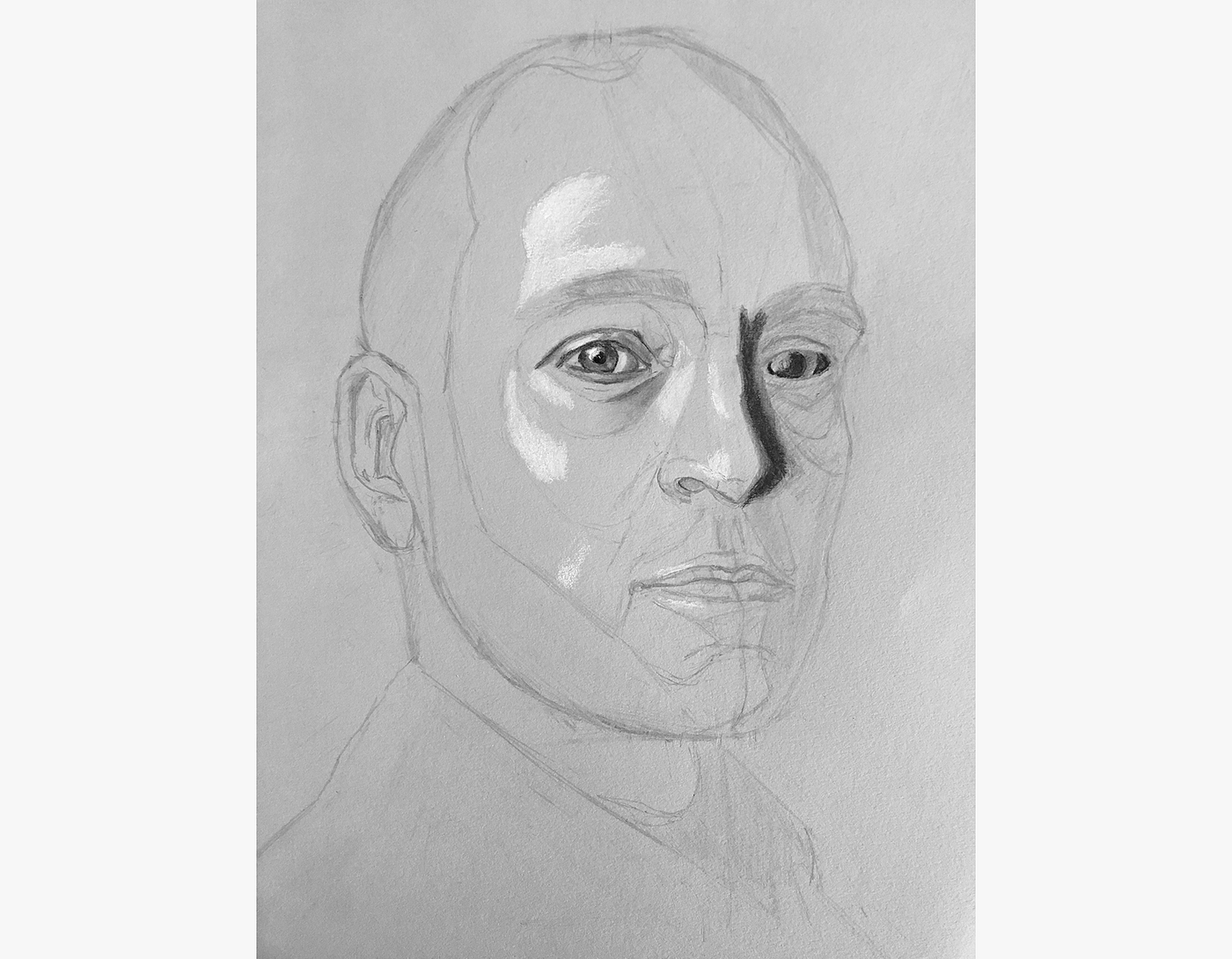
I continued shading the darkest areas along the right side of the confront.
Additionally, while doing this, to check the accurateness of my central, I started developing the eye.
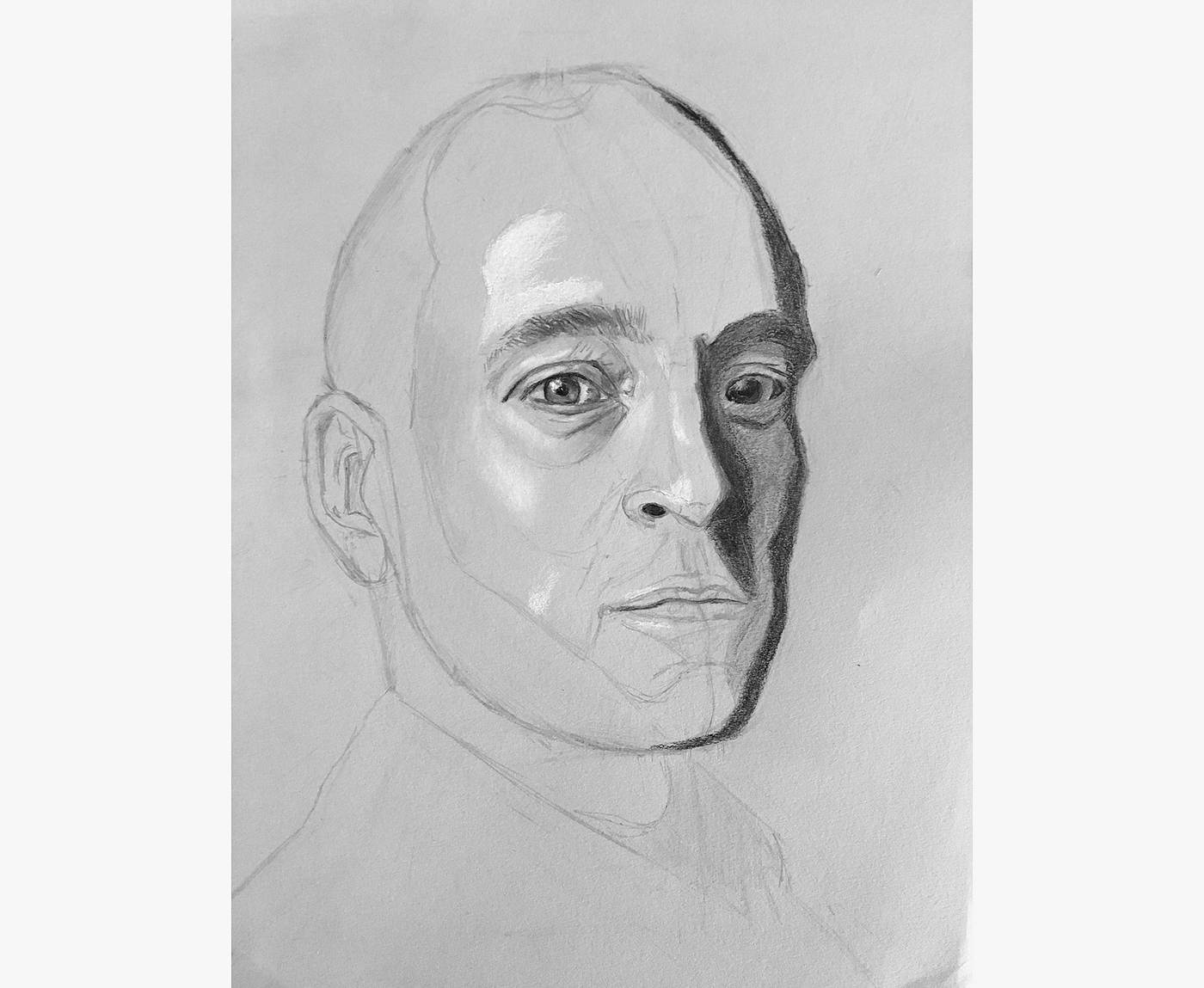
I finished upward my central, past adding shadows to the lower confront and the back of the head, and was ready to brainstorm modeling the form (finding the intermediate values between the darks and lights).
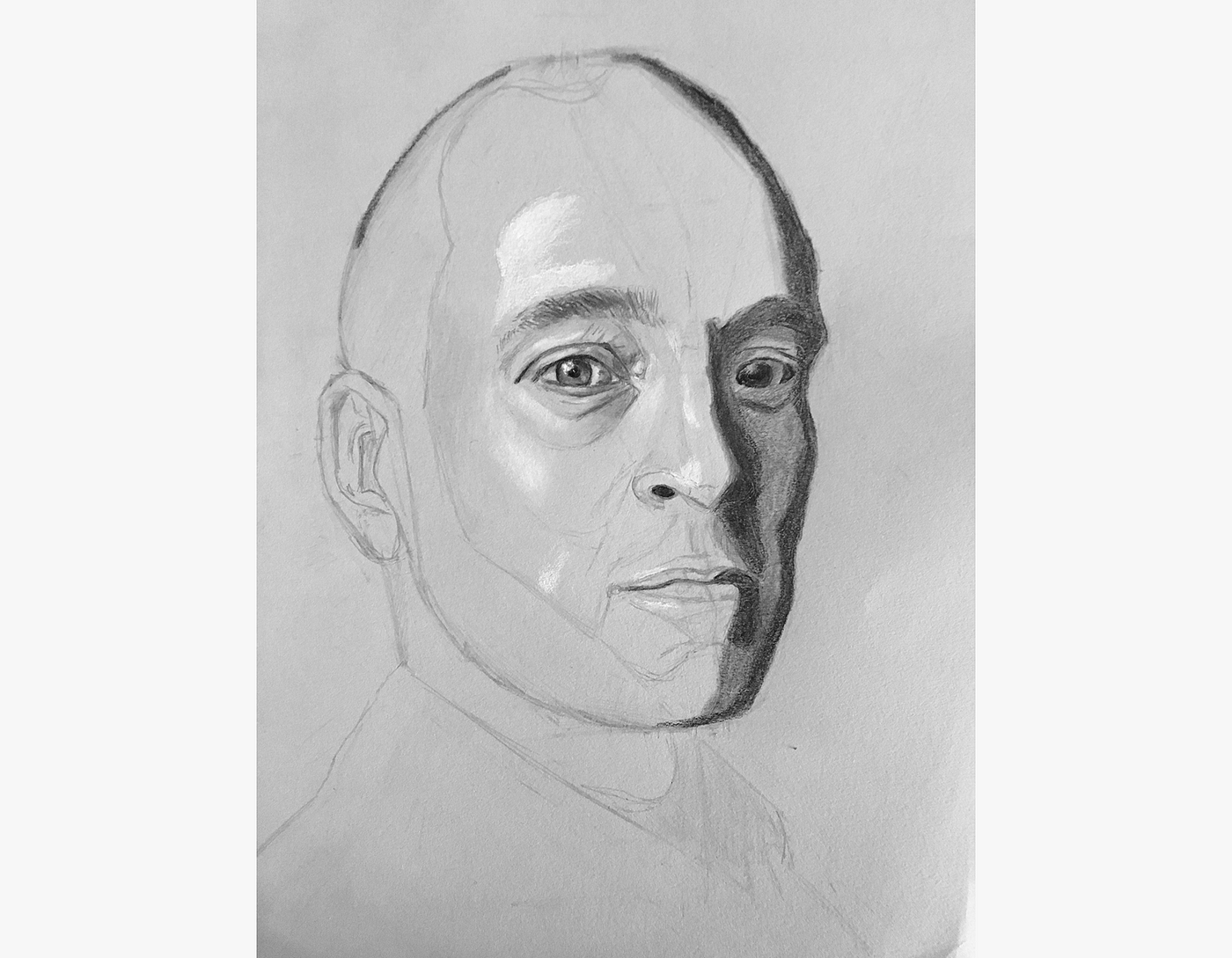
I started with the forehead.
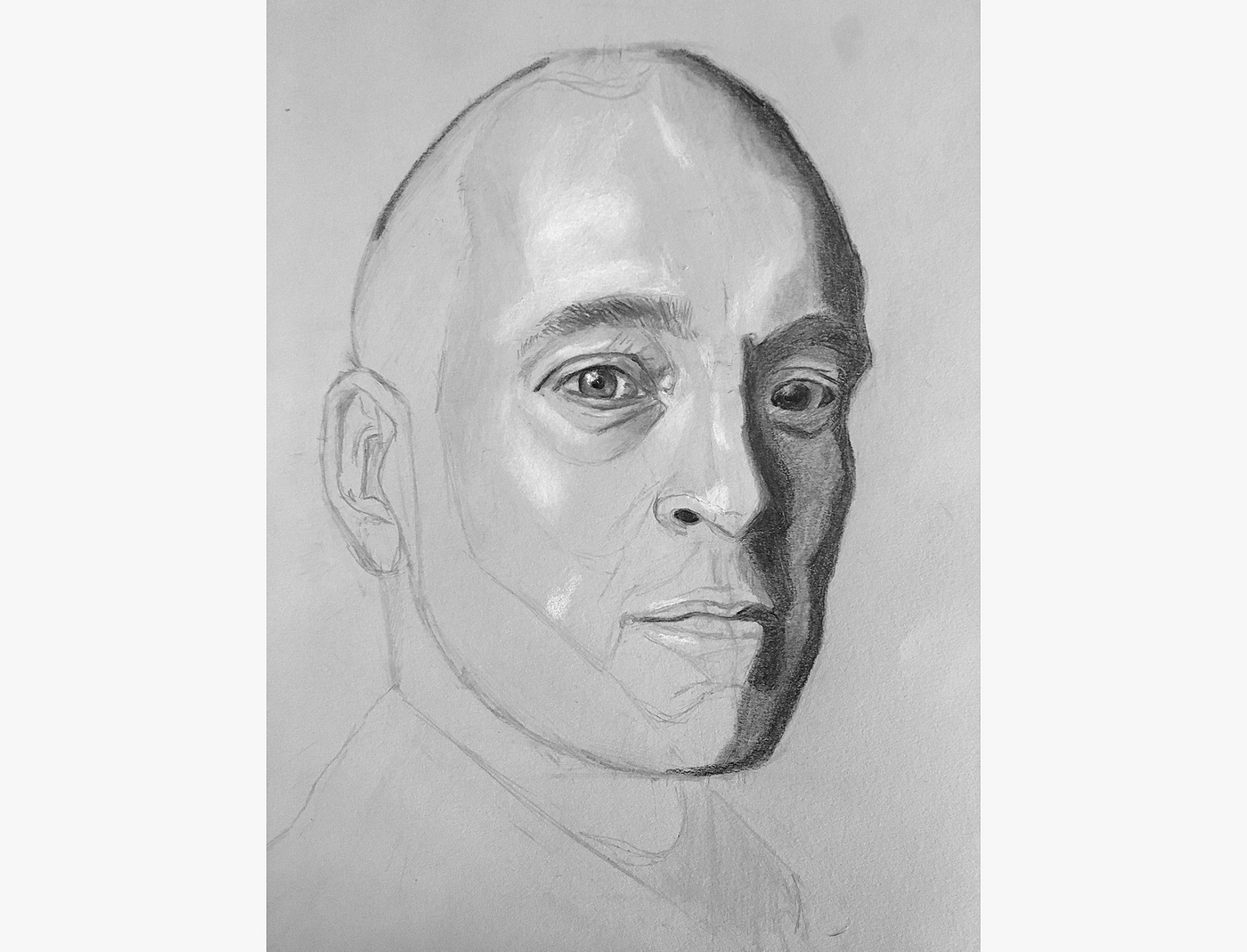
Added a bit more particular.
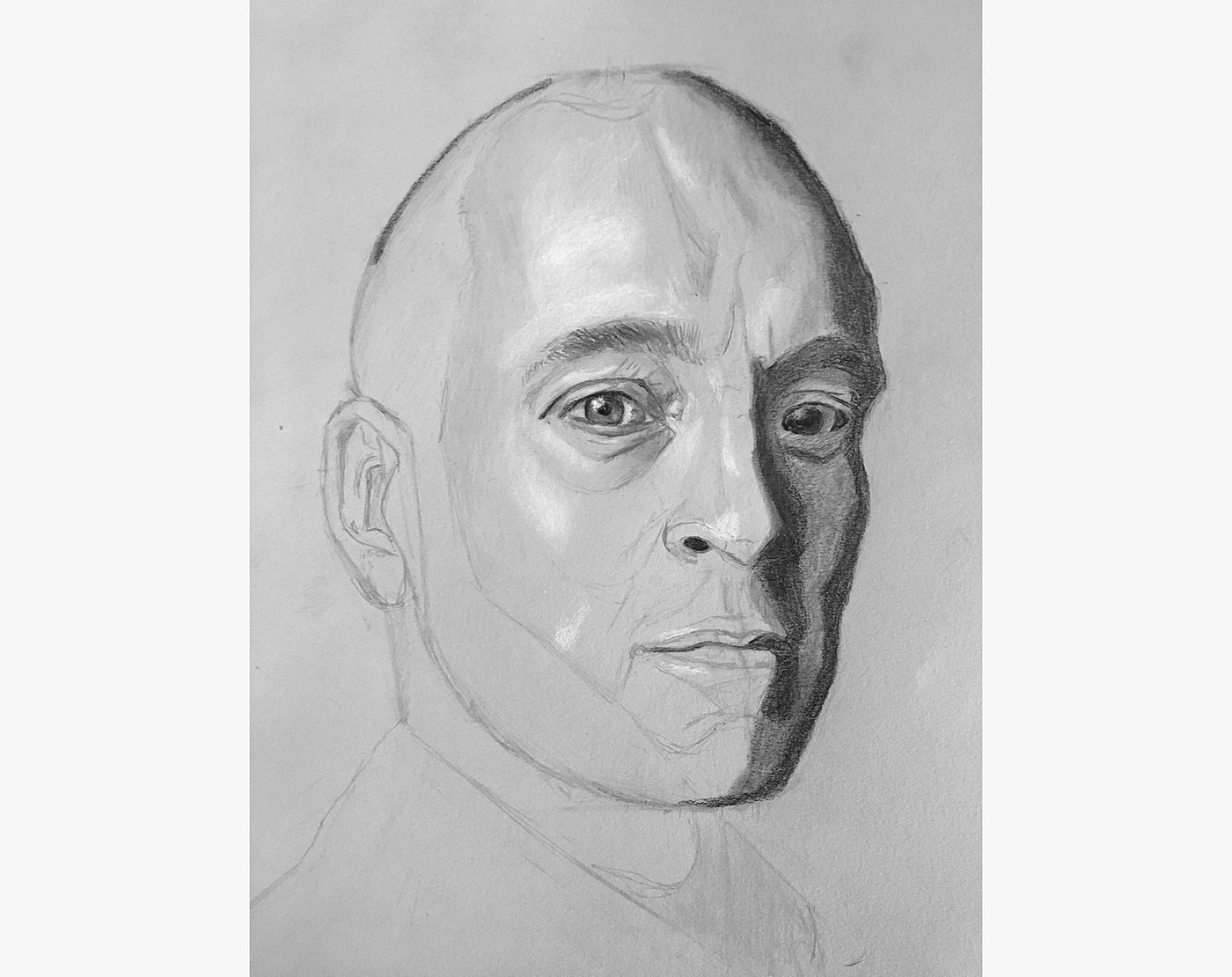
And and so smoothed everything out.
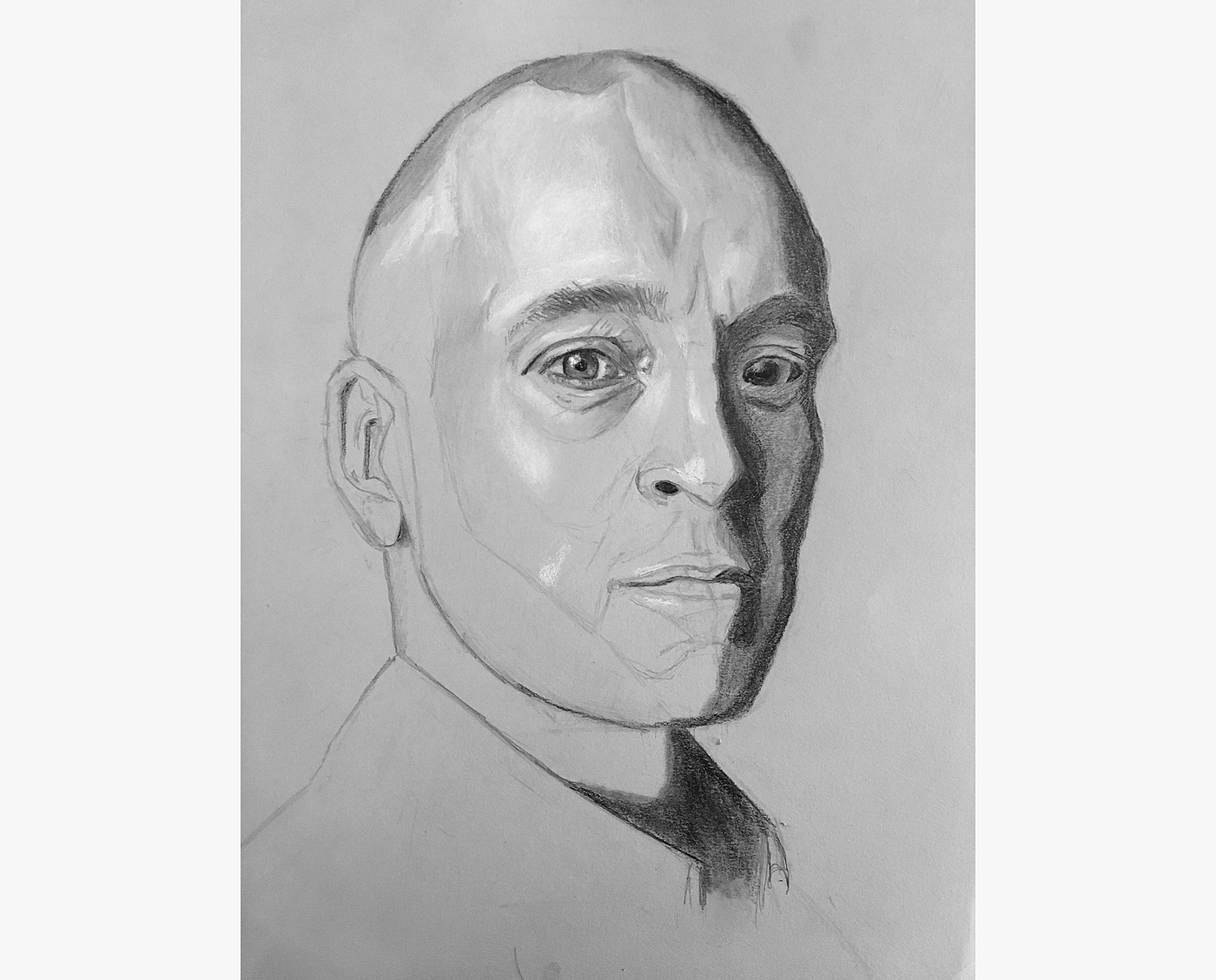
This is where I stopped for the day, after another ii.5 hours of working.
Derren looks a bit too shiny right at present — a bit like a mannequin or the Tin Human — simply I'm optimistic that this effect will vanish once I model the rest of the form.
I'thou guessing I have another v hours of work left on this.
Today, similar yesterday, I continued calculation tonal values to the portrait. I spent a little less than 2 hours, and am getting really excited about the results.
Here's where I stopped yesterday.
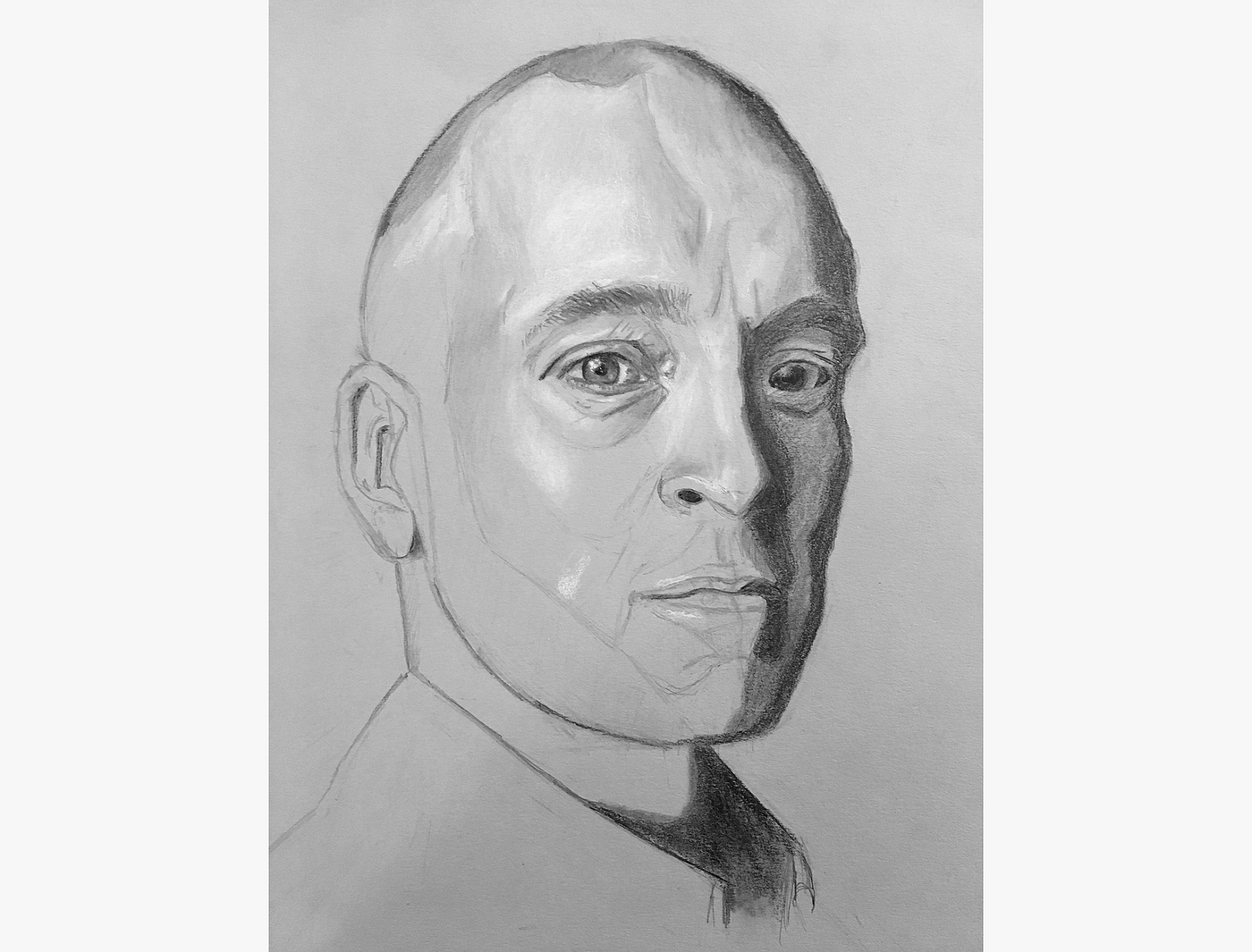
I proceeded today by outset addressing the nose.
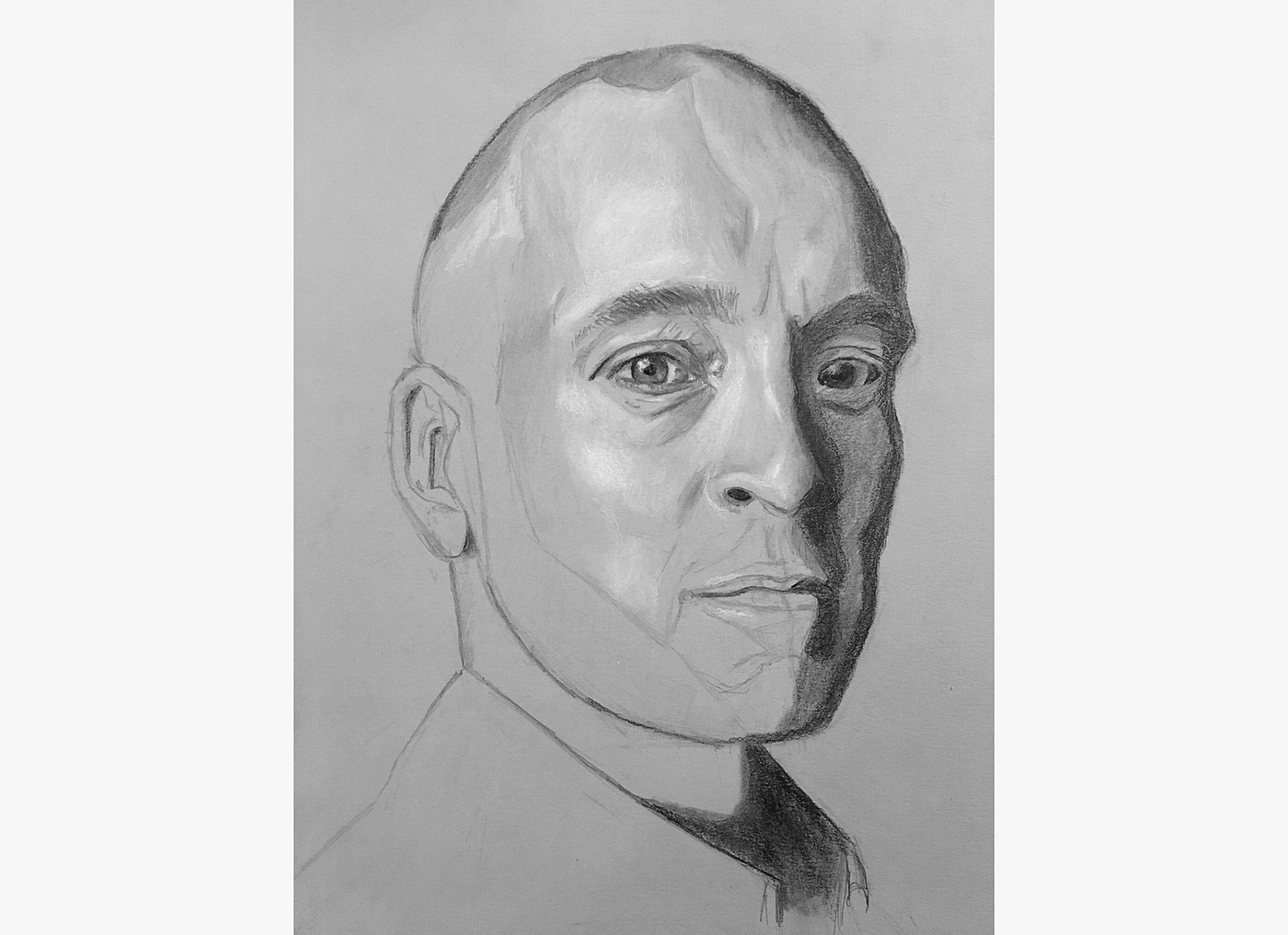
Then, I addressed the right one-half of the confront — further developing the shadow.
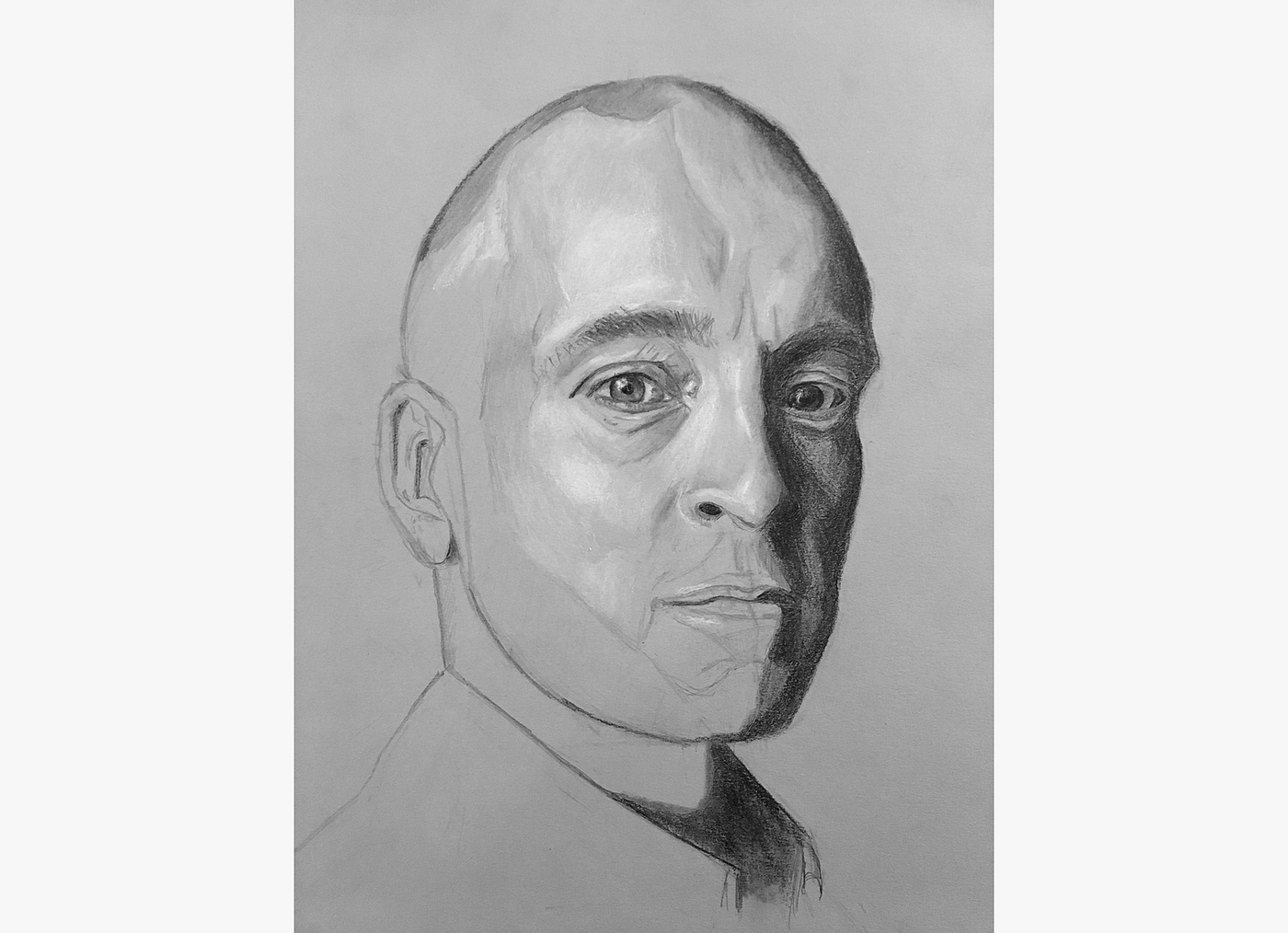
Next, I moved on to Derren'due south pilus and beard.
Since the demo portrait in course is based on a long-haired female model, I had to do a bit more freestyling at this point. I think it works.
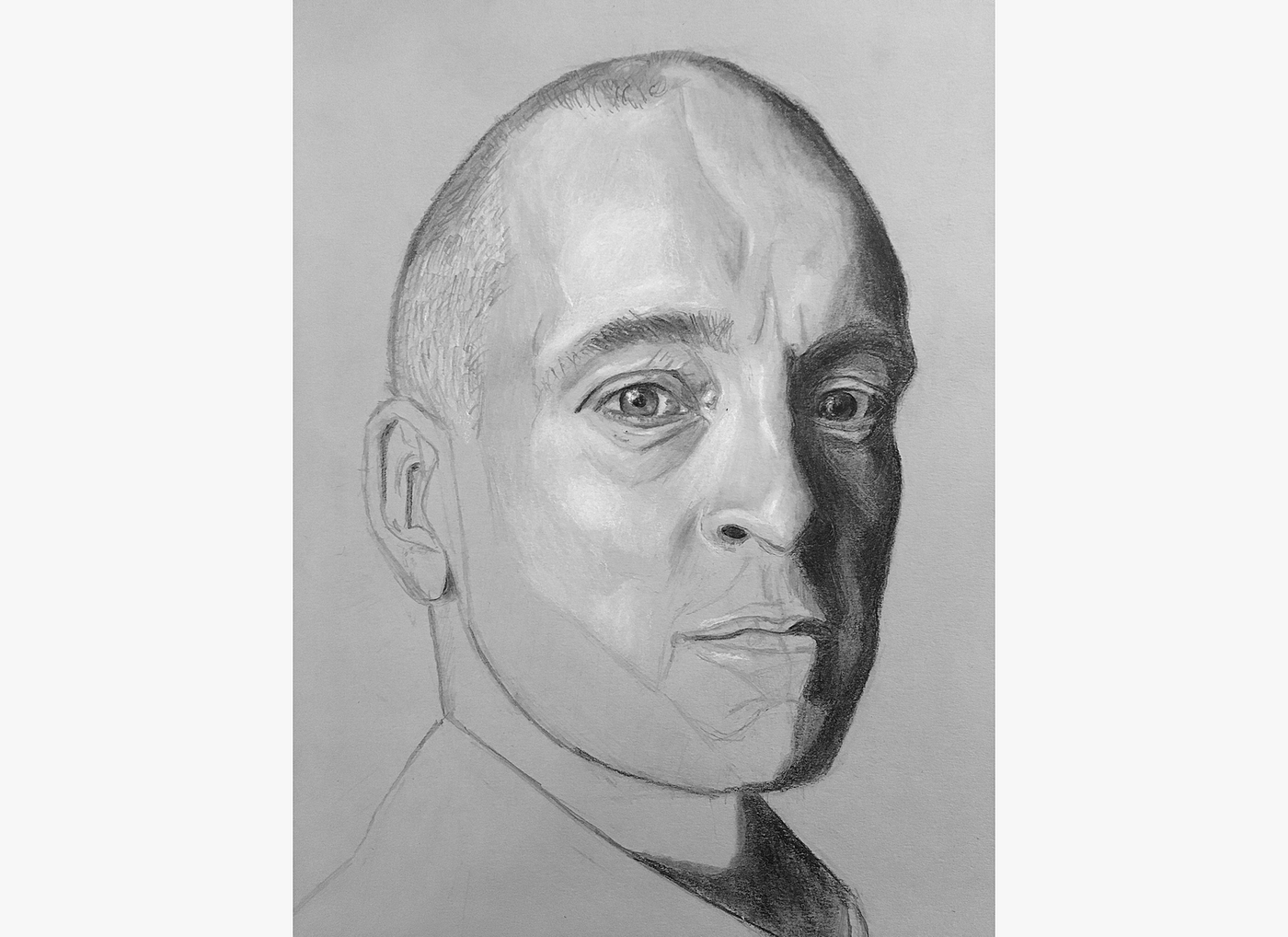
I continued with the upper function of the beard, and finished up for the day.
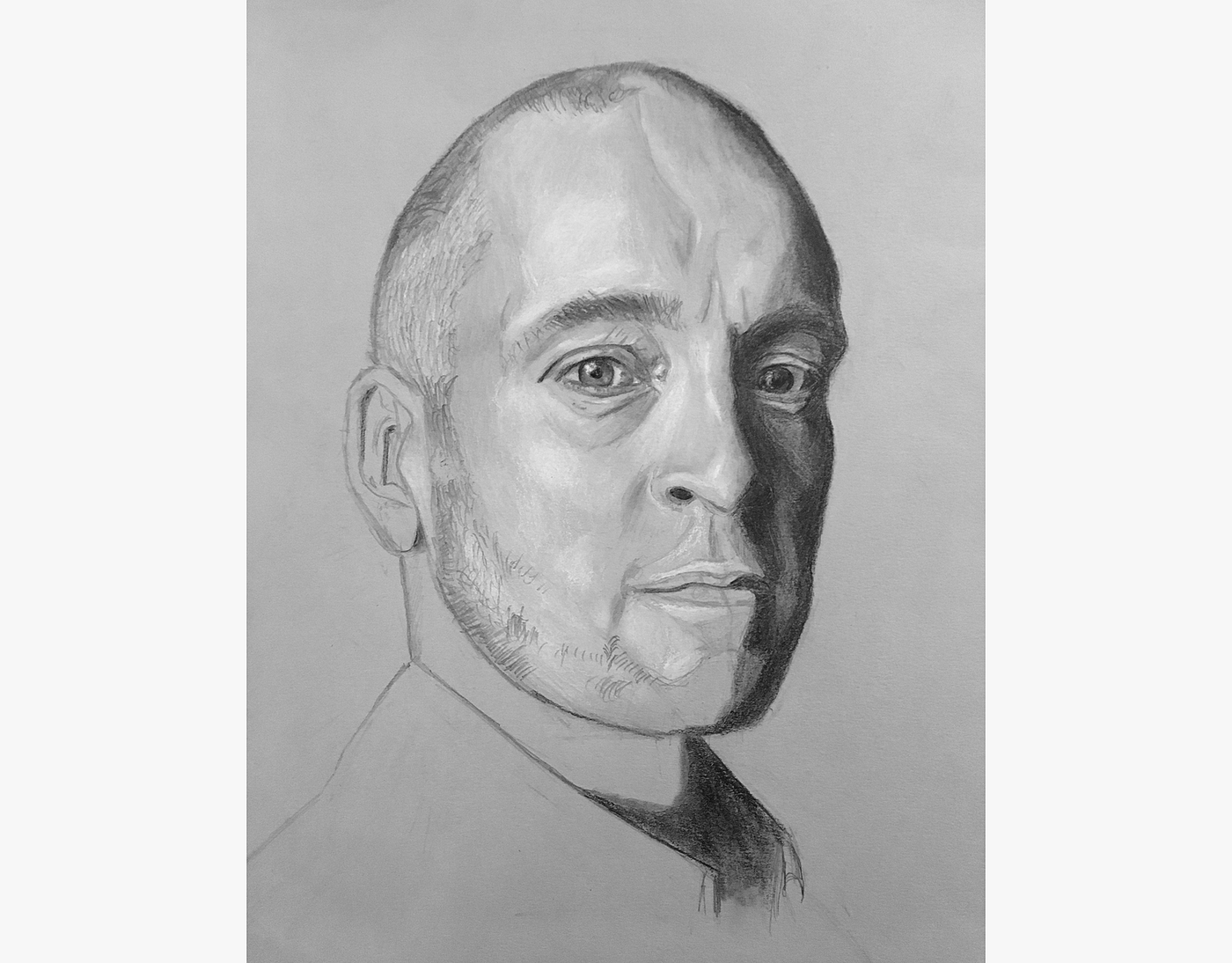
Tomorrow, I need to finish the mouth, the ear, the neck, the lower part of the beard, and perhaps the clothing.
Getting close…

Today, after another 2.five hours of work, I finally completed my Derren Brown portrait.
In the coming days, I volition write a few detailed posts well-nigh what I've learned, how I program to move forrard, etc., but for now, I'll only share the final photos of my progress.
Today's progress
I started off past detailing the lips.
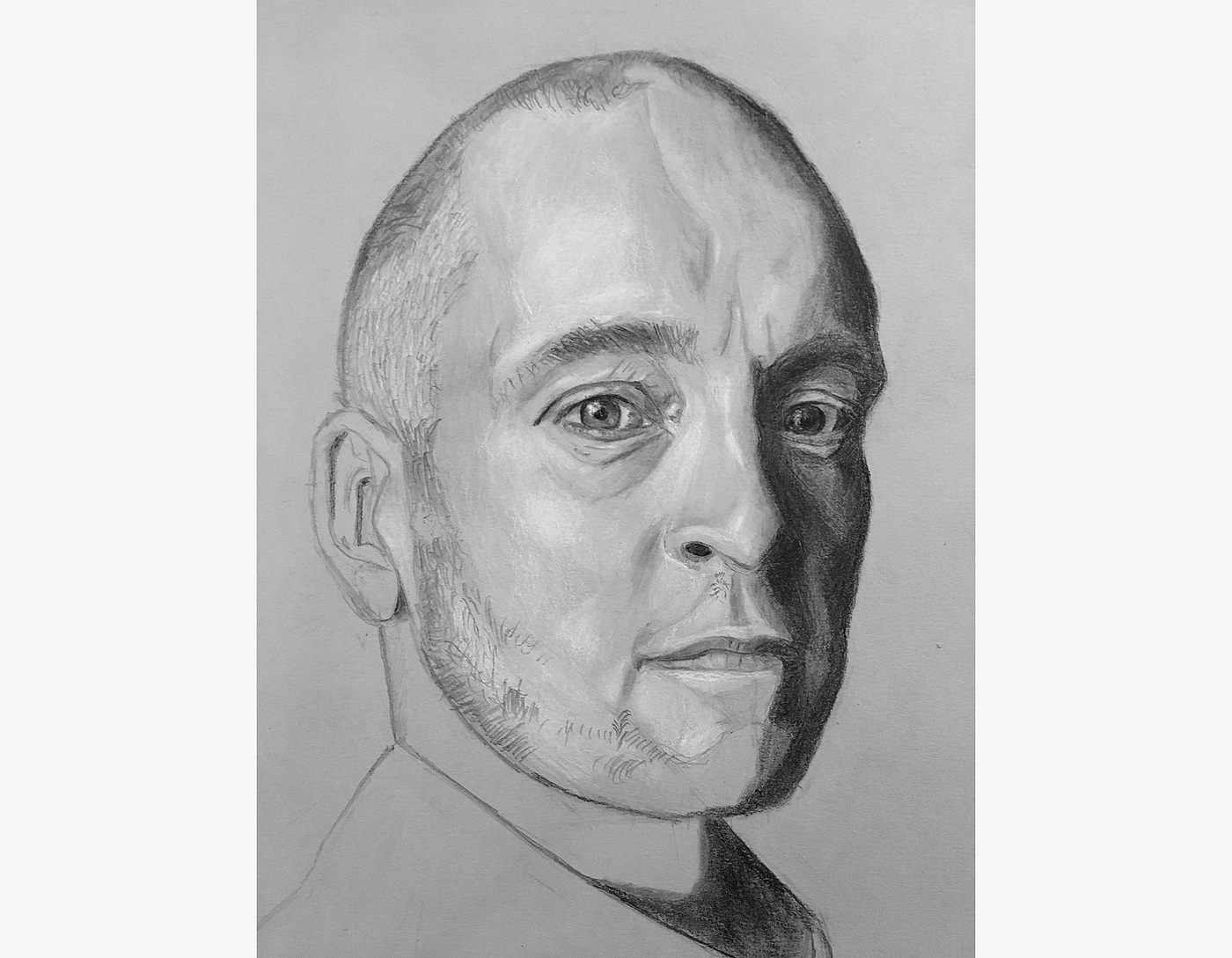
And so, I added the mustache.
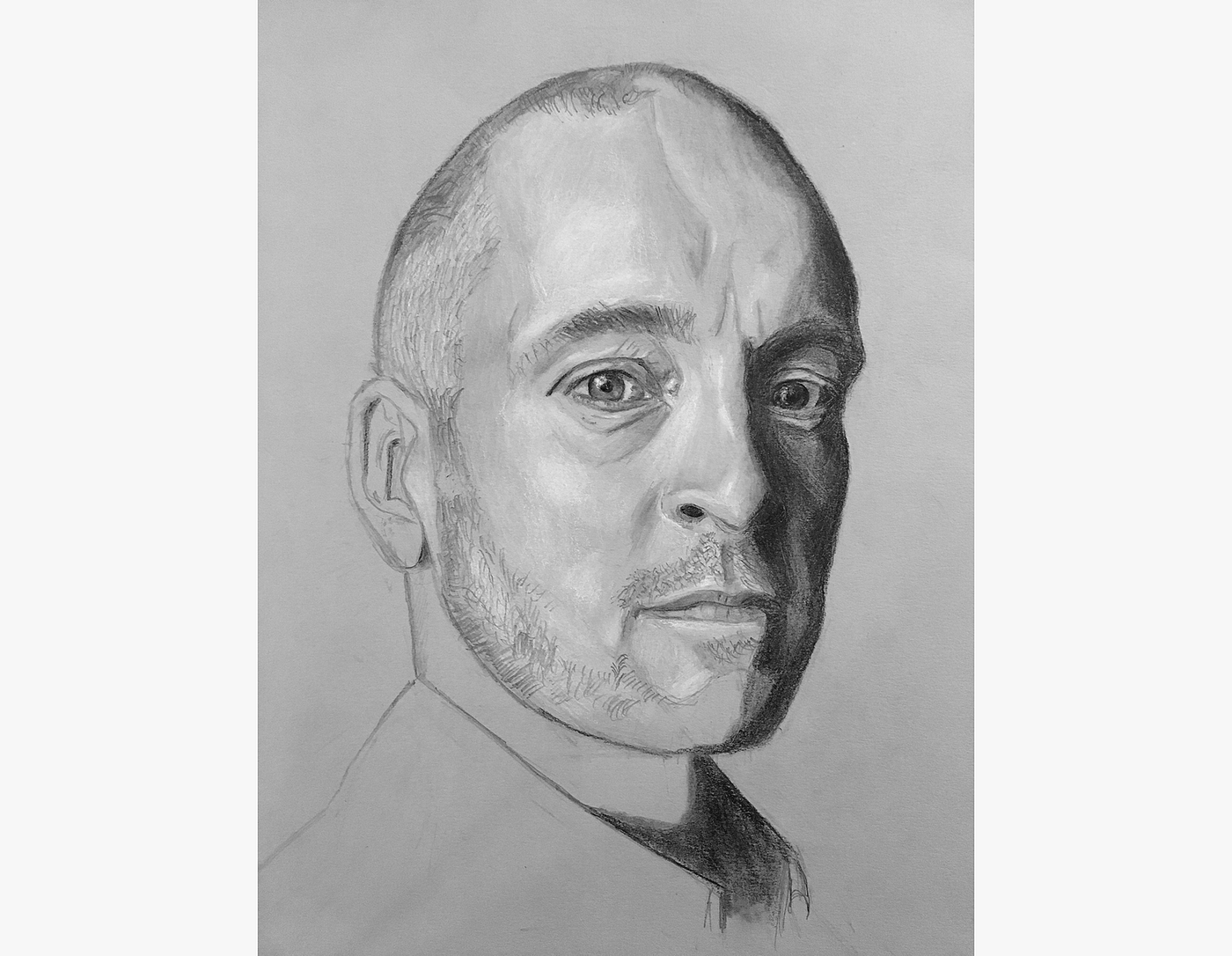
With this facial hair momentum, I finished off the beard.
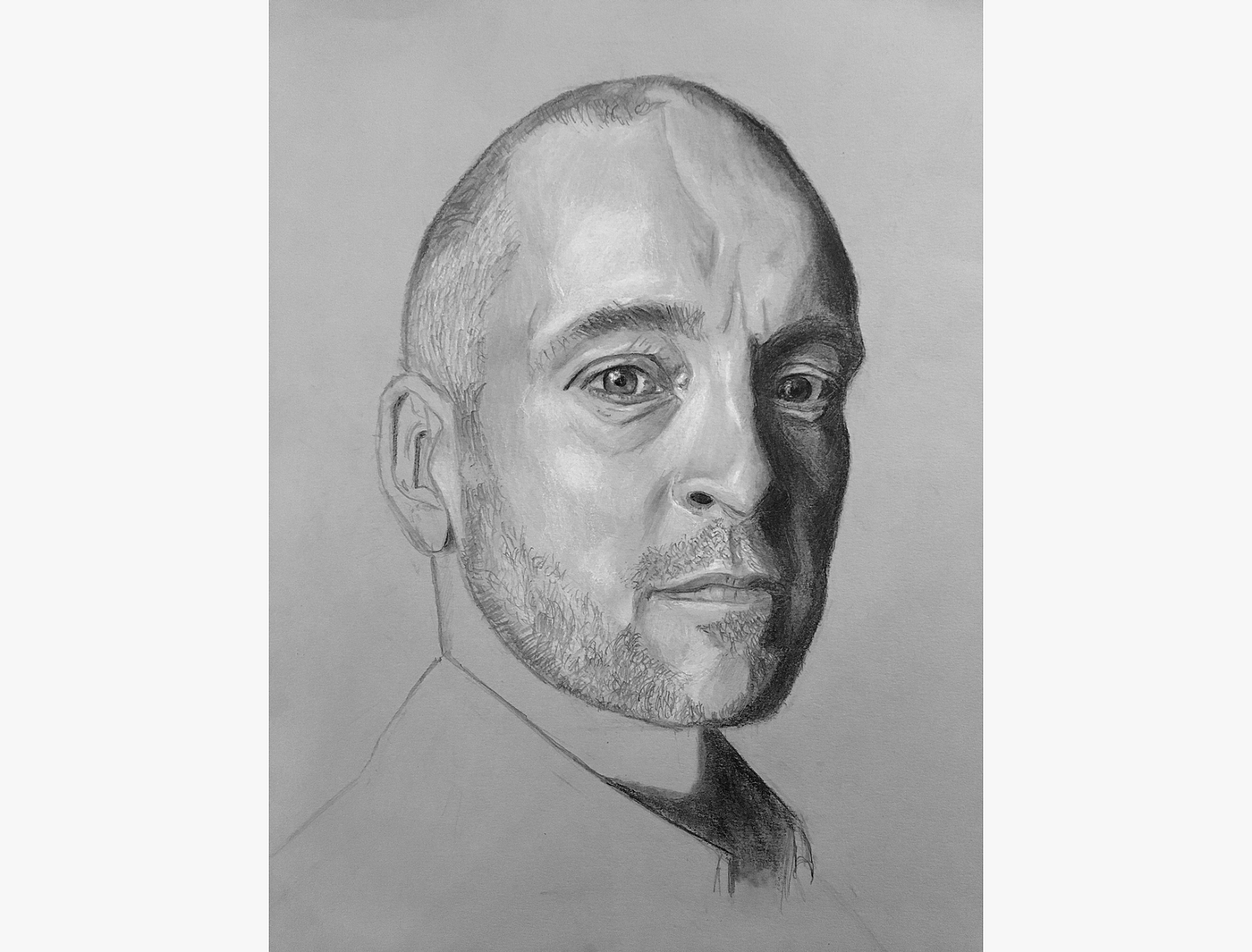
And then, the ear.
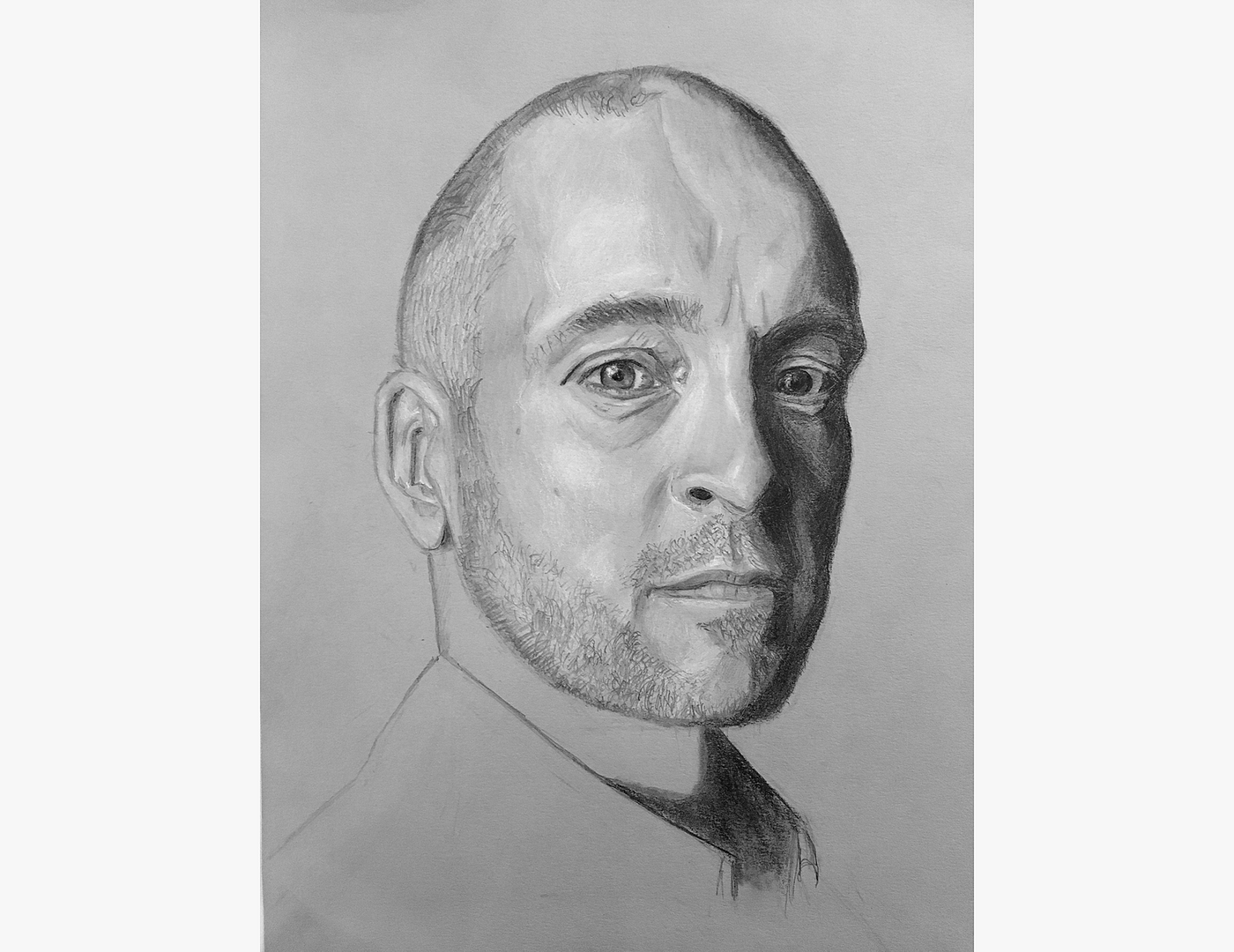
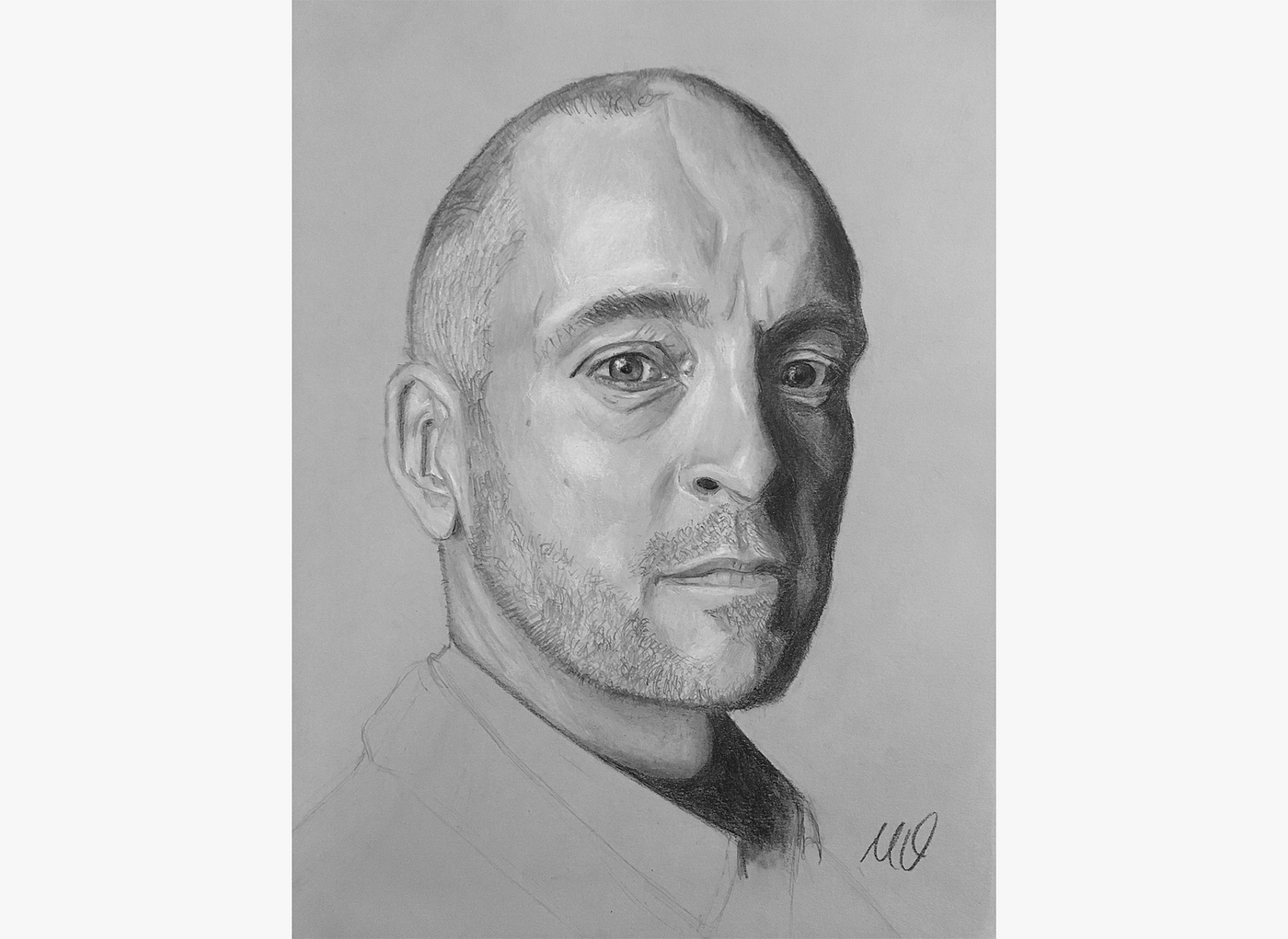
Finally, I completed the neck, decided not to address the clothes, signed it, and I was done.
For my first portrait of the calendar month, I'k quite happy with how it turned out.

Ix days ago, I began my xxx-day quest to learn how to draw photorealistic portraits. Since then, I've watched the entire 10 hours of the Vitruvian Studio drawing course, every bit well as spent 14.5 hours working on my kickoff portrait.
Here'southward the upshot…
And here'southward a video documenting the progression.
Considering where I started only nine days ago (encounter the before portrait), it's hard for me to believe that I really drew this. Information technology's not perfect, but I'chiliad definitely excited about the outcome.
Part of me lacks the motivation to proceed cartoon, as I feel like I've already accomplished my goal. The other (more overpowering) function of me realizes that I have another 21 days to amend even further, and then that's what I programme to do.
In particular, I'grand going try to reduce the corporeality of time necessary to consummate a portrait like this. With some practice, I think I tin reduce my fourth dimension down from 14.5 hours to 4–five hours.
Tomorrow, I'm going to become through my previous posts (ane, 2, 3, 4, five, 6) and write up a "Portrait Drawing Cheat Canvas". Then, I'thousand going to break downwards the cheat sheet into isolated, practicable skills and drills, piece of work on those private skills for one–2 weeks, and and so offset working on my cocky-portrait to cease off the calendar month.
Here is my "Portrait Cartoon Cheat Sheet", which features step-by-step instructions on how to draw a portrait.
These steps are based on the fantabulous portrait drawing course past Vitruvian Studio, which I highly recommend y'all purchase if you are serious about learning how to draw.
The Instructions
- Marker the pinnacle of the head. Arbitrarily depict a line towards the top of the page. This represents the summit of the head.
- Marking the bottom of the chin. Arbitrarily depict a line near the lower third of the page. This represents the lesser of the mentum.
- Marking the notch of the neck. On the subject, using your pencil as a guide, measure the distance from the everyman point of the head to the notch of the neck. Determine how many of these distances can fit inside the vertical distance of the head. Employ this is as guide to draw a horizontal line towards the bottom of the folio to represent the notch of the neck.
- Find the highest indicate of the head. Arbitrarily determine a bespeak on the meridian line. This represents the highest indicate of the caput. Often, on the discipline, this bespeak sits far dorsum on the head.
- Find the everyman point of the chin. Using your pencil equally a guide, determine the bending from the highest point of the head to the lowest point of the chin. Describe a line at this angle from the highest betoken of the caput (as marked on the page) downward towards the lesser of the chin line. Draw a dash where these lines intersect. This intersection represents the lowest betoken of the chin.
- Find the leftmost boundary. Identify the leftmost boundary on your subject field. Determine the angle to this leftmost point from the highest betoken, and depict a line at that bending from the highest bespeak towards the leftmost boundary on the page. Do the same from the lowest point. Draw a marking where these two lines intersect. This intersection represents the leftmost purlieus. The technique used to notice this boundary is called triangulation.
- Find the rightmost purlieus. Once more, triangulate from the highest and lowest points to find the rightmost boundary of the head.
- Check the bending. On the subject area, utilise your pencil to find the angle between the leftmost and rightmost boundaries. Cheque if this bending matches the angle represented on the folio. If not, retriangulate and check again.
- Describe the outer-boundary of the caput and hair. Triangulate points around the head and connect them with straight lines. Once the general shape seems right, smoothen out the kinks. Check the angles between various points on the subject area and on the page to brand sure everything looks right. If there seems to be inconsistencies, retriangulate and adjust. Do the same for the hair line.
- Depict the vertical middle line. Pick some central indicate that looks similar its on the vertical center line. Triangulate from outer-points inward to discover this key point. Check the angle from the bottom/middle of the mentum to this point. Employ this as a guide to draw in the unabridged vertical heart line. As the center line approaches the top of the head, it typically flattens, as it rounds back behind the head.
- Draw the level of the optics. The level of the eyes typically falls about halfway betwixt the top and bottom of the head. Utilise this as a starting point. Draw in this level, then check angles to confirm. Move up or downward until everything checks out.
- Describe in the level of the brows and lesser of the olfactory organ. If you divide the face length into thirds, typically the level of the brows fall on the upper tertiary line and the level of the olfactory organ falls on the lesser third line. Use this as a starting point. Describe in these level, and the check angles to confirm. Move the level up or down until everything checks out.
- Depict in the level of the showtime of the nose. The nose begins somewhere between the level of the brows and the level of the eyes. Gauge where this is and describe it in.
- Depict in the bottom and middle of the lips. If you divide the distance between the lesser of the nose and the bottom of the chin into halves, the level of the lesser of the lips typically falls at the halfway indicate. Use this as a starting betoken to draw in this level. So, gauge where the middle of the lips falls relative to the altitude betwixt the lesser of the lips and the bottom of the nose. Draw that in.
- Adapt the center line for the olfactory organ. Starting from the level of the start of the olfactory organ, adjust the center line so its angle matches the center line of the olfactory organ. Typically this volition be in two parts. The angle outwards from the level of the start of the nose to the peak of the nose, and the angle in from the acme of the olfactory organ to the bottom of the nose.
- Adjust the center line for the mouth. The mouth typically has some volume, which pushes the center line forwards. Adjust the center line forward below the nose to account for the book in the mouth.
- Draw in the shape of the eyes and eye sockets. Triangulate the corners of the eyes, and then draw in the complete shapes. Do the aforementioned for the lids and the eye sockets.
- Draw in the shape of the brows. Triangulate the corners of the brows, so draw in the complete shapes.
- Describe in the shape of the nose. Triangulate the peak of the olfactory organ and the fly of the nose. And then, depict in the complete shape.
- Draw in the shape of the oral cavity. Triangulate the corners of the mouth. And then, draw in the complete shape.
- Draw in the level of the chin. Triangulate the level of the chin, and depict a line to distinguish the shape.
- Draw in the shape of the ear. Triangulate points of bending-change around the ear. Connect these points with accordingly angled lines, and then smoothen out the kinks.
- Describe in shadow shapes. Identify shapes of chief shadow areas. Triangulate their boundaries and draw them in.
- Darken the shadow shapes. Lightly shade in the shadow areas of the portrait. Utilize a soft, make clean paint brush to smoothen out the material on the page. This volition innovate some 3-dimensionality to your portrait, which should help you meliorate visualize if anything doesn't seem quite right. If in that location is something that seems incorrect, set it.
- Particular the eyes. Draw in the iris, pupils, and other details.
- Particular the nose. Draw in the nostrils and other details.
- Item the lips. Smoothen out the shape of the lips.
- Item the ear. Depict in some of the main inner land marks.
- Key the cartoon. Identify the lightest and darkest tones on the subject, and add these tones to the page.
- Modeling an expanse. Option an area of the head (like the forehead), and particular some of the main places of tone-modify. Place and add together in the principal light and dark areas. Using a shading stump and the necessary pencils, fill in the transition tones. To better run into the shapes of highlights and shadow, squint your optics until the face isn't recognizable as a face, merely rather a collection of tonal blobs.
- Model the remaining areas. Continue as to a higher place until all areas are modeled.
- Sign information technology. And you're washed.
A few days ago, I finished drawing my first portrait. Since then, I've reread my notes, reviewed some parts of the course, and wrote up my "Portrait Drawing Cheat Sheet".
With all the steps documented, it's now time to deliberately practice the most of import skills.
In detail, as I said on 24-hour interval 35, I believe that it's most important to accurately capture the proportions of the caput, the head shape, and the level of the features. If these things are done correctly, the rest of the procedure is very forgiving. If non, the portrait volition terminate up beautifully shaded, simply won't look like the subject.
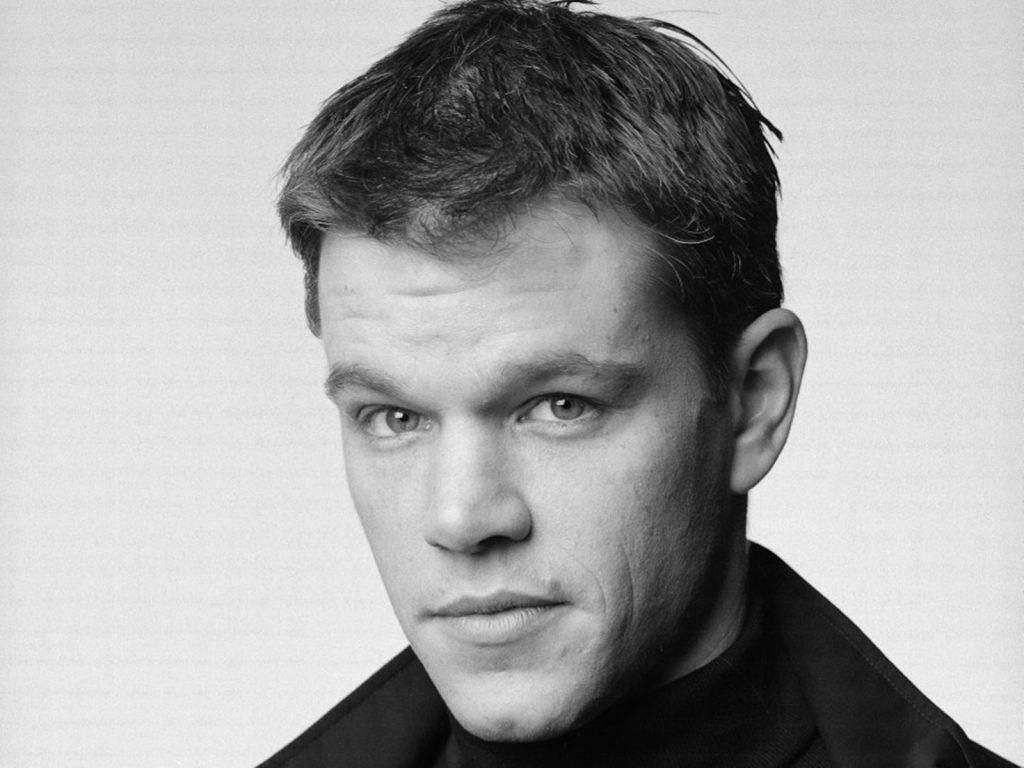
Today, I'm going to do finding the correct proportions of the subject's head using a few celebrities: Matt Damon, Natalie Portman, and Morgan Freeman.
Matt Damon
Here's the photo I'one thousand using.
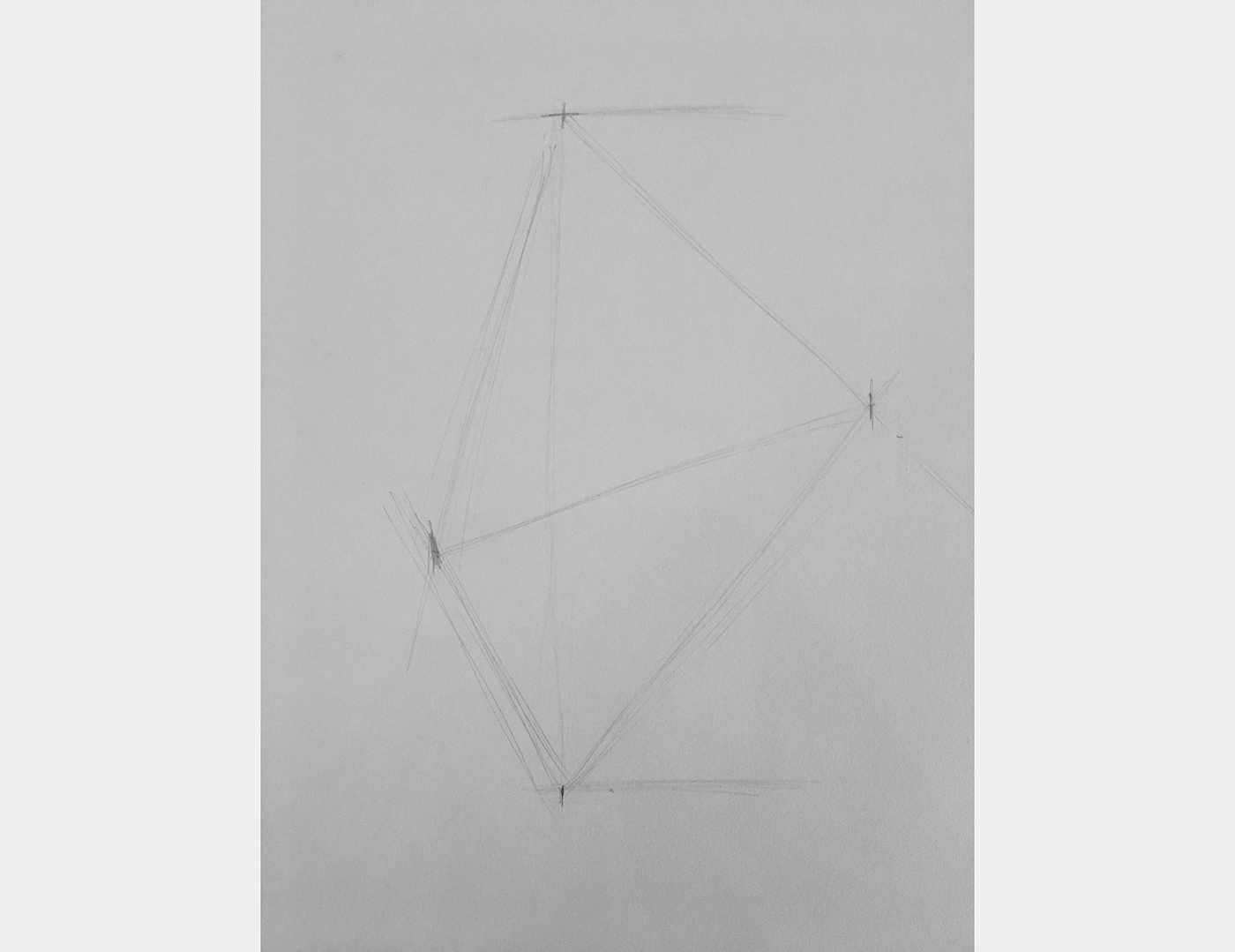
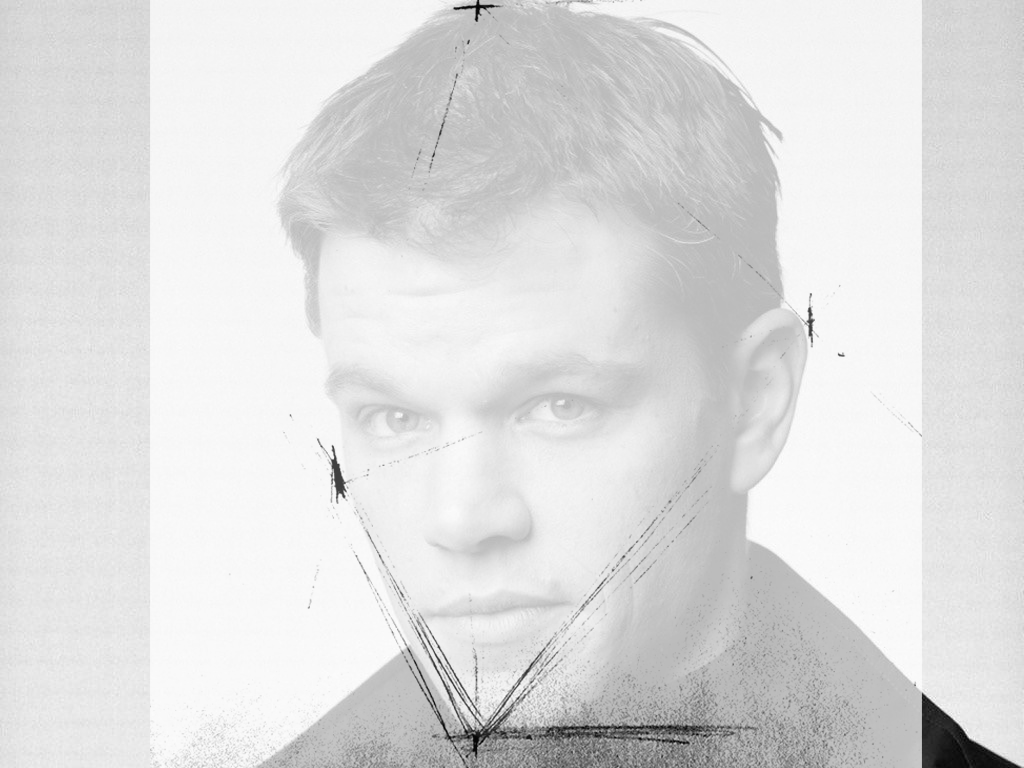
Here'southward my effort to locate the meridian of his head, the lowest point of his chin (which is located on the chin's left side), the leftmost signal of his cheek, and the rightmost point of his ear.
In Photoshop, I overlaid my sketch on the photograph to check. I was pretty authentic.
Natalie Portman
Here's Natalie.
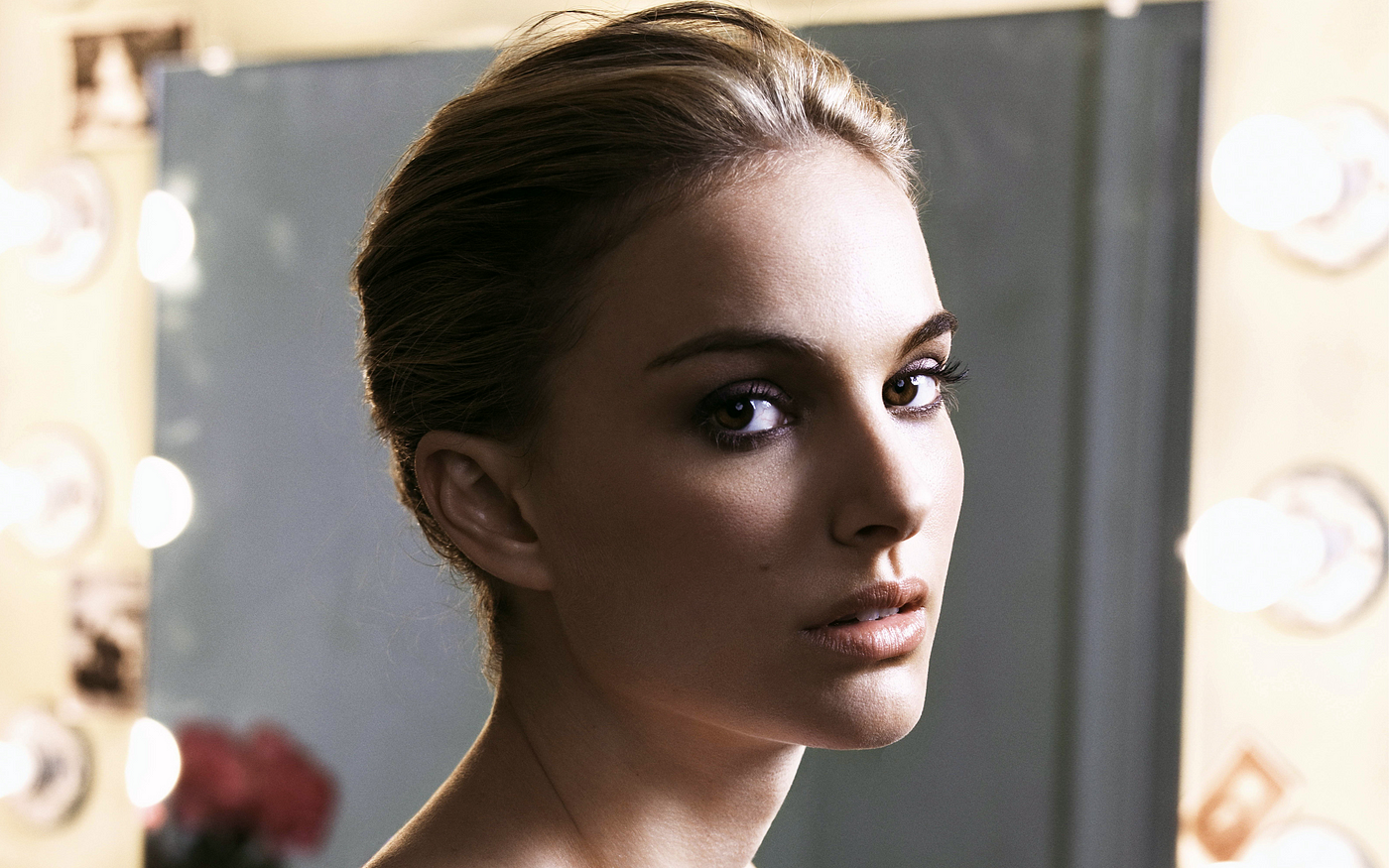
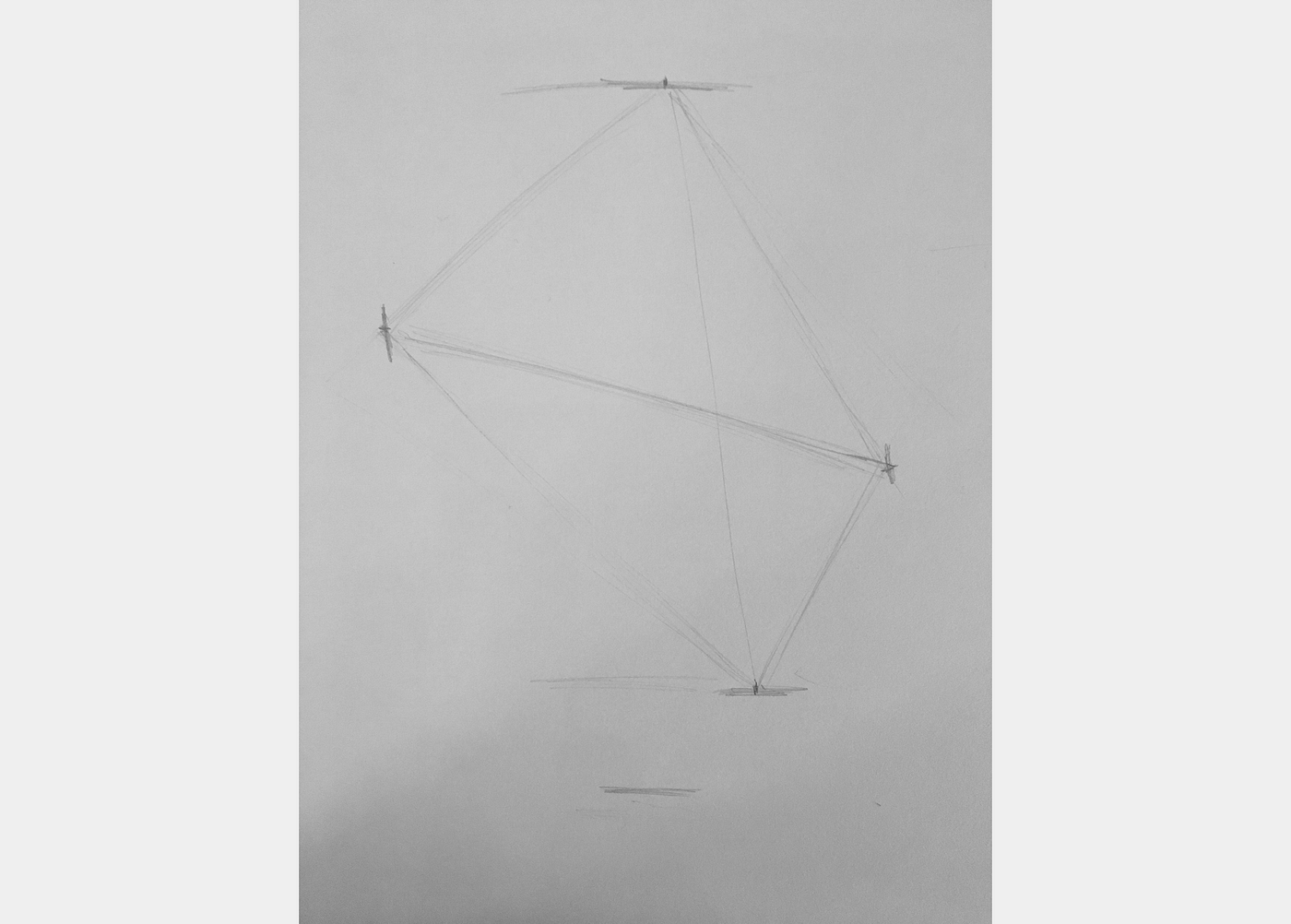
And here'southward my effort to locate the acme of her pilus, the everyman point of her chin (over again on the mentum's left side), the rightmost indicate of her cheek, the leftmost signal of her hair, and the notch of her neck.
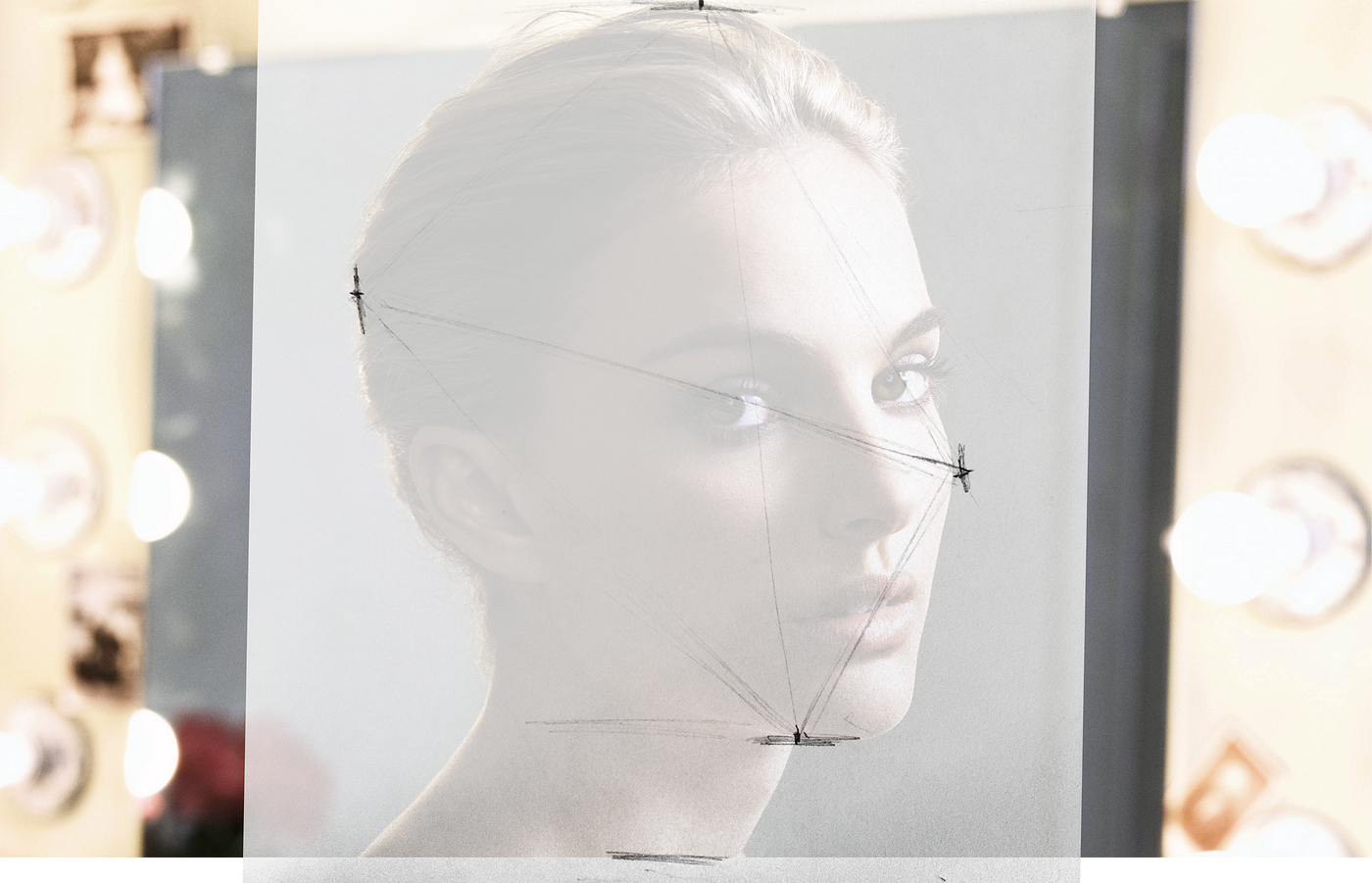
Checking in Photoshop, everything seems pretty accurate. Although, the low point of the chin may be slightly too far left.
Morgan Freeman
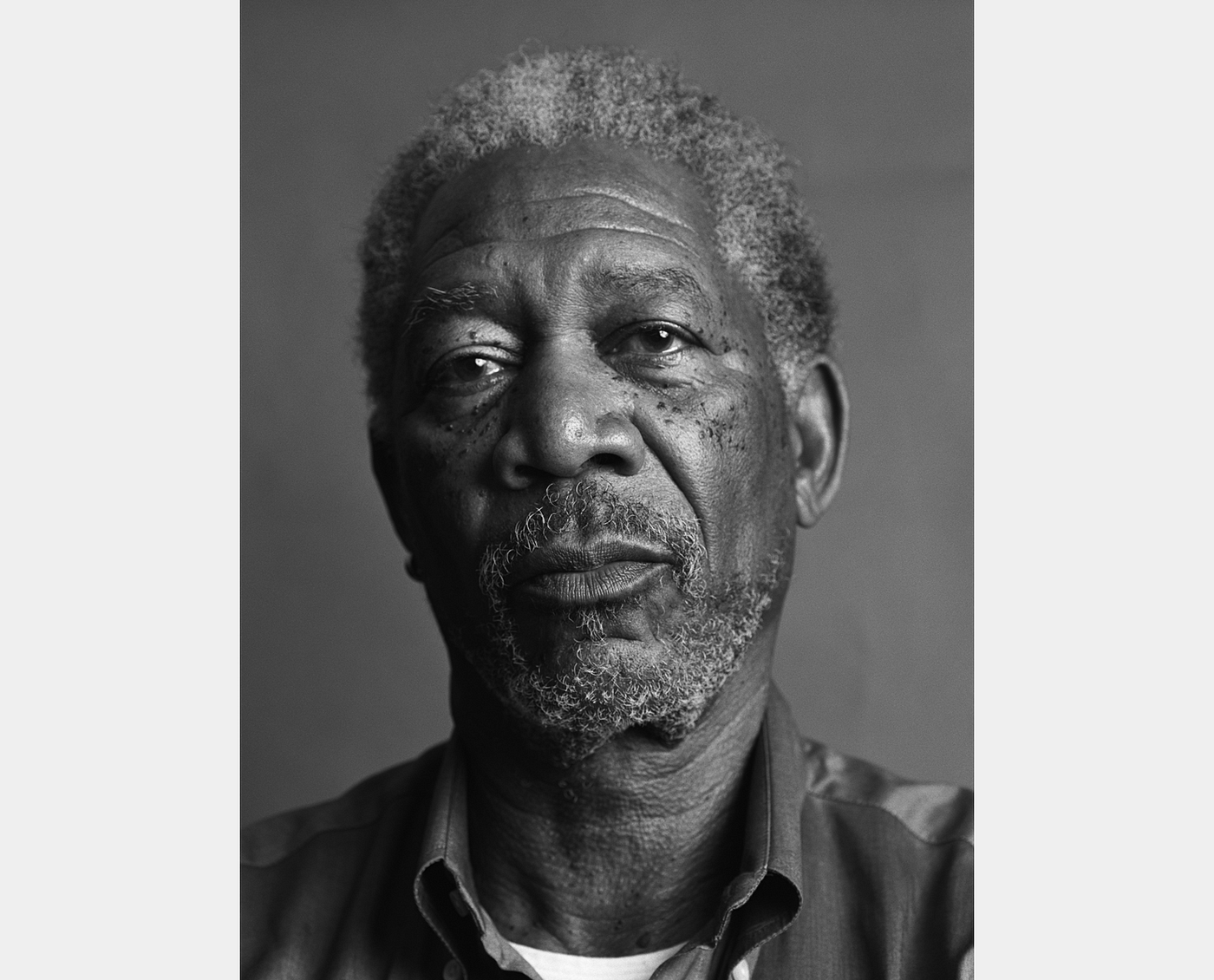
Here I try to locate the peak of his head, the lowest point of his chin, the rightmost betoken of his ear, the leftmost point of his ear, and the notch of his neck.
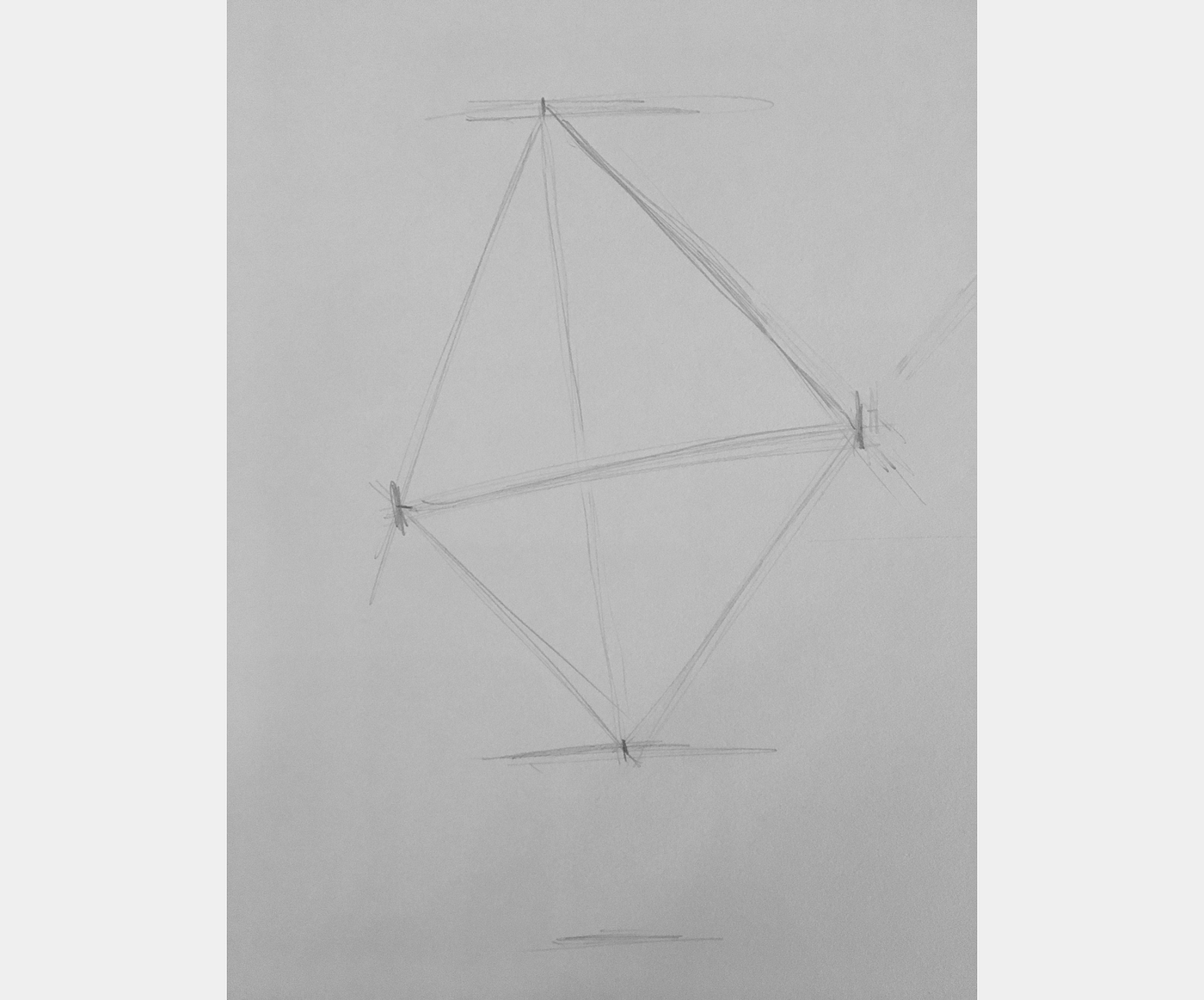
This i looks right on the coin.
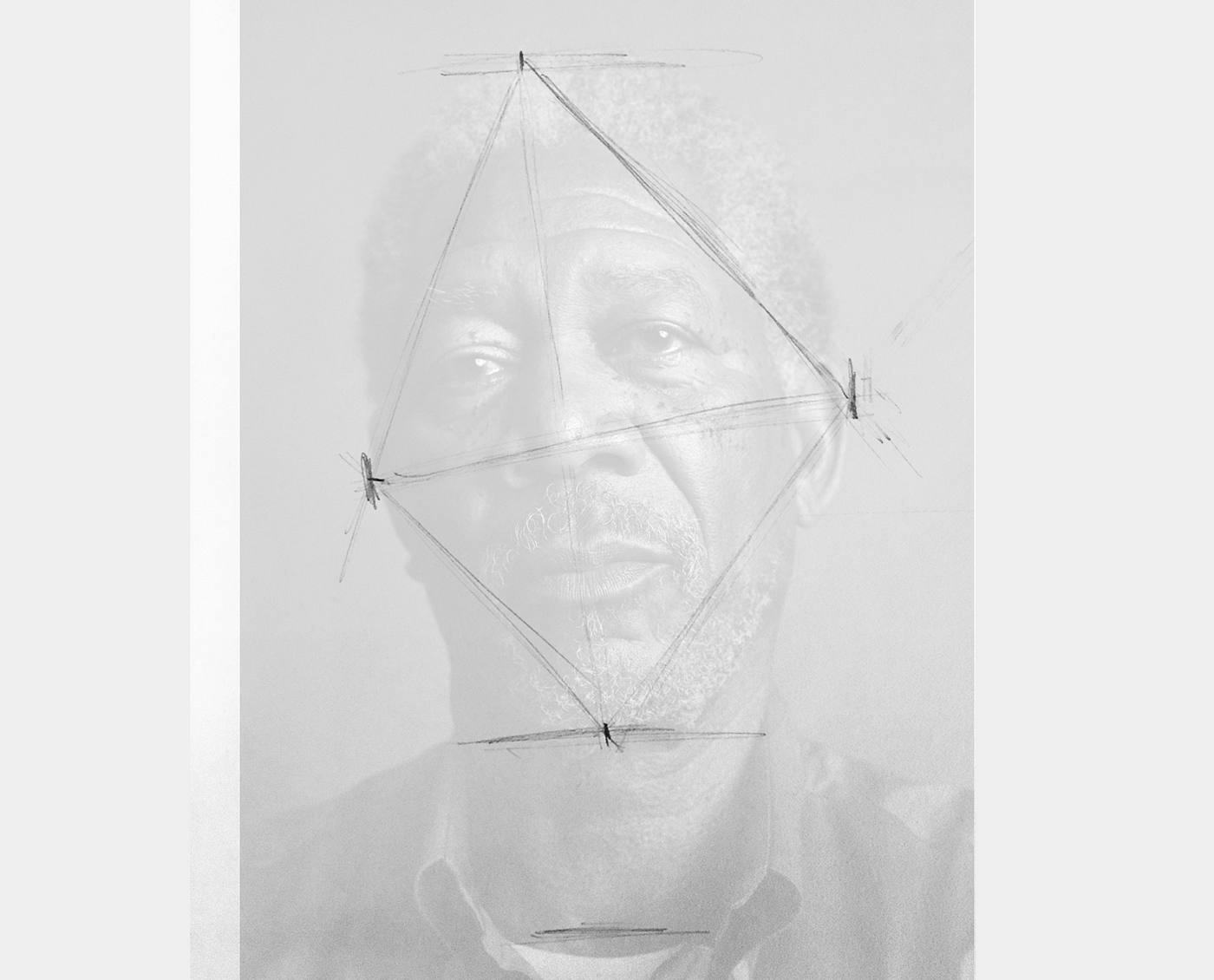
With each of the sketches, unlike with my Derren Brownish portrait, I felt that I was able to see the angle on the subject and accurately replicate information technology on the page with limited effort.
This is a good sign…
Yesterday, I practiced triangulating the proportions of a few celebrity heads.
For example, here'southward 1 I did of Natalie Portman.
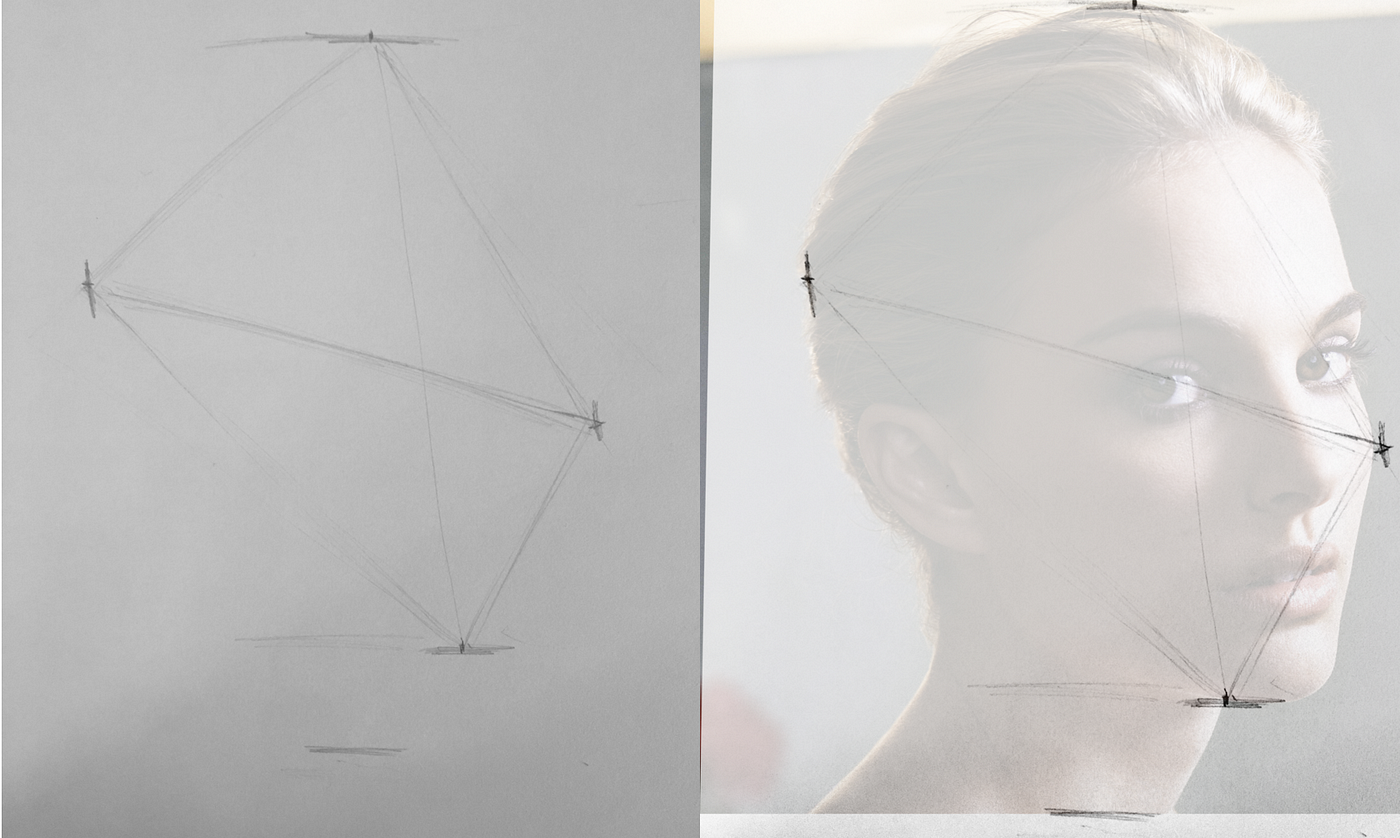
Today, I practiced triangulating the complete caput shape and gauging the level of features.
It took well-nigh 45 minutes.
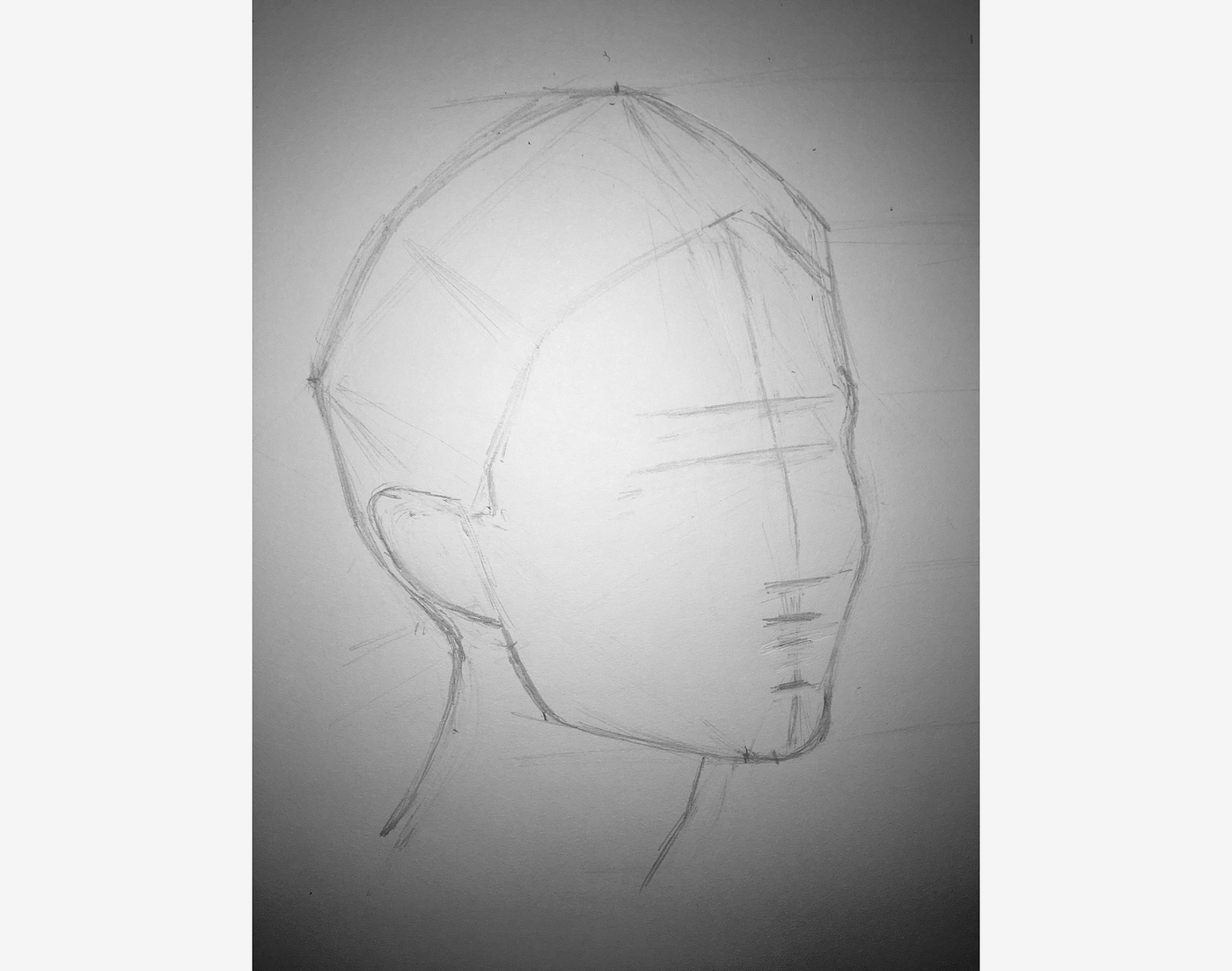
To appraise my piece of work, I overlaid the sketch on Natalie.
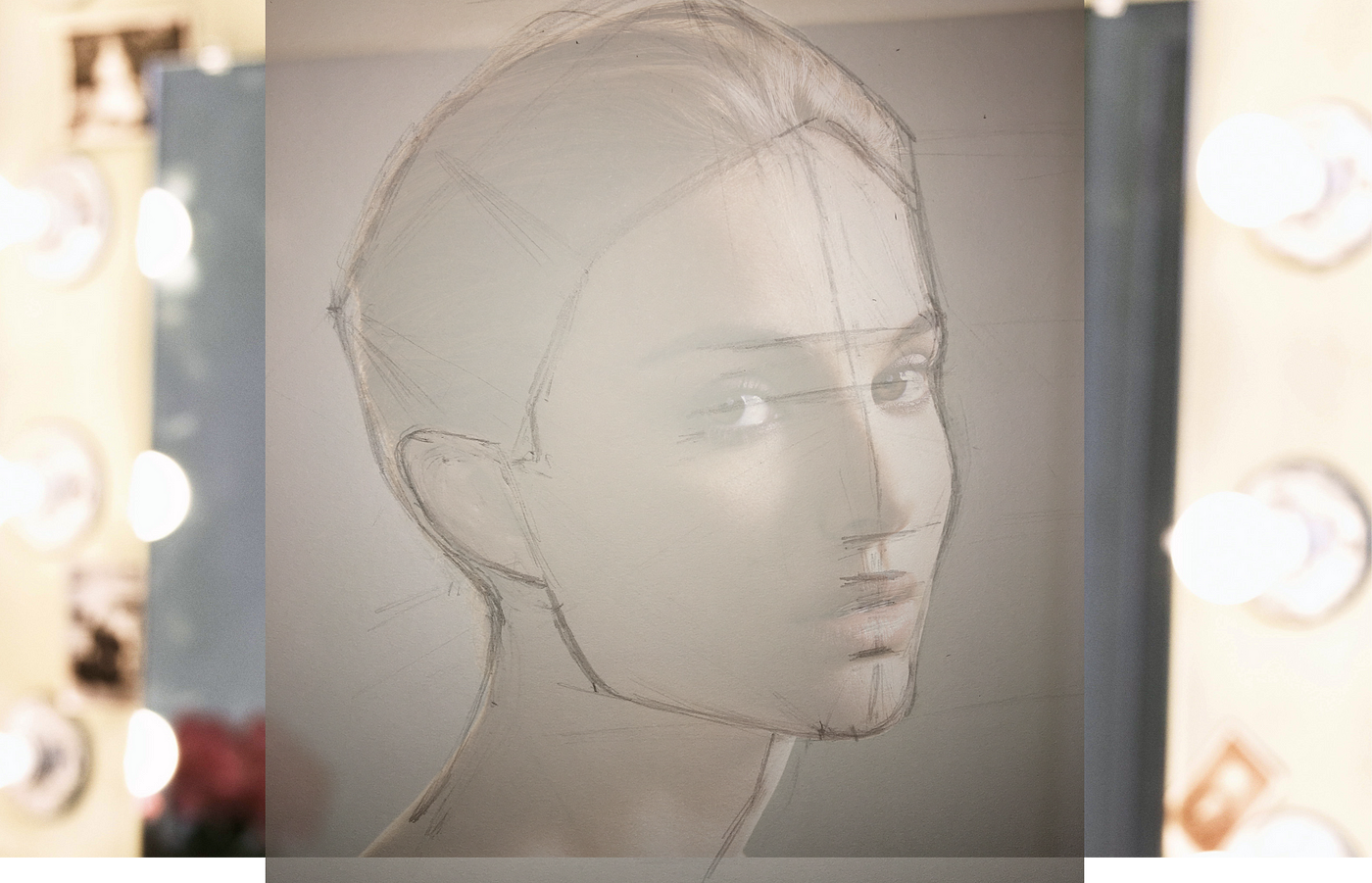
My Critique
- The face shape is accurate
- The level of the features is accurate
- The angle of the features is accurate
- The centre line curves a little too rapidly equally it moves up between the optics
- The neck shape is inaccurate — I peculiarly misestimated the starting point of the neck on the correct side.
- Above the right centre, the angle of the head/hair is too steep
- The summit of the caput is too steep
- The angle of the pilus above the ear isn't steep enough
Overall, I'd give the sketch a B-.
Since I was accurate with the face shape and the level of features, if I continued working, I suspect I would develop the face adequately accurately. Every bit a result, I would likely have enough authentic information to gradually correct the major mistakes with the caput and hair shape.
Tomorrow, I'll practice once again on a different celebrity.

Today, I didn't take too much time to draw. So, I rapidly progressed the Matt Damon sketch I started 2 days ago.
Here's what I shared on Sunday.
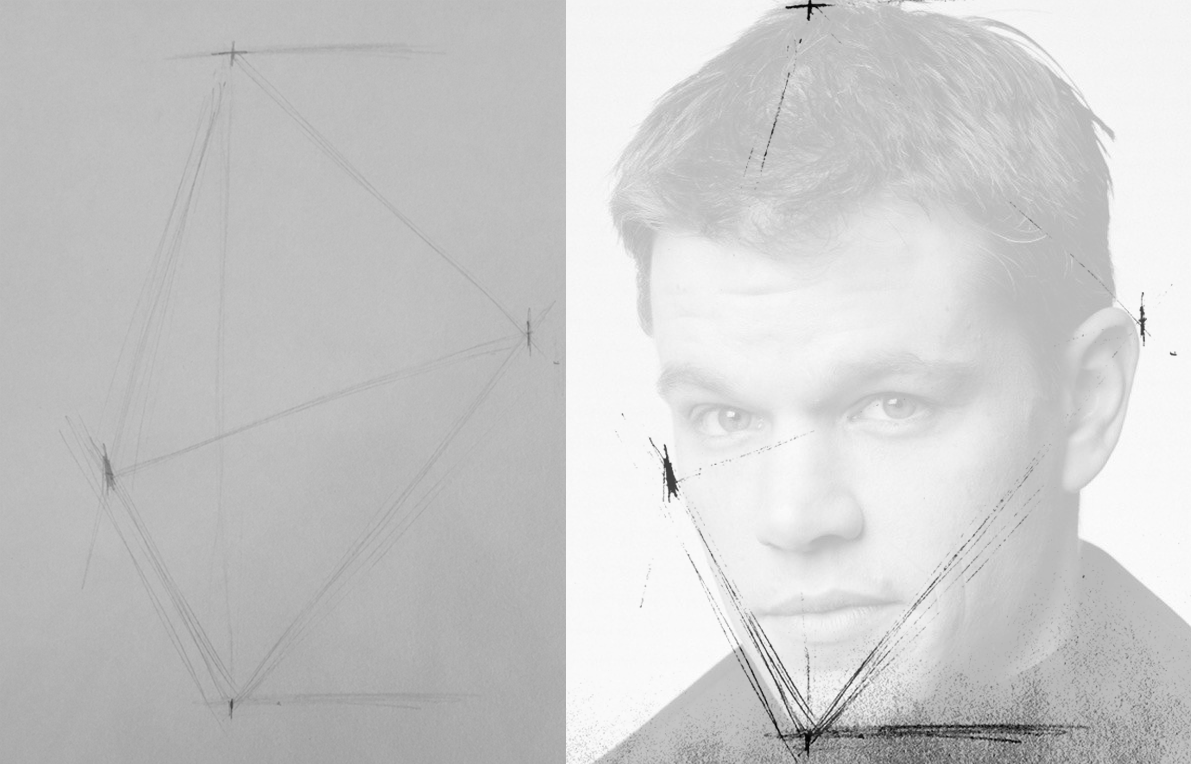
Today, I spent xxx minutes sketching the head shape and feature guides.
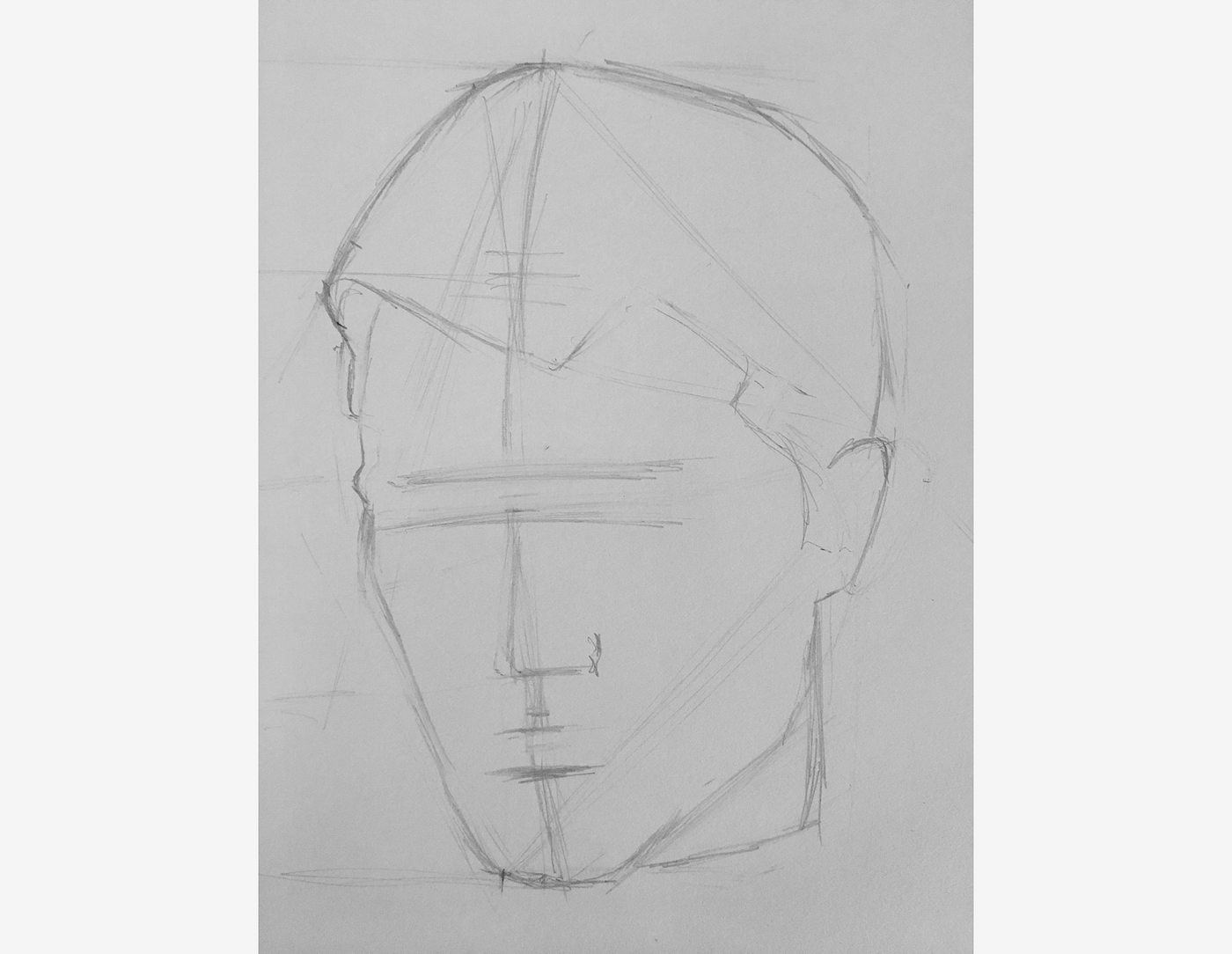
Just looking at the sketch, the caput shapes seems a little narrow for Matt Damon. Simply, overlaid on the photo, it seems to friction match up.
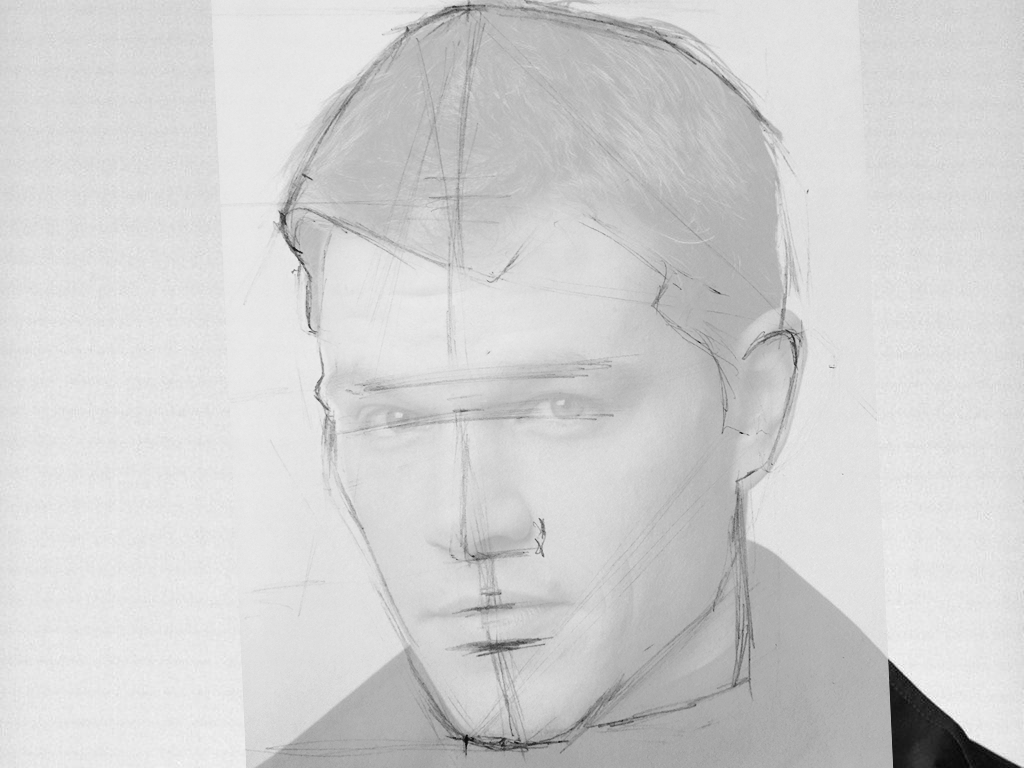
With the exception of the oddly tiny ear, everything else seems to line up well. The caput shape, face shape, and hair shape seem authentic. The level of the features and the centre line seem authentic. The wing of the nose is a bit too far to the right, but I really just threw that in for fun.
Overall, I'k pretty happy with the effect — peculiarly since I sketched this fairly apace. I guess that means I'm improving…
Last month, when I was learning to memorize a deck of cards at grandmaster speeds, I started unintentionally seeing playing cards in the real-world. In particular, existent-world things (like wheelchairs and airplanes), which have association in my mnemonic organisation, were triggering images of playing cards, without any conscious thought on my part.
Simply, I was rewiring my brain.
This month, as I learn to describe faces, I'g experiencing a new phenomenon… For the past few days, I've found myself scrutinizing and deconstructing other people'southward faces on the train, at work, on the street, at Whole Foods, etc. Wherever at that place is a face, I can't assist merely try to analyze it, and imagine how I'd draw it.
Now (and I hope this eventually wears off), when I encounter a new face, my first instinct is to estimate the ratio betwixt the elevation and width of the head. Other times, I just look to see what shapes the middle sockets are. Or how prominent the brow ridge is. Or if the nose and brows as pause the face in thirds.
Basically, I can't stop staring at people.
So, thanks people of San Francisco for not getting totally creeped out. I promise I'll terminate shortly.

For the past couple days, I've been itching to first my self-portrait. So, today, I did just that.
After working for about an hour, I was able to end sketching the outline of the caput, hair, and neck.
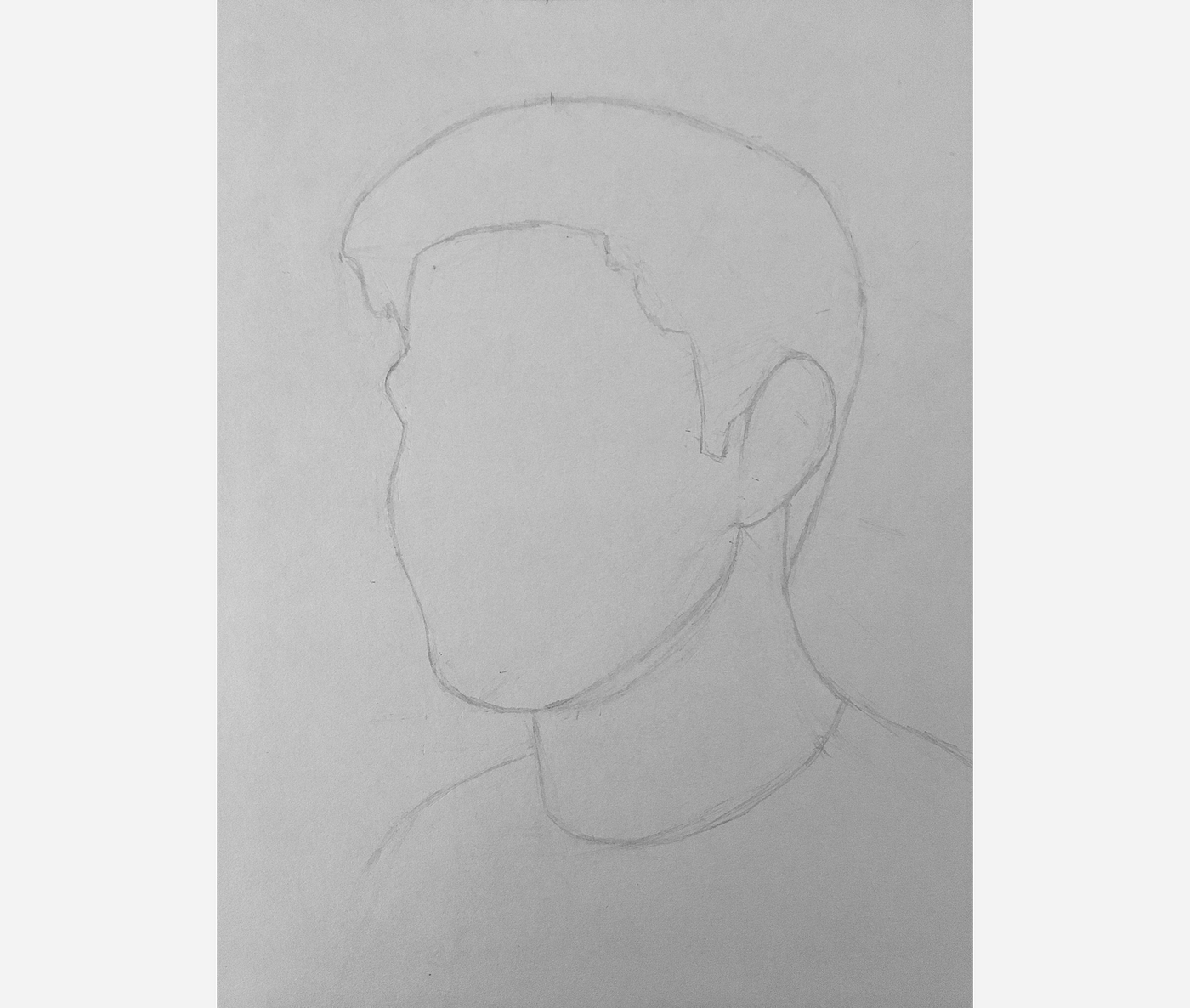
And here's a video of today's progression.
And then far, and so practiced. Tomorrow, I'll start blocking in the features.
Today, I connected working on my self-portrait. Although information technology'south coming together nicely, I made a error upfront that's definitely costing me now.
Earlier, I get to that, though, let me starting time share today's progress.
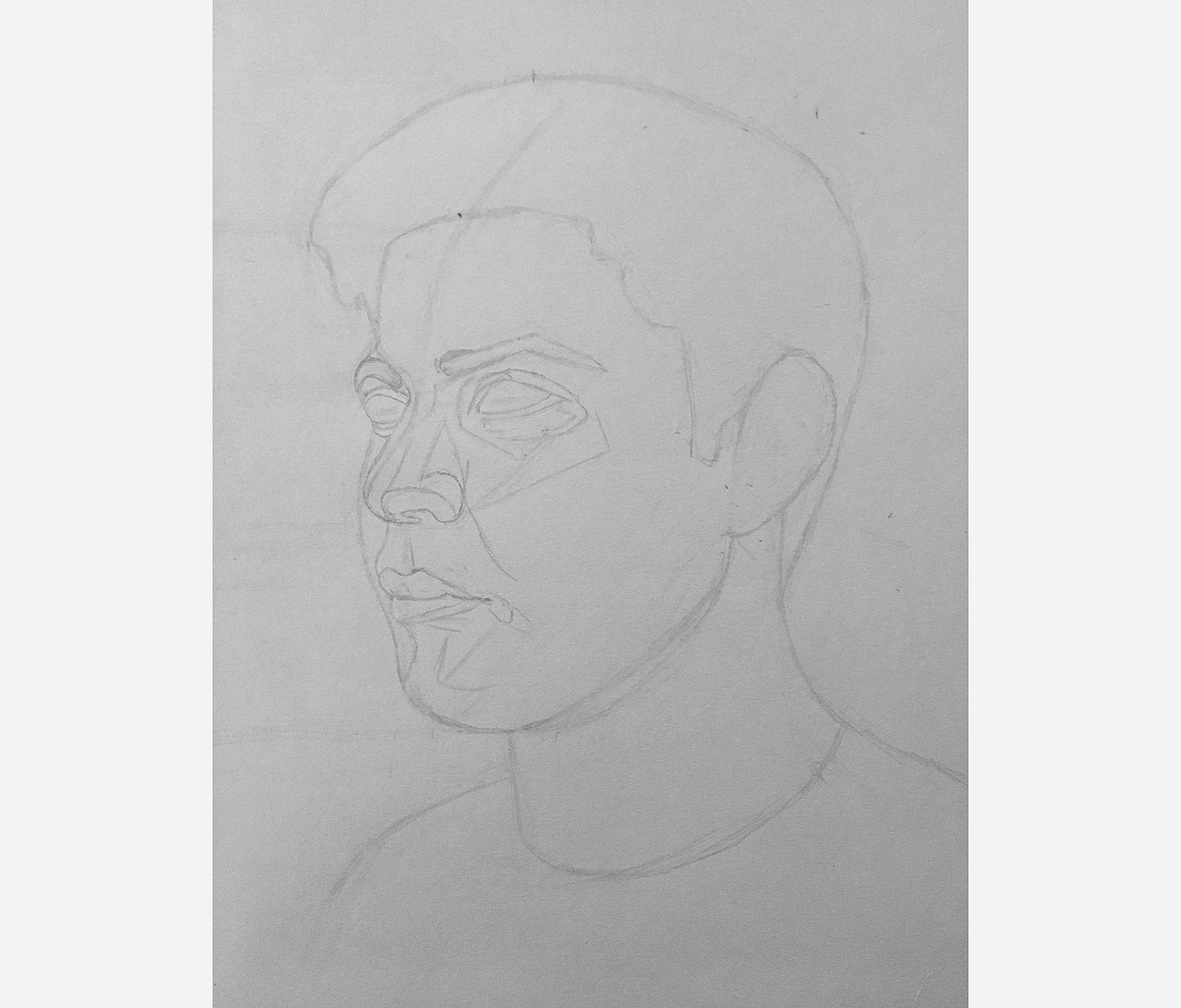
My mistake
Although I'm loving the composition of my self-portrait, I've sadly describe everything 10–xx% as well minor.
Accept a await at the self-portrait side-past-side with the Derren Brown portrait. My caput is noticeably smaller.
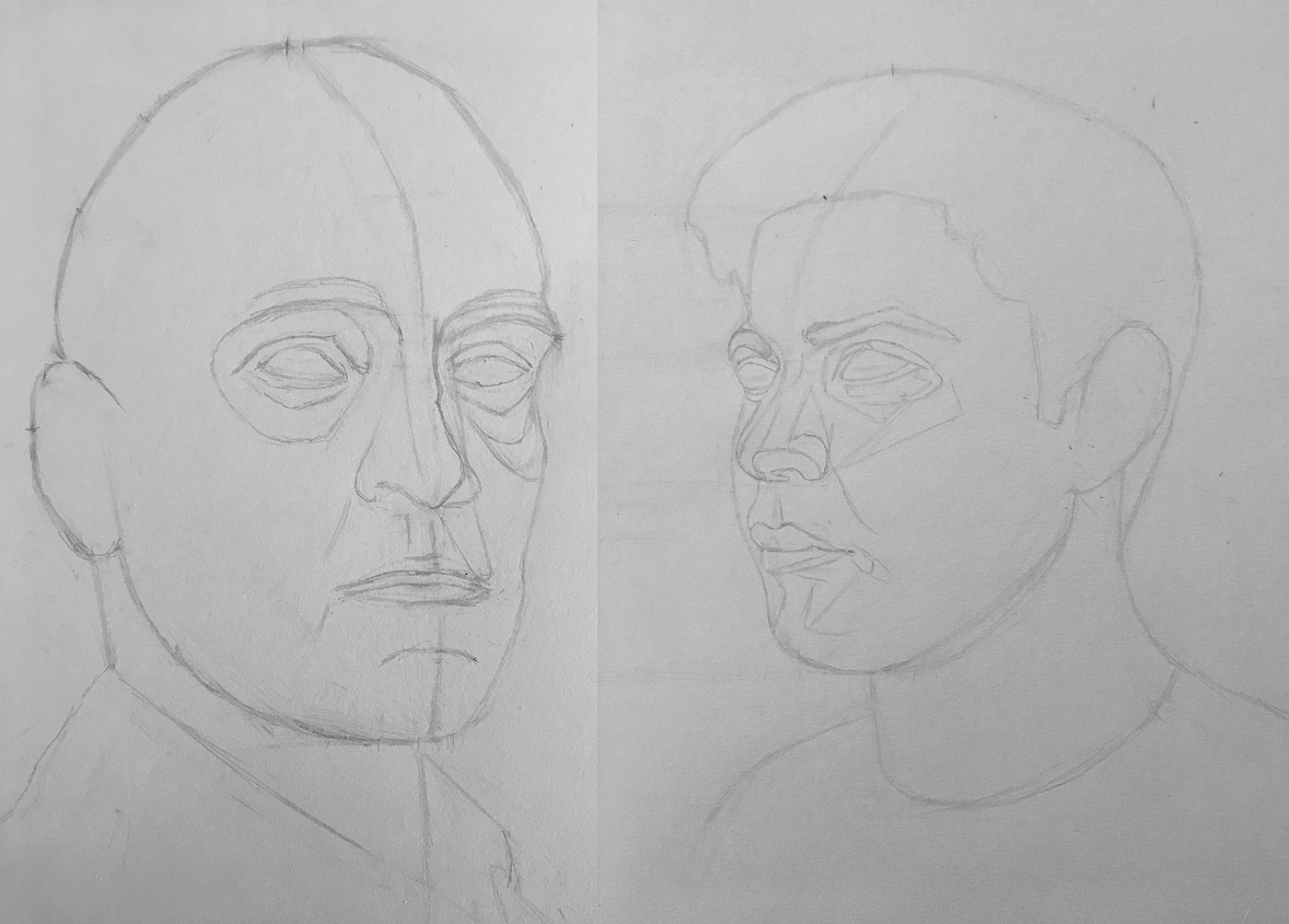
Once again, I recollect this is okay compositionally, but it's however a bit of a problem — particularly, for two reasons.
- A smaller drawing offers smaller margins for mistake. If I slightly misplace the corner of the mouth or the height of the brow, the distance between the correct and incorrect placements represents a proportionally larger difference on a smaller drawing. In other words, smaller drawings are less forgiving and errors are more pronounced.
- A smaller drawing means effectively details. My pencil sharpener doesn't seem to work very well with the pencils I have, which means I'thou drawing the tiny eyelids on my self-portrait with a tree trunk. Basically, the smaller drawing requires that I work in effectively areas, which is challenging with the tools I have.
Still, I will persist, since, even with the sizing fault (and the associated challenges), I'1000 quite happy with the portrait so far.
In fact, challenges are probably a skillful matter (I hope). Ideally, they push me to become a improve artist.
Anyhow, I call up the takeaway is that I demand to invest in a amend pencil sharpener…
Today, my self-portrait progress is cleaved into two parts:
- Finishing the sketch
- Defacing the sketch (a.k.a. calculation tonal values)
Finishing the sketch
Yesterday, I was able to sketch near fourscore% of the portrait. Today, I just demand to add together the final details.
I beginning past blocking in shadow areas near the mouth, on the brow, and on the neck.

And so, I darken the hair and eyebrows.
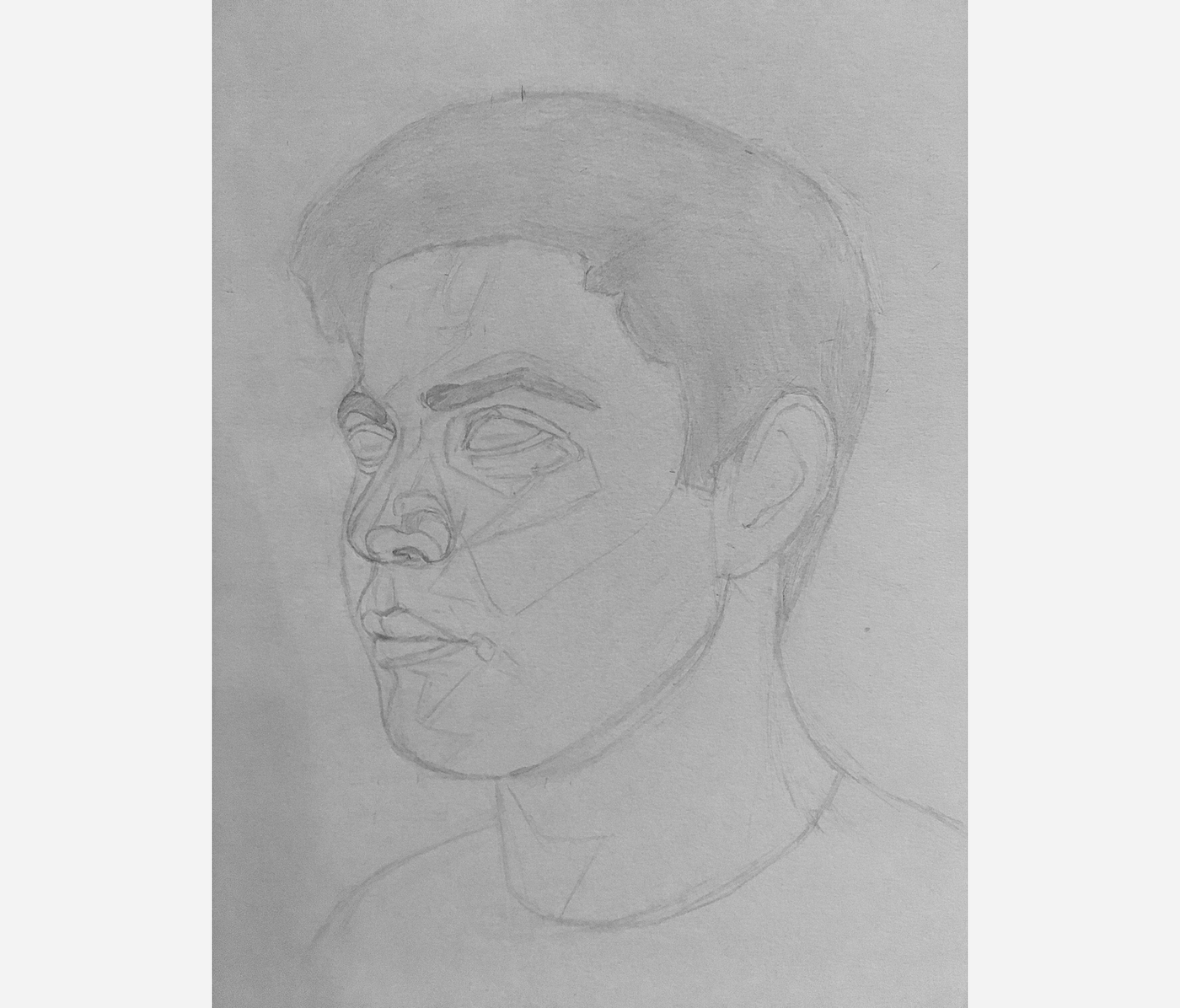
I add detail to the optics, and the portrait jumps to life.
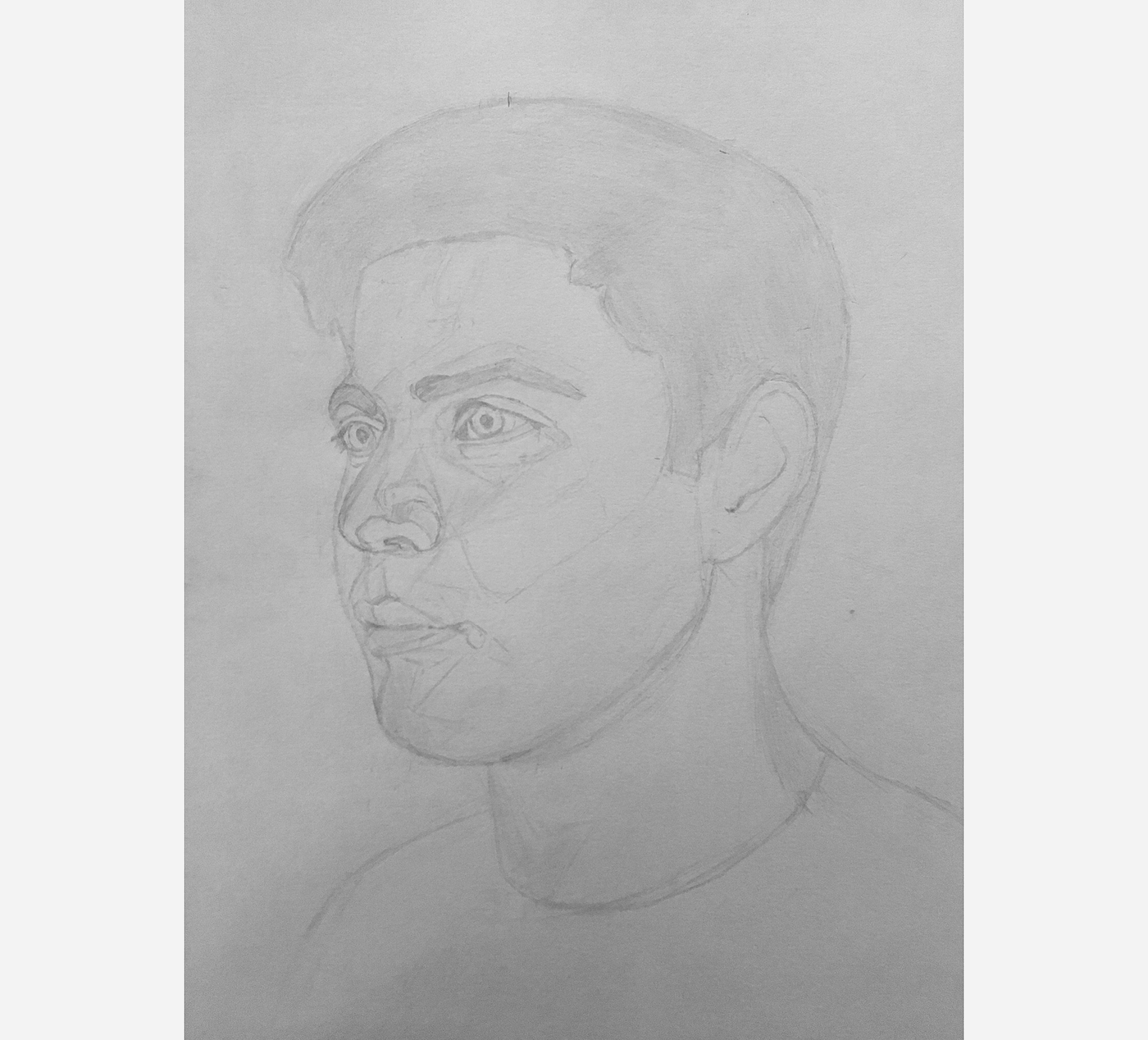
Finally, I detail the ear, which is one of my favorite parts of the whole process. (Ears are just weird looking and fun to draw)
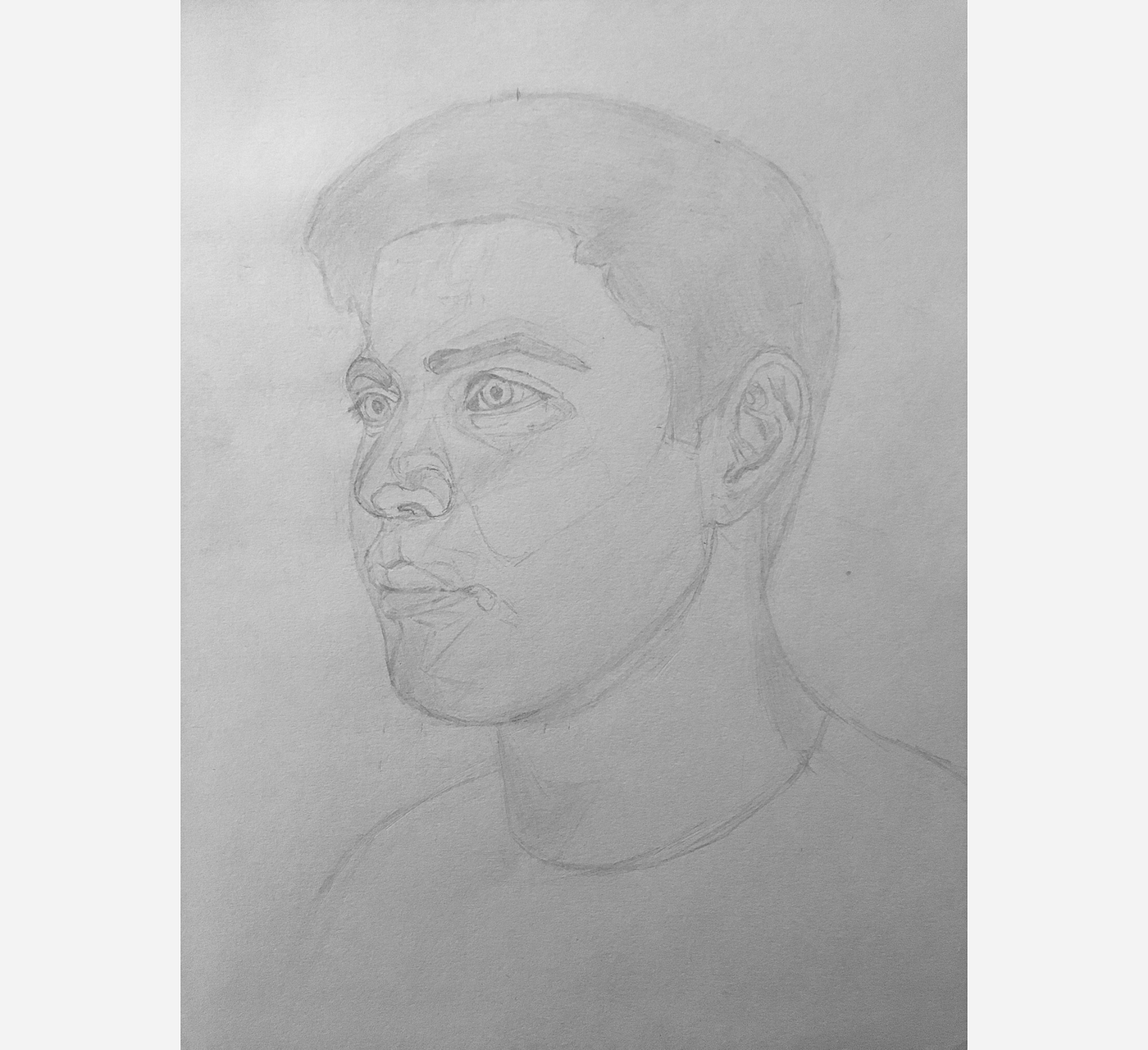
With the ear done, my sketch is complete.
Interestingly, this abyss is a fleck problematic: Because the sketch feels whole (and, from my perspective, represents an interesting, standalone piece of art), I struggle to proceed working on it.
The portrait merely feels balanced at this bespeak. Every bit soon as I get-go adding tonal values, that residual will be disrupted, and won't return until I'm nearly done with the whole portrait.
It almost feels unnatural to add together tonal values to the sketch, as if I'grand defacing something I worked difficult to create.
Nevertheless, I must continue. So, hither I go… Fourth dimension to temporarily deface my work.
Defacing my portrait
I start by blackening one of the eyebrows. This is easy, and hopefully volition help me build momentum.
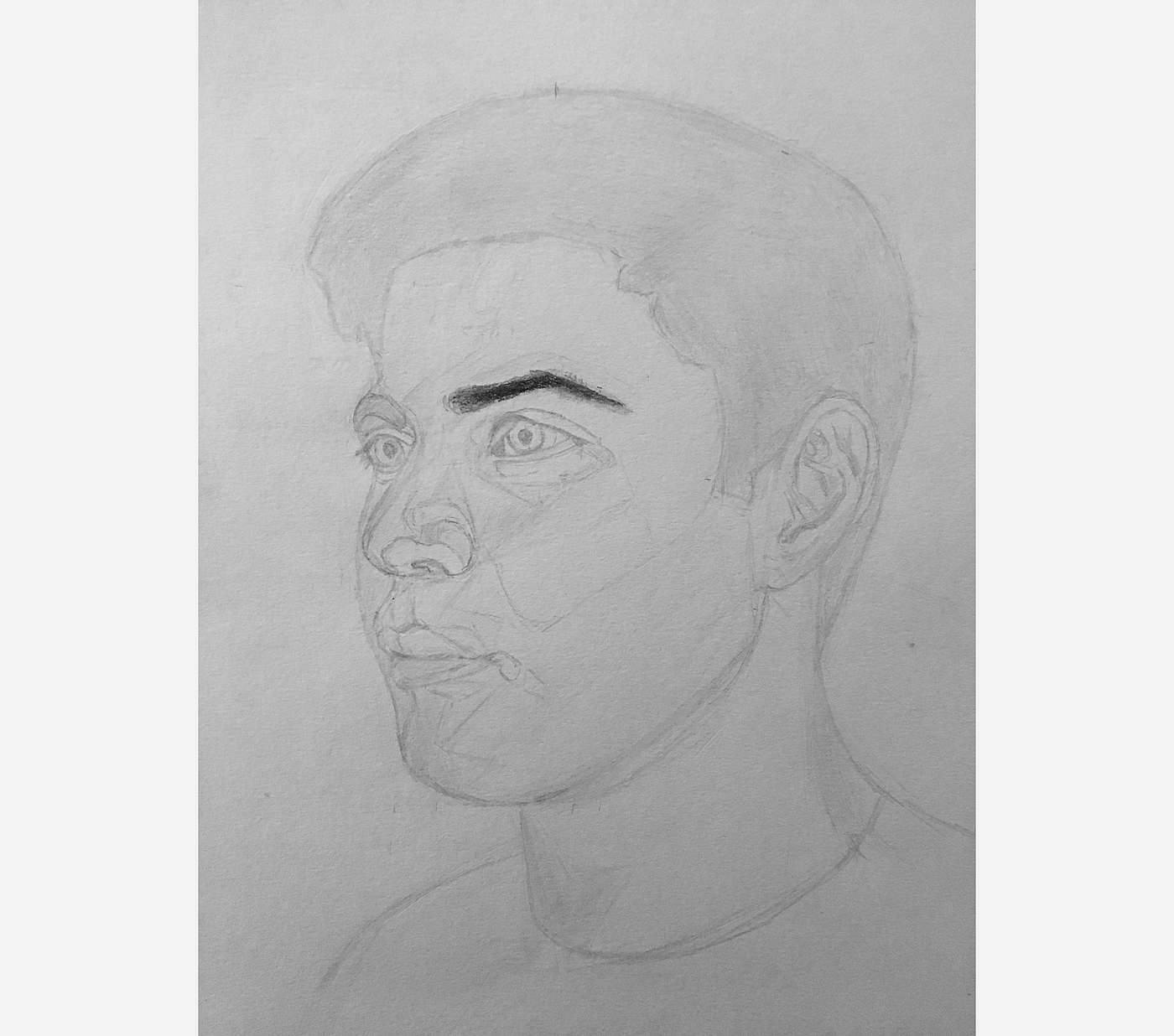
I continue with my black pencil, darkening the other eyebrow and the hair.
I can't seem to hands get the hair to be one smooth black mass. Instead, the grain of the paper is very noticeable, giving me a dainty salted look. Even after ambitious blending with a blending stump and a dry out brush, I however can't get the material distributed nicely on the paper.
I may need to invest in some powder graphite (but I'll return to this later).
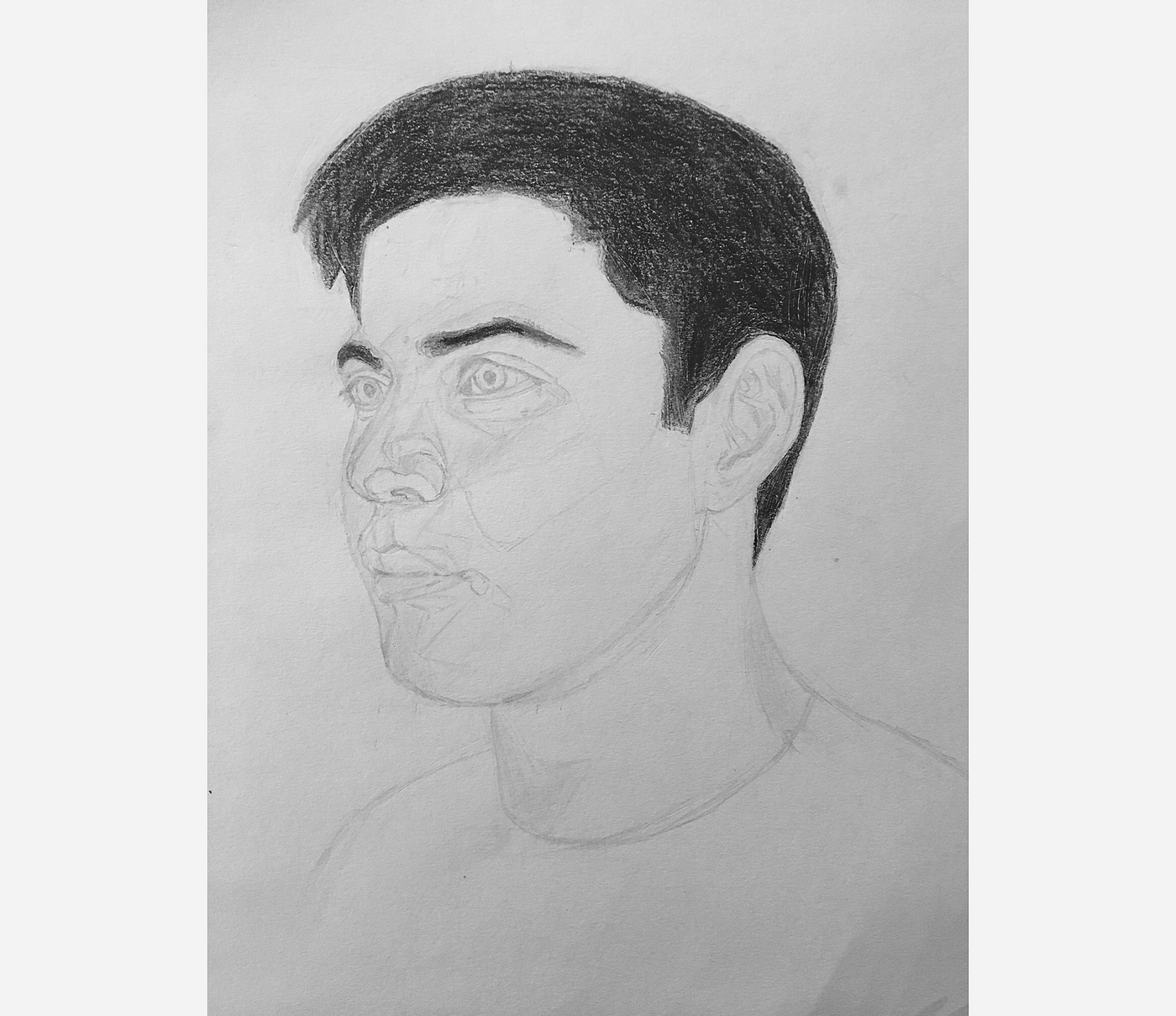
Next, I first on the prominent eye. This is where the real defacing starts, as it'southward going to be a while until information technology doesn't look similar I'thousand wearing makeup.
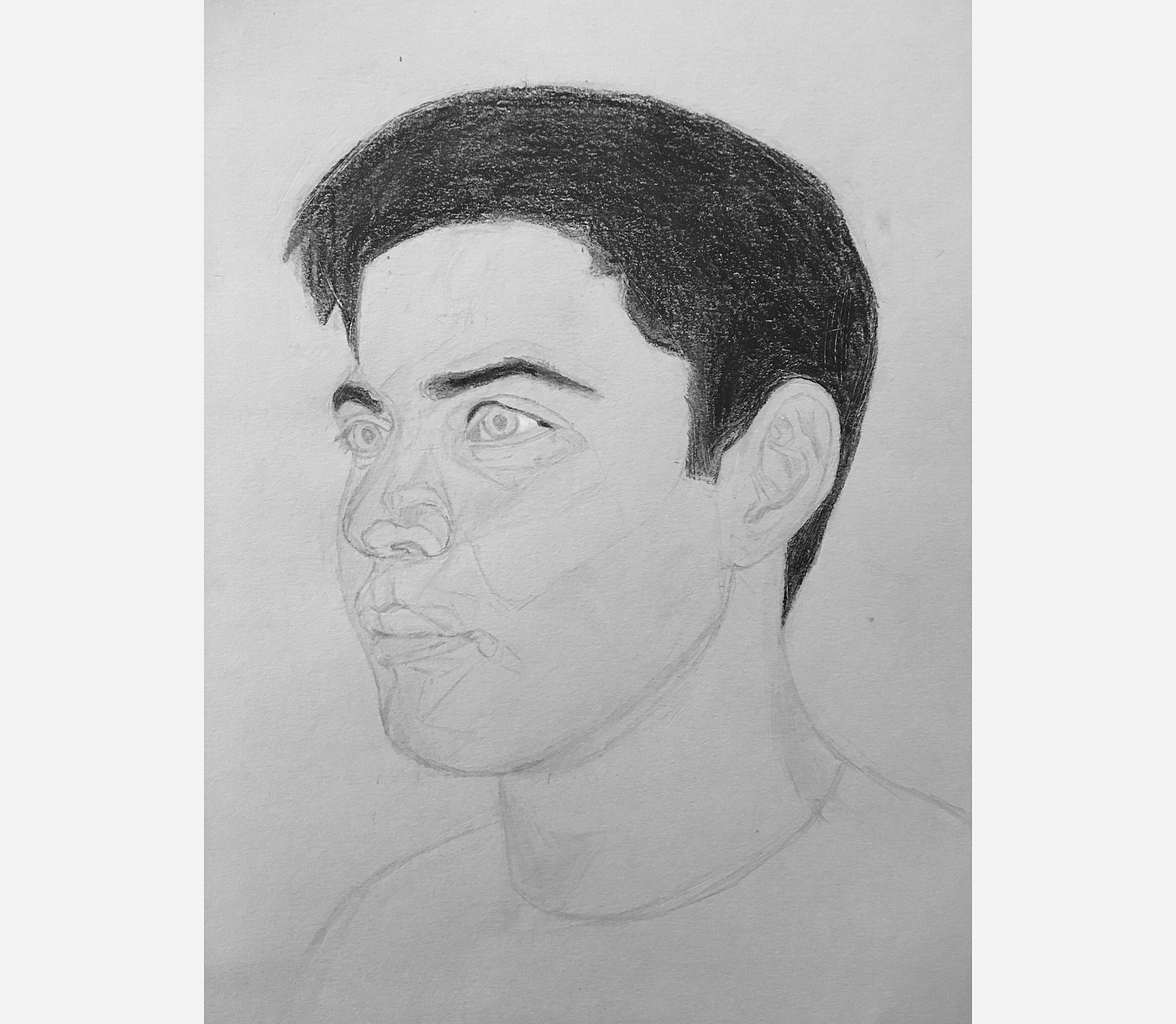
After many more minutes of work on the eye, I stop for the night. I'll go along more tomorrow.
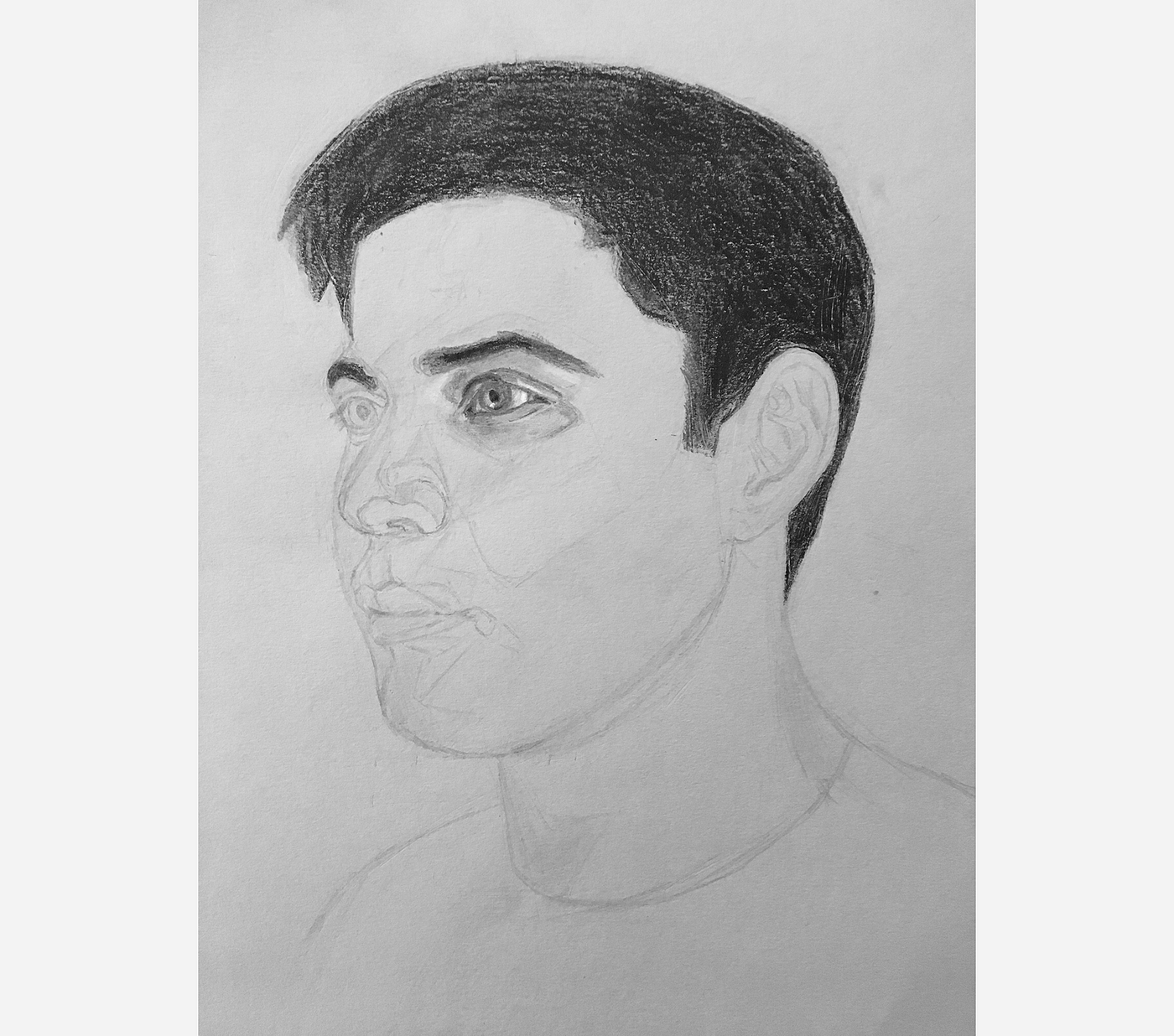
Today, I spent a couple hours working on the eyes and nose surface area of my self-portrait.
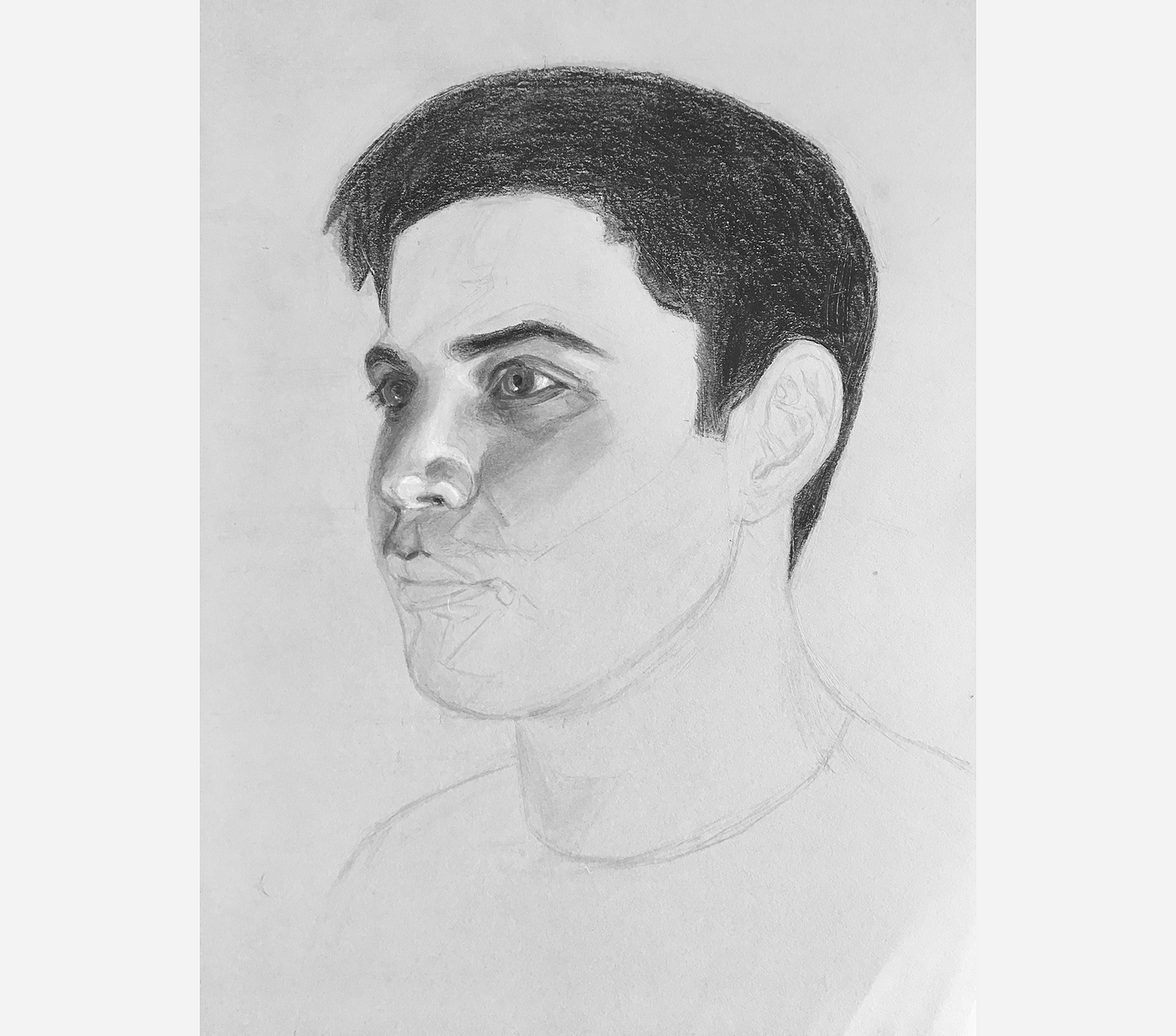
My tonal arroyo is noticeably dissimilar than that used on the Derren Chocolate-brown portrait.
With Derren, I wanted to ensure the portrait emanated three-dimensionality, so I pushed aggressively on the contrast of the portrait. I also didn't care much for the micro-gradations of shadow/light, as I was more concerned with the correctness of the bigger shapes.
Every bit a result, the portrait definitely has a stunning roundness, but I wouldn't phone call it photorealistic.
Thus, this time around, with my self-portrait, I'm aiming to more closely match tones, while too paying attention to the smaller areas of light autumn-off. With this attention, my promise is to create a more than realistic rendering of my confront.
It's nevertheless difficult to tell whether I'll be successful, but nosotros'll find out soon…

In most of my posts, I tend to exist pretty positive (i.due east. "Whoa, today went amend than expected…", "I'm really pleased with today'southward progress…", "I tin can't believe how skillful this is…", etc.).
This is generally because I'thou very bullish on this unabridged project.
However, in my past 3 posts (I made a mistake, Intentionally defacing my self-portrait, and Fighting for photorealism), I've tried to interrupt this tendency, and share some of the 24-hour interval-to-solar day challenges I face.
While I am still very positive virtually this project, and happily have on the micro-challenges, I thought sharing some of these things would exist more interesting than writing about how every day is always better than the last.
Anyway, standing with this theme, today, I want to share an interesting struggle.
The Calorie-free Situation in San Francisco
For some (possibly, legal) reason, most apartments in San Francisco don't accept overhead lights in their chief living areas. Usually, apartments only have overhead lights in the bathroom and (sometimes) the kitchen, which is the case for my apartment.
As a result, the balance of my apartment is lit via Ikea floor lamps, which, although they do a xc% good job, it turns out, at nighttime, there's just not enough light for detail-oriented drawing.
During the sketching phase of my self-portrait, I didn't need to see precise tone, and so sketching at dark was no problem.
However, now that I'm trying to advisedly model the lights/shadows of my face, I need more light.
I considered drawing in the bathroom, just this isn't entirely comfortable. Especially considering I was worried that the portrait would get wet/damaged on the sink, whose counter is the about viable drawing area.
Since, without deconstruction, the kitchen tabular array doesn't fit through the bathroom door (I tried…), I needed to discover somewhere else to work tonight.
I concluded up beyond the street from my apartment at a well-lit coworking space, which was great for drawing, but not-and then-dandy for picture-taking. The abundance of overhead lights meant that, however I positioned my trunk, I was always casting a shadow on the portrait.
Thus, in one case I finished drawing, I came back to my dark apartment to snap a photo.
After my light-seeking adventure, hither'south what I was able to attain.
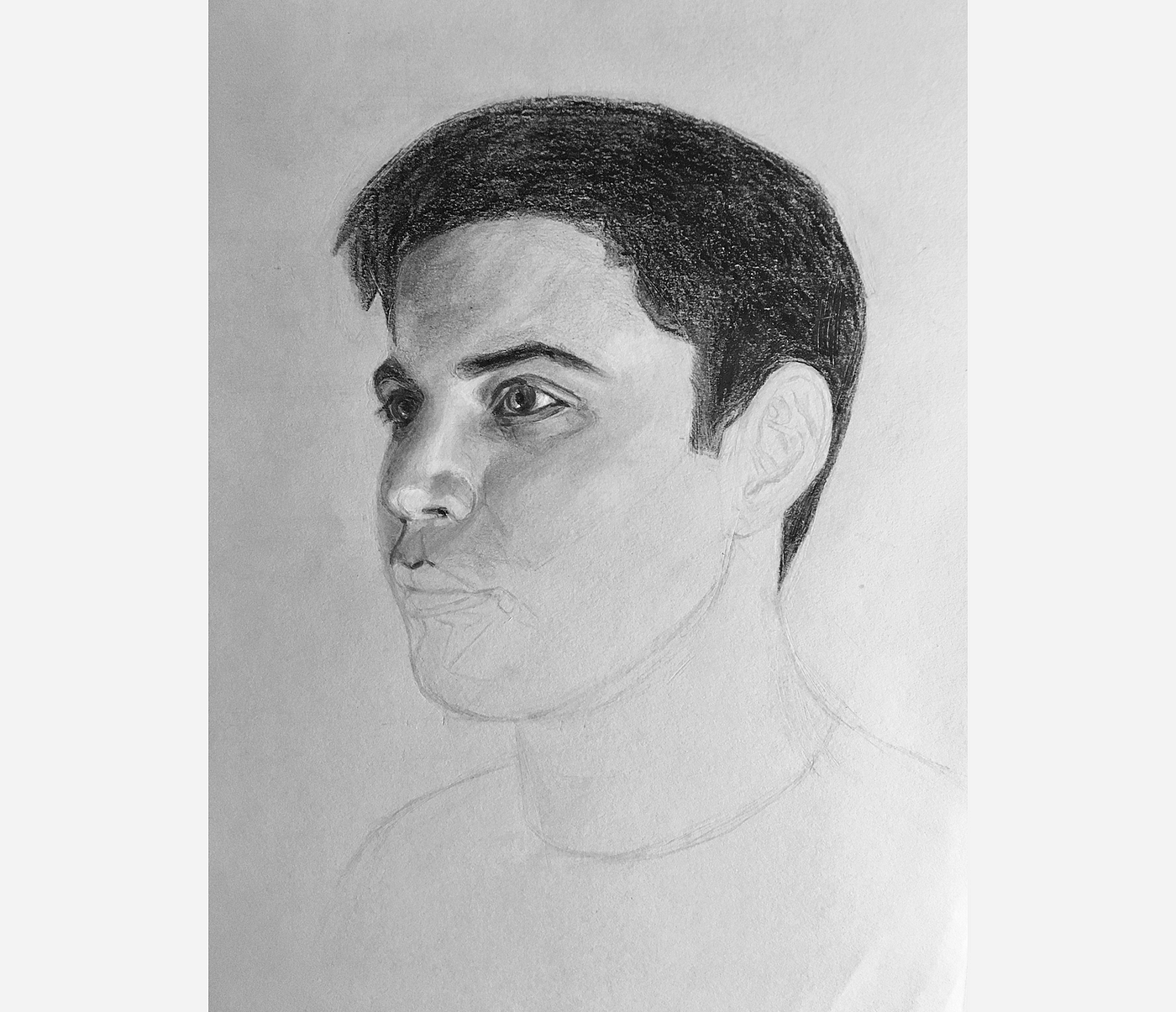
Today, I only had x minutes to draw, so I spent all 10 darkening the hair and eyebrows on my self-portrait, until they were as blackness as I could get them.
This greatly improved the portrait in two ways:
- The relative tones of the face to the hair are much more accurate now, which helps with realism.
- The shape of the pilus on the left side of the portrait wasn't quite right, so this gave me the chance to ready it.
Here's the before…
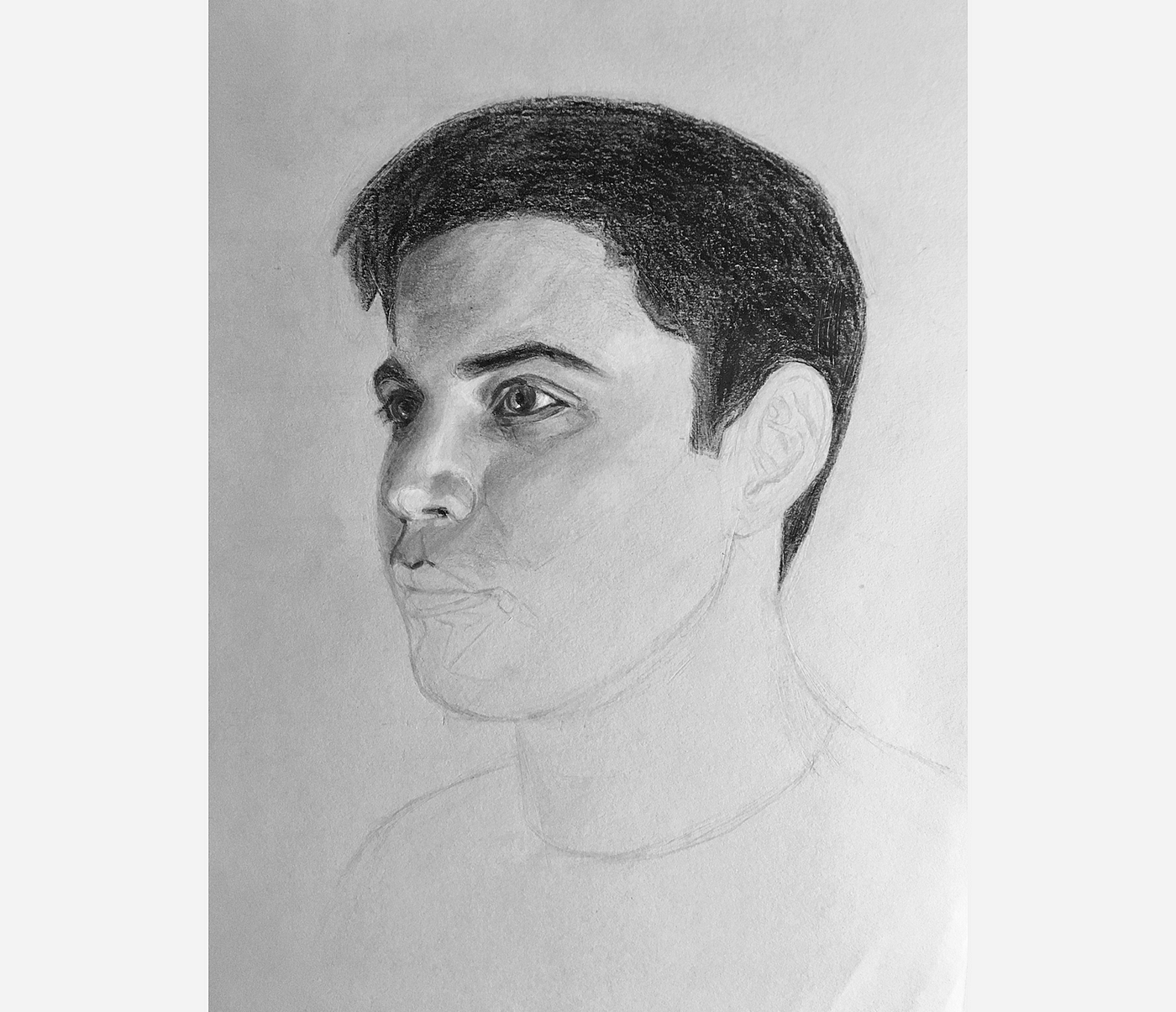
And the after
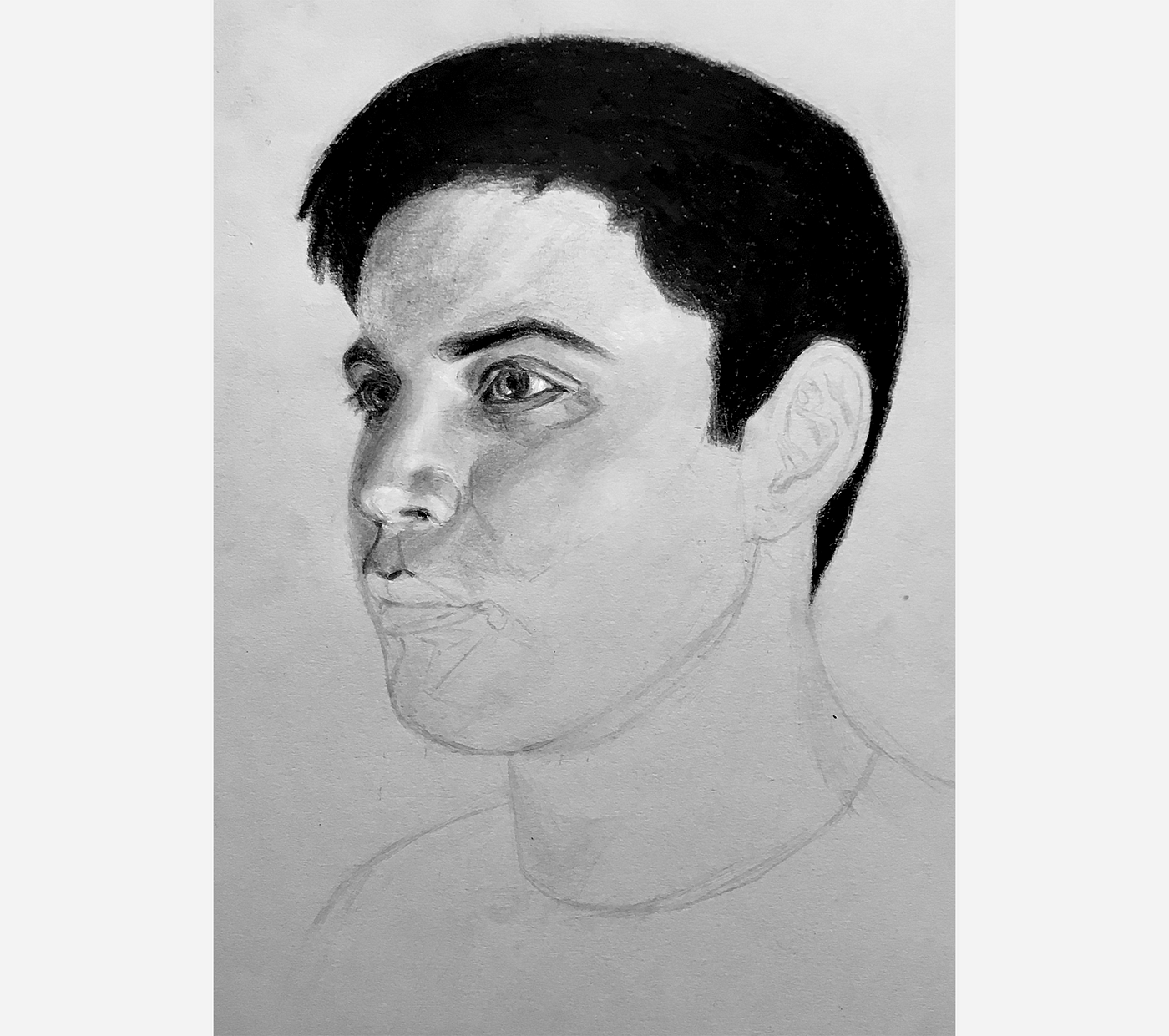
At start, the blackness of the pilus is a bit jarring, simply it accurately represents the "exposure" I'm going for (where the pilus is emitting no lite, and thus, shows up every bit pure black).
Although today'due south darkening session improved things, the portrait notwithstanding seems a flake odd and unbalanced considering of the nakedness of the mouth and cheek. I'll showtime tackling those areas tomorrow.
Yesterday, I declared that today I would get-go working on the mouth and cheek areas of my self-portrait. And yet, somehow, the day is over, and the mouth and cheek areas are still naked.
Instead, I got caught up making micro-changes to the parts of the portrait I've already worked on (the eyes, nose, forehead, etc.). It seems I tin make small improvements forever.
This is clearly not the right approach. Especially because… Every bit I brainstorm shading the mouth, I volition need to make adjustments to the olfactory organ area, so everything fits together. As I begin shading the cheek, I volition demand to make adjustments to the eye area, so everything fits together. And and then on.
Perhaps, I'thou only stalling out of fear: One time the rima oris and cheek are adult, I'll take a much ameliorate idea if the portrait is any good.
If I am fearful, I definitely need to become over it.
To do so, tomorrow, I'll focus, not on perfectly detailing the mouth and cheek, but instead, broadly blocking in the right tonal values.
With the full general tones in identify, I'll have enough momentum to push the portrait towards completion.

Today, I spent an hour developing out the rest of my self-portrait.
Information technology went from looking similar this…
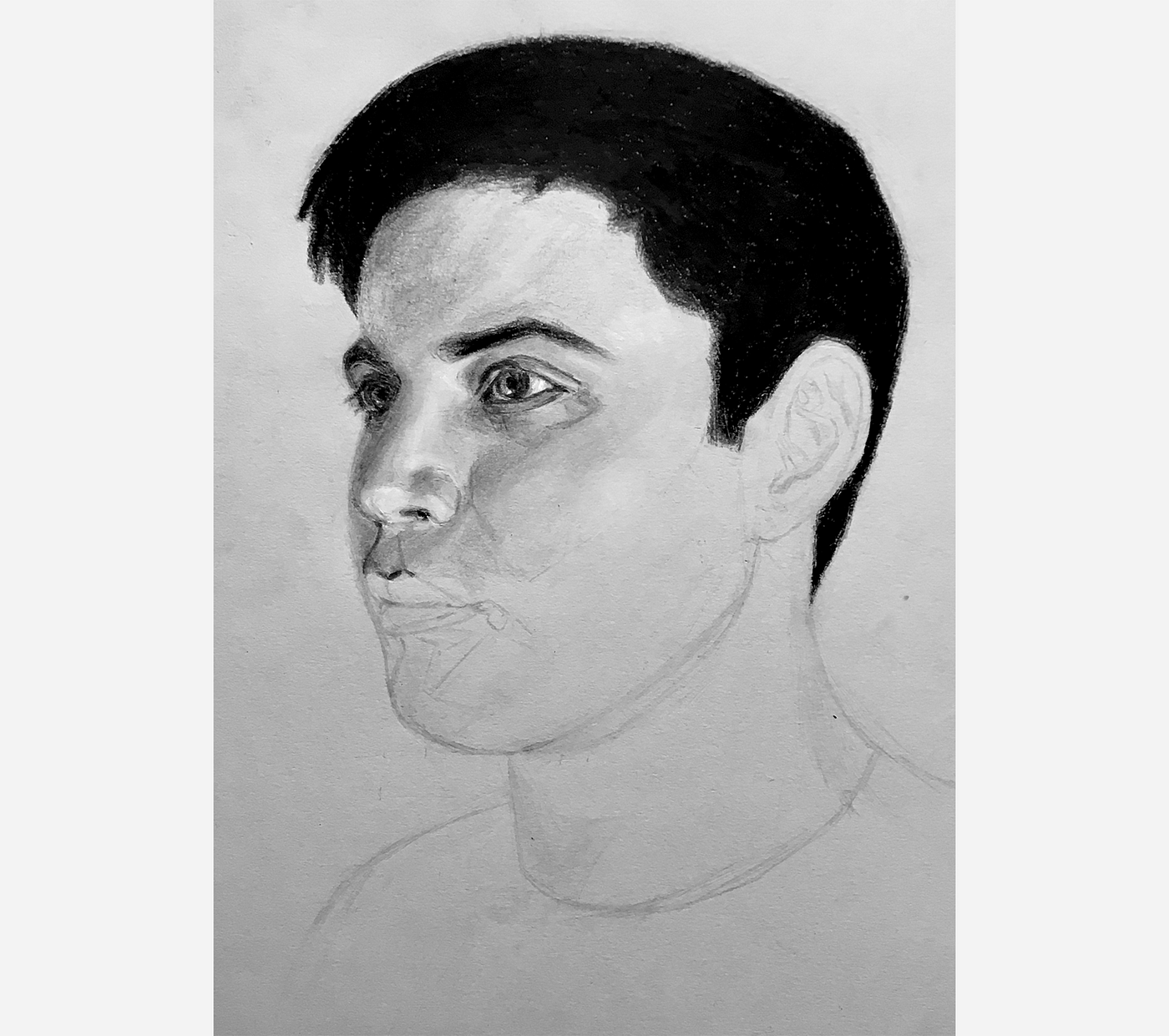
To looking like this.
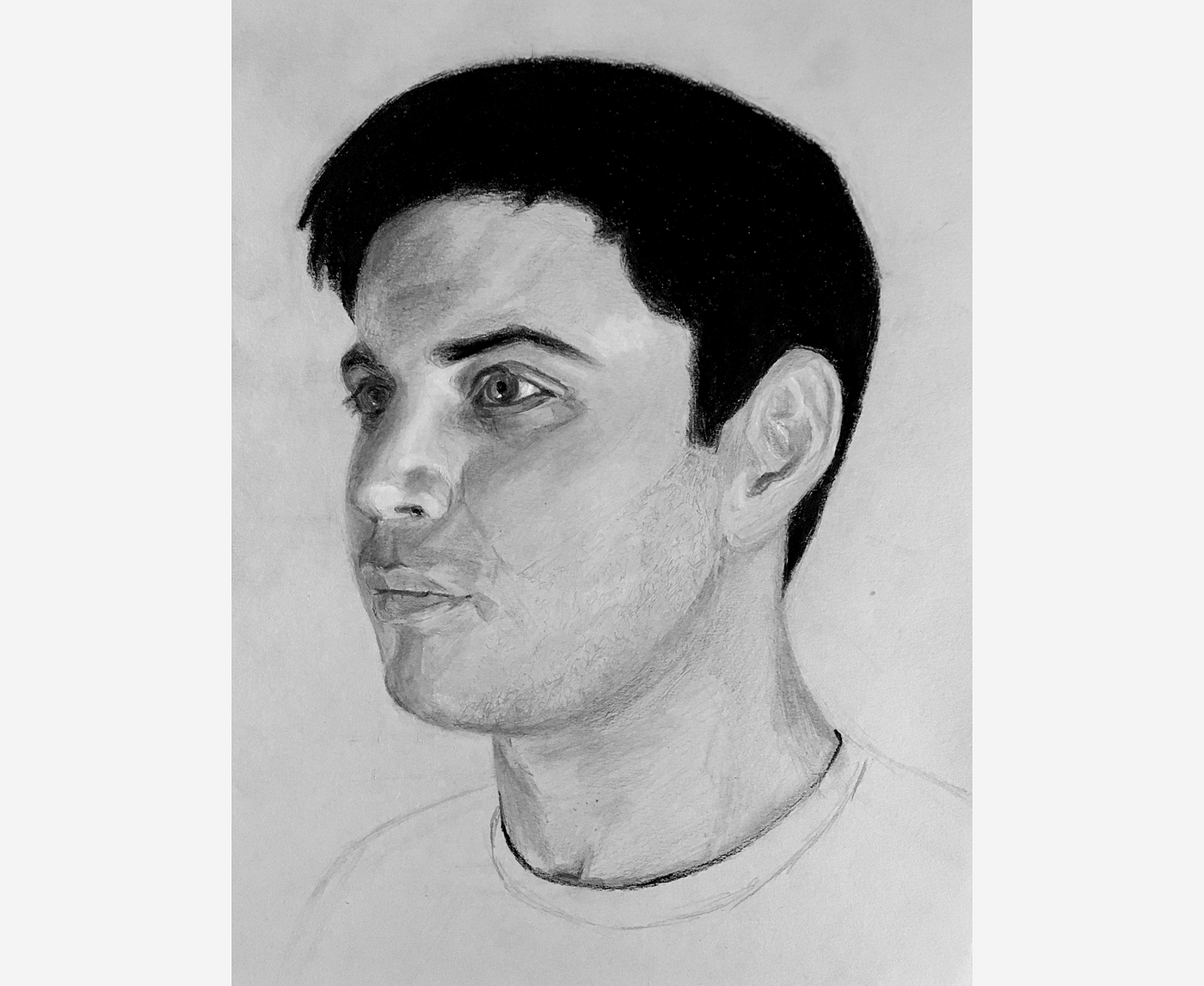
Information technology'southward starting to wait similar me, merely it still looks similar a cartoon — mostly considering I haven't blended the newly developed areas like the cervix, cheek, mouth, ear, brow, etc. Pretty much the whole thing.
I've been holding off on the blending because my blending stump is unusably dirty.
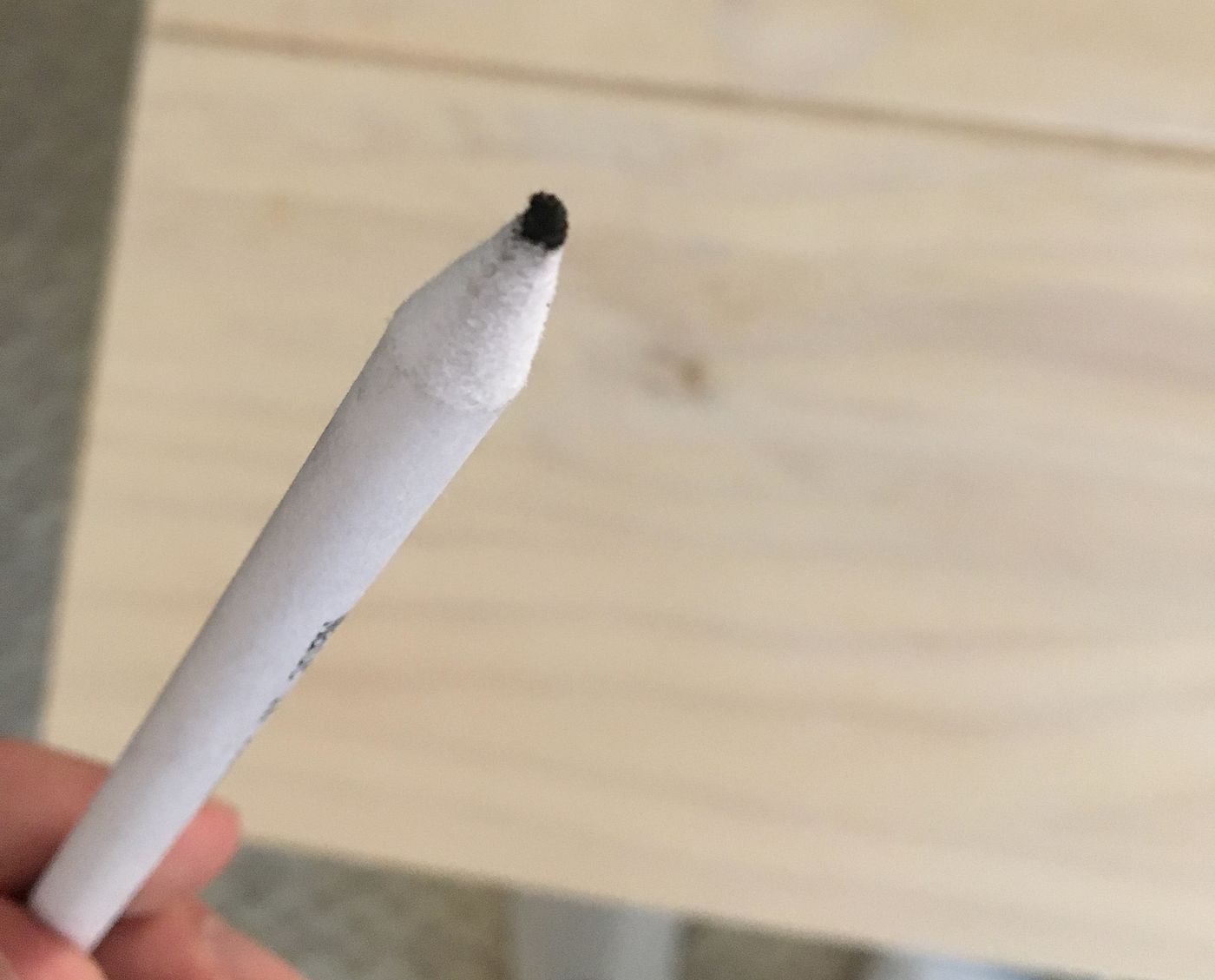
Tomorrow, I'll go swing past the art store and option up a few fresh ones.

I picked up some new blending stumps today, and went to work smoothing the value changes over my face and neck. Here'south the event…
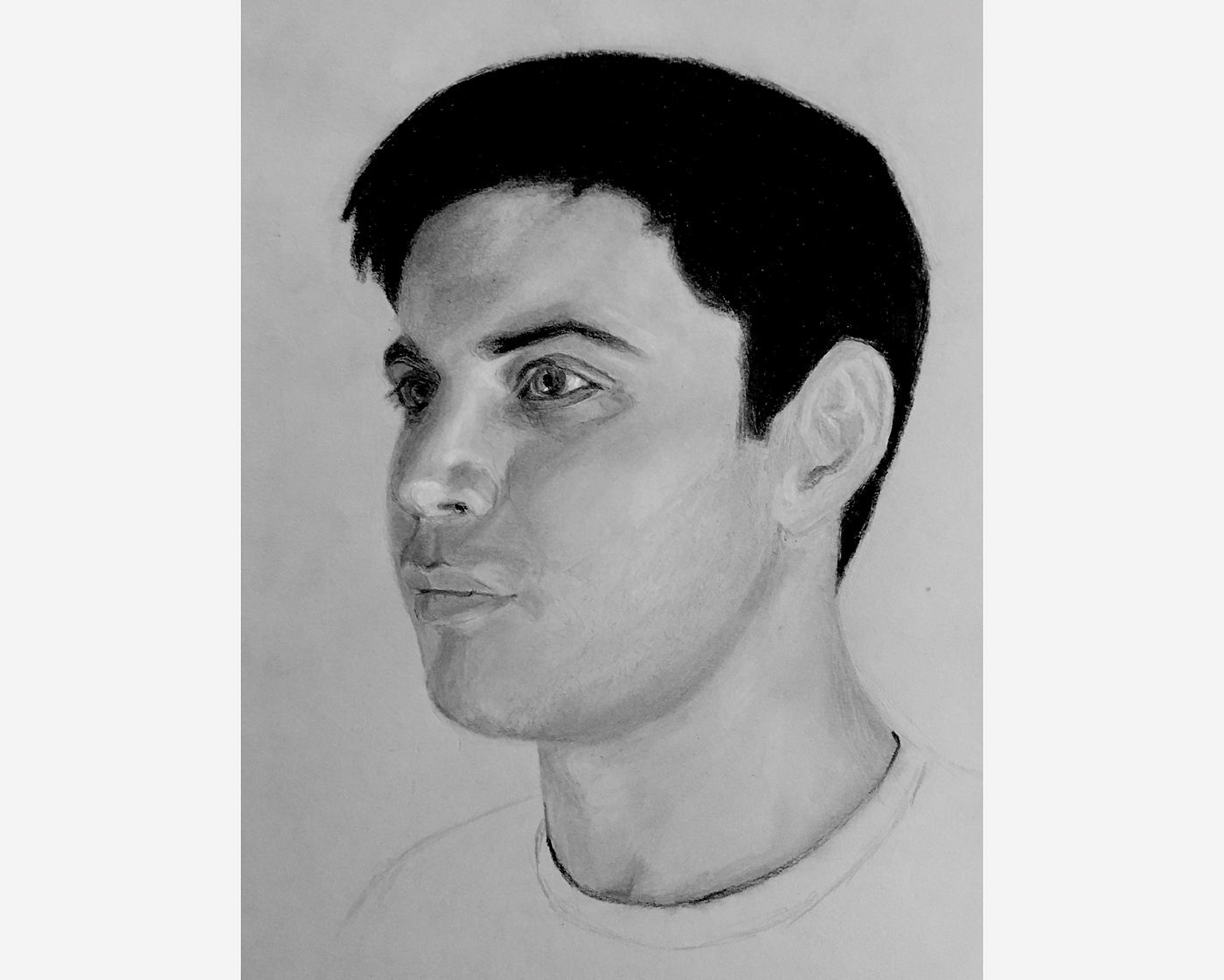
When compared with the before, the difference is pretty striking. In the before portrait, I look like a sickly, pencil-sketched version of myself, while the after version has a much nicer roundness and weight to it.
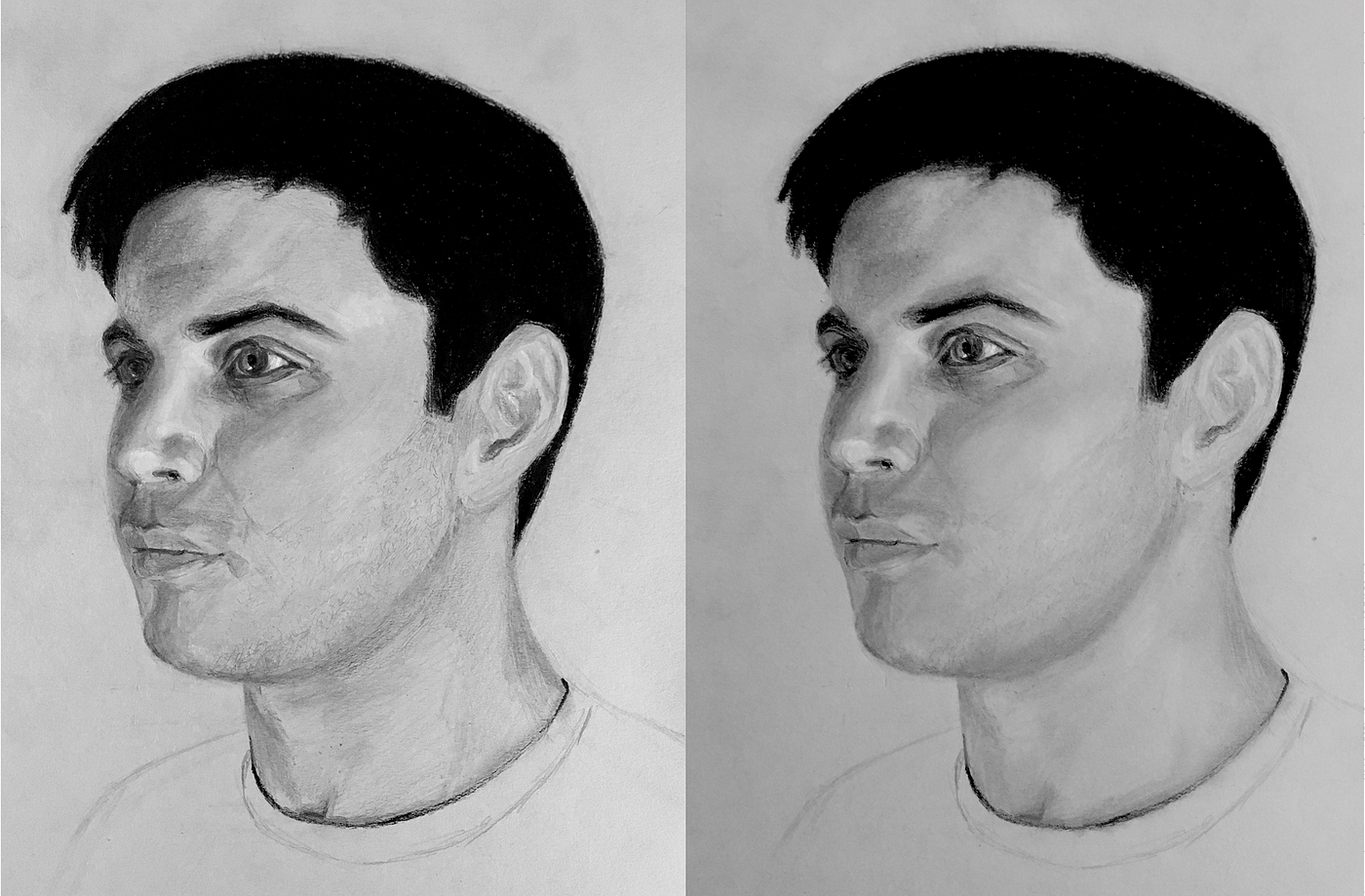
Tomorrow, I'll make some minor tweaks, sign it, and hang it on the wall.

24 days agone, to kick off December's challenge, I tried to draw a self-portrait.
Then, over the next 3.5 weeks, I completed a ten-60 minutes drawing course, drew a few other people, and so spent 8 hours on a new cocky-portrait.
Here are the before and afterwards.
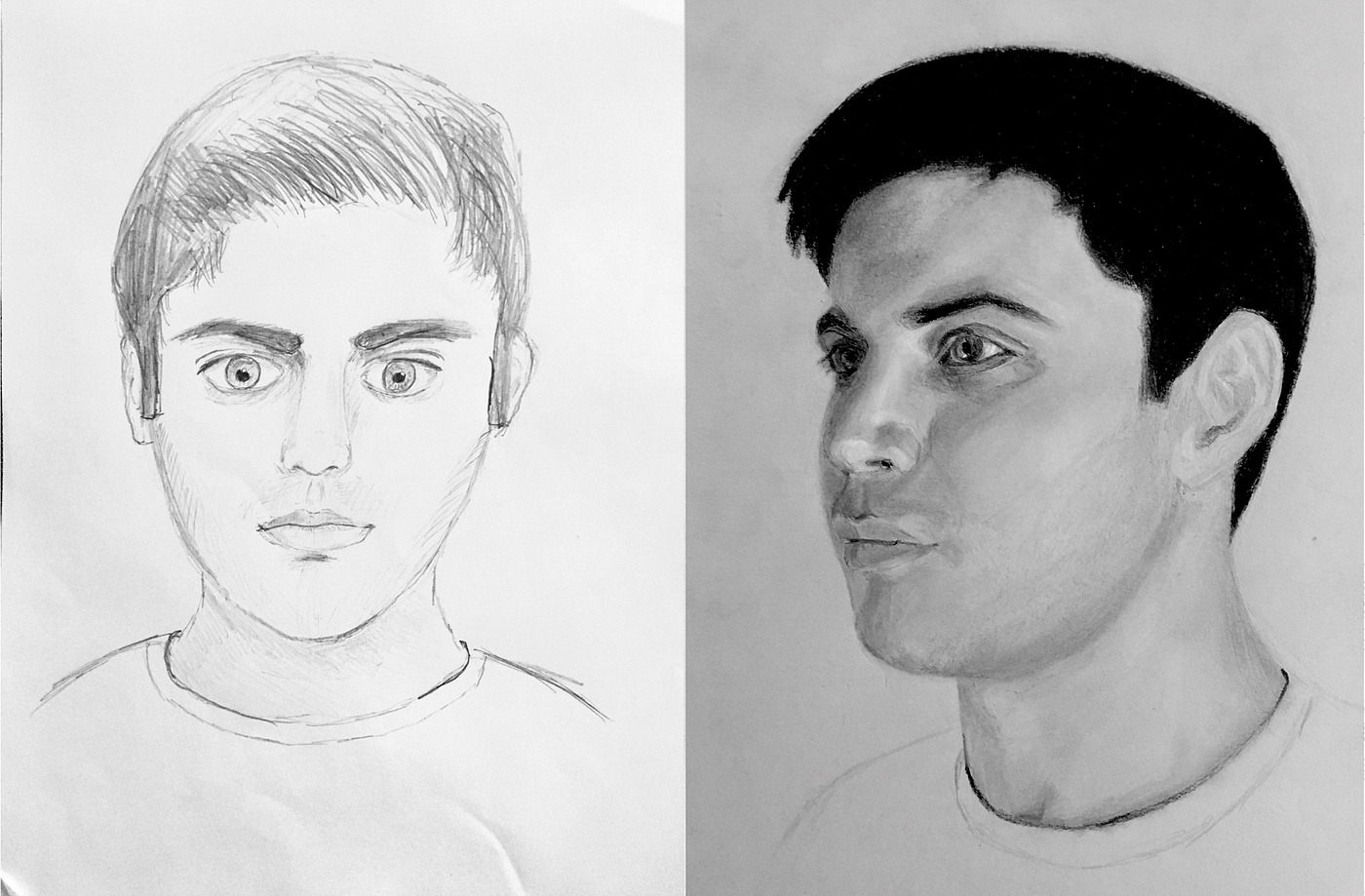
And here's a fourth dimension-lapse of the 8 hours of drawing.
I'thousand happy with the result, and actually think the cocky-portrait looks a lot like me.
Tomorrow, I'll write upwardly a more than thorough critique. But until then, I'm declaring this month's challenge a success.
Yesterday, I declared this calendar month'south challenge a success, noting the differences between my before and after self-portraits.

And while my most contempo self-portrait is a major improvement, and does look very much like me, I still do have some quick critical thoughts on it, which I've cleaved down into ii parts: 1. Likeness and ii. Artistry.
1. Likeness
- Overall, the likeness is strong. The portrait unequivocally looks similar me. Although, information technology isn't perfect.
- My expression/emotion in the portrait is plausibly mine, peculiarly in the optics.
- The shape of hair near the ear and back of the head is very authentic. However, the hair line doesn't seem completely correct, and it'due south probably the second biggest reason why the portrait doesn't look perfectly like me. The hair line should probably come down on the forehead and should be less rounded. When I snapped a photograph of myself (on which I based this portrait), I had but gotten a shorter-than-normal haircut, which is probably why I'm not used to the haircut I drew.
- On newspaper, I feel I captured the nose perfectly, simply, equally a result of the shadow, information technology may seem slightly too small-scale/short. To accost this, I could have accentuated the tonal difference between the cheek and the shadowed part of the nose, but I wanted to remain as tonally accurate as possible and chose not to.
- I'm very happy with how the cervix turned out. Its weight and main features (the Adam'due south apple tree and the notch at my collar line) seem accurate.
- There is something odd near the ear. It seems a flake out of place.
- The eyebrows may be the slightest bit sparse, merely they are very close to reality.
- The biggest potential miss is my cheek. While I do have prominent cheeks when I smiling (which I'm not doing here), I too have a fairly slender face and a reasonably defined jaw. Depending on how I look at the cheek, information technology sometimes appears too circular and likewise full. Other times, when I wait at the portrait, my centre renders this area properly. If anything, I probably could accept fabricated the lesser of the face (in the rolling shadow) a fleck more angular.
Nevertheless, even with these critiques in isolation, the portrait every bit a whole comes together nicely and captures a strong likeness. Thus, I've left it equally is, since I care more nigh an overall likeness (versus a non-cohesive collection of individually accurate features).
two. Artistry
Before I drew my self-portrait, I drew a portrait of Derren Brown.
This portrait has two big advantages over my self-portrait: 1. The tonal range over the face up is much greater, and 2. The midtone of the face matches the tone of the paper.
With my self-portrait, I strayed from both of these advantages. For ane, on purpose. For the other, less and so.
one. Narrow tonal range
Purposefully, I chose to base my self-portrait on a photo with a tighter tonal range, since I wanted to challenge and button my abilities (Cartoon a portrait with heavy contrast requires less subtly and is, in my opinion, easier).
Arguably, the dissimilarity of the Derren Brown portrait makes it a more visually compelling portrait, simply this is another topic completely (get-go, I wanted to chief accurate portraiture before tackling well-composed portraiture).
Fifty-fifty with the narrow tonal range, my self-portrait withal maintains a conceivable roundness and depth.
2. Dark midtones
Less purposefully, I chose a photograph where the midtone of my confront was darker than the paper.
This was a bit of a fault, just a good learning opportunity. As a effect of this decision, unlike with my Derren portrait, I had to pencil-shade the mid-tones on my face, leading to a slightly dirtier portrait. (In the example with Derren, where there were midtones, I left the blank paper untouched and clean).
Especially before I smoothed out my confront, information technology looked equally if I had just been cleaning chimneys.
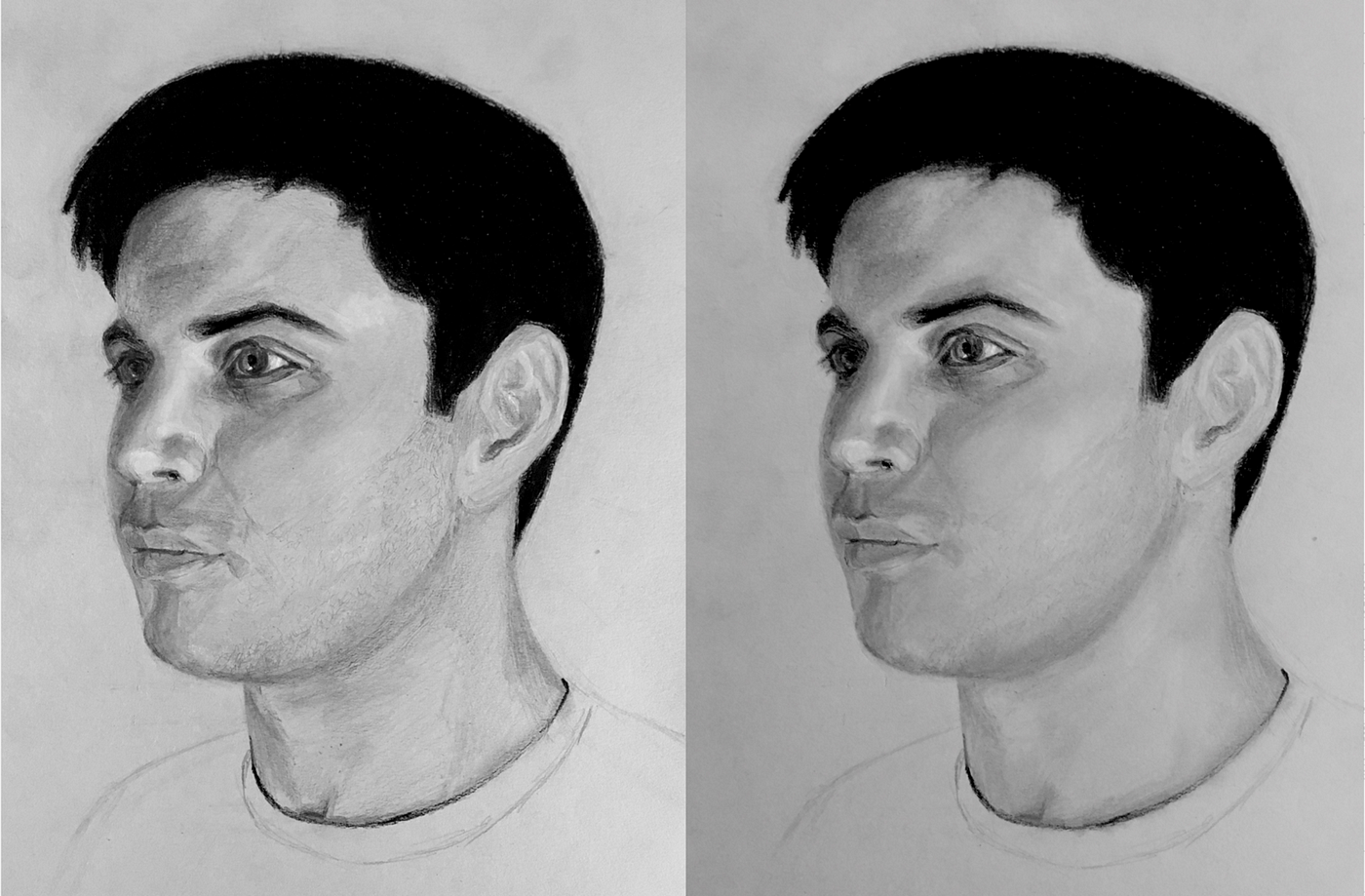
While the Derren Brown portrait (with its ultra-contrasty tonal range) may be a more than dynamic portrait, my self portrait seems closer to photorealism, which is the main improvement I was aiming for.
Overall, I'm very happy with the result.

After spending nearly a month learning to draw portraits, I'm more than convinced than ever that anyone can draw. Fifty-fifty if you don't take whatsoever artistic talent.
To me, drawing is a flake like doing your laundry. Before y'all do it for the starting time fourth dimension, yous experience it's much more than complicated than it really is, and thus, you experience incapable of trying. So, you're shown that doing your laundry is only a matter of putting your clothes in the machine, pouring in some lather, and clicking a button. Much easier than yous idea.
Information technology turns out drawing is very similar. From the outside, it seems much more complex than information technology actually is. Nonetheless, in one case you learn the two or three basic principles, drawing (at least, at my level) becomes nearly as straight forward as doing your laundry.
In fact, in lodge to draw a reasonable portrait, you only demand to know the two post-obit skills:
i. Triangulation
2. "Outside-in" Shading
In one case you're equipped with these ii techniques, you'll be ready to follow the "Portrait Cartoon Crook Sheet" and draw your first portrait.
You'll exist surprised at how well it goes. I know I was…

Every bit I mentioned at the commencement of this month, British illusionist Derren Chocolate-brown originally inspired me to beginning drawing portraits. In fact, to admit this inspiration, Derren was the subject of my first portrait.
Even so, Derren didn't inspire me with his drawings, but rather, his paintings, similar these…
Of course, these paintings are congenital on a prerequisite foundation of drawing, merely they as well introduce a whole new skill fix that I would dearest to cultivate.
Watching Derren paint, it seems like in that location are clear parallels between shading a drawing and painting a portrait: He sets a mid-tone color, adds the lights and darks, works his fashion towards the centre, so adds detail.
There are also clearly major differences, similar evaluating and mixing colors, general painting hygiene (letting pigment dry, etc.), and all-time practices I'm probably not nonetheless aware of.
And while this seems like a major bound from my drawing studies, I now have the creative conviction to attempt a painting like this, without whatsoever (or very little) additional instruction.
In the coming months, I plan to start sketching a portrait on canvass, and then experimenting with paint.
Last month, I memorized a shuffled deck of cards in under two minutes, which required obsessive, consistent practise. If I were to stop practicing, over fourth dimension I would lose this skill.
However, I don't call up the same is truthful for my newly-found cartoon skills. By and large because… I didn't larn anything new this calendar month.
Well, that's non exactly right. While I didn't cultivate any new drawing-enabled motor skills or creative skills, I did learned to structure my already-existing skills inside of a better drawing process.
In other words, if I can think the process, which, in my stance, just depends on two very straightforward insights, I will always be able to depict at the level I tin now.
In 20 years, even if I don't practice from now until so, every bit long as I tin remember triangulation and outside-in shading, I will be able to fully replicate my results from this month.
I recollect that's a pretty cool thing, and then expect out for my Medium post in 20 years.
On December 1st, I drew this.
26 hours of practice subsequently, I drew this.
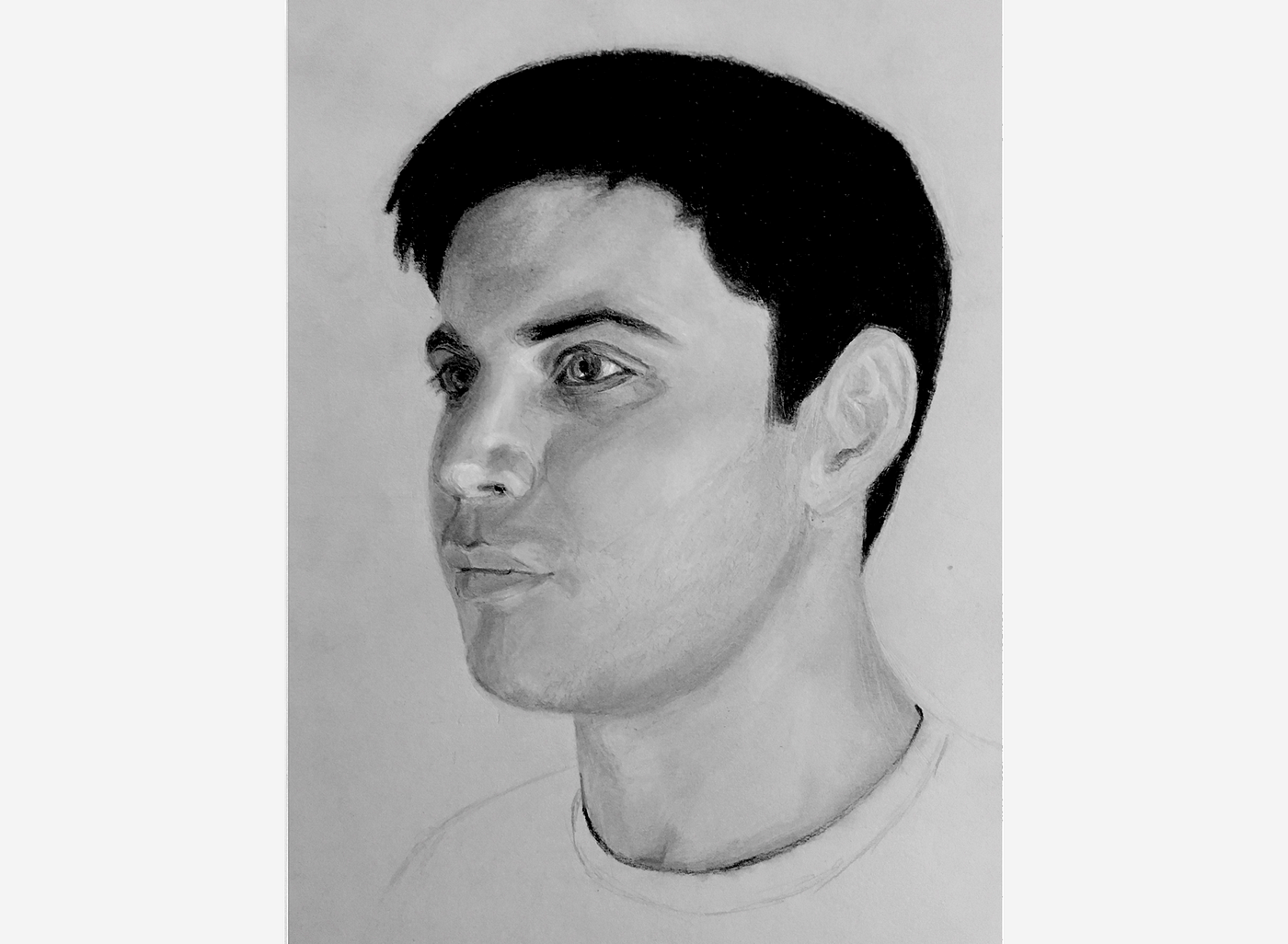
In other words, afterward practicing for about an hour per day for 26 days, I majorly improved my portrait drawing skills.
Last month, information technology merely took me 22 hours to become a grandmaster of memory.
I think this is going to exist a theme for the unabridged Month to Primary project: If my practice is deliberate and consistent, it's going to have a lot less time than expected to principal these seemingly good-level skills.
The trick, then, is to create a mechanism to forcefulness deliberate and consistent exercise month later on month. This is the difficult part about learning these new skills, non the time required.
Something to recall virtually every bit you start planning your 2017 resolutions…
Today, I flew from San Francisco to Florida to meet up with my family for a few days. I'll be here until Jan 4th.
I left all my cartoon supplies backside, so I'm definitely non drawing any more this month.
I did, however, bring a Rubik's Cube with me in preparation for Jan's challenge (which starts in two days).
I'm definitely eager to get-go a new challenge, since I similar the idea of ever being in pursuit of something (which perchance suggests that I need to learn how to relax). Nonetheless, instead, these past 2 months, I've finished both challenges on Day 24 (of the month), and thus, needed to await, without a claiming, for a week, until the adjacent i began/begins.
Should I only start the adjacent challenge once I stop the previous one? I'm not sure. On one manus, this seems reasonable and fourth dimension-efficient. On the other hand, there is something very tidy about starting on the outset of each calendar month.
Clearly, I have some amount of obsessive compulsiveness going on, but I'm curious to know what you think…
Should I await for the get-go of each calendar month to offset a new challenge, and enjoy my few days of relaxing (if available), or should I just use my extra fourth dimension towards future challenges and start immediately?
Let me know.
Today, to gloat the New Yr, I decided to compile my personal highlights from 2016, which includes Month to Principal, only as well everything else from my life.
Rather than writing some other M2M post today, I'll encourage yous to cheque out that post if y'all're interested.

This mail is part of Max's year-long accelerated learning project, Calendar month to Master.
Max Deutsch is the co-founder of Monthly — an online teaching platform that partners with some of the earth'southward biggest YouTubers to create one-calendar month, highly-immersive online classes.
If you lot want to follow forth with Max's twelvemonth-long accelerated learning projection, make sure to follow this Medium account.
For exclusive content on accelerated learning, subject field, and lifestyle design, subscribe to my once-in-a-while newsletter.

Source: https://medium.com/@maxdeutsch/how-i-learned-to-draw-realistic-portraits-in-only-30-days-3fb8e8eccee0
Posted by: hammittlever2000.blogspot.com
0 Response to "How To Draw A Human Face From The Side"
Post a Comment