

How To Draw A 6:1 Dovetail
It's the practicality daily woodworking brings: infrequent practicality!
A question is raised quite oft virtually dovetail sizing. Is at that place a formula woodworkers use, an industry standard? Because we don't always make them oftentimes enough nosotros can discover the problems surrounding sizing and proportion disruptive; pin size in relation to dovetail sizes would indeed be simple enough if all drawer and box stock size was truly standard and even so but of course that's never going to happen. Most box and drawer sizing is determined by many factors and nigh often they are not i, 2, 3 or iv units in size but more probable 1.35 units or iii.68 and any size in between. And so a drawer is more likely to exist an awkward iii 7/8″ tall or 85.8mm tall instead of an easily divisible number like 4″ say or 10cm.
This alone makes calibration and proportion nigh impossible to standardise using non mechanical means. Mostly it comes downward to what aesthetically pleases you. Because most customers know then little about this chemical element, they simply cannot generally care too much about these proportional sizings; they are relying on you and all they actually desire is to come across dovetails. One thing they generally know is that dovetails are the magic joint that holds all things together for life—manus fabricated ways dovetail joints and seeing dovetails leaves them feeling secure.
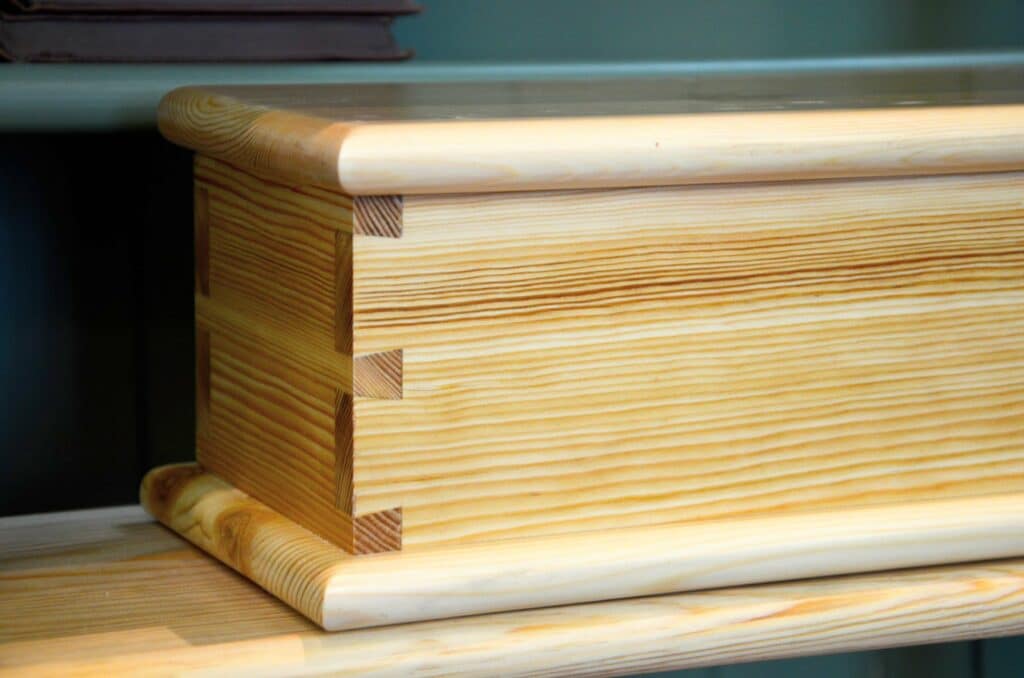
I've heard of and seen some different methods adult to systematically size pins to tails and tails to pins; some are mechanical but when information technology's too mechanically developed the rhythm becomes lost for me, and of course the worst examples are when the automobile over engineers the finish result. That's considering there'due south no 'flex'; information technology's become exactly that, mechanical, automaton, thoughtless. So that's the reason the eye picks the manus cut dovetail and the machined ones and sets them apart. Simply looking at the woods, sizing its portion, eying the grain in its configuration, depth of colour, contrast, weighing upwardly its growth seasons recorded in that location in rings and such like that, I ultimately rely on my eye to guess which tails and pins I think would work best. So indeed it's a question of sizing the pins and tails that determines the amend outcome—non always the easiest of tasks for anyone, let alone a novice woodworker with aspirations for that perfect box.
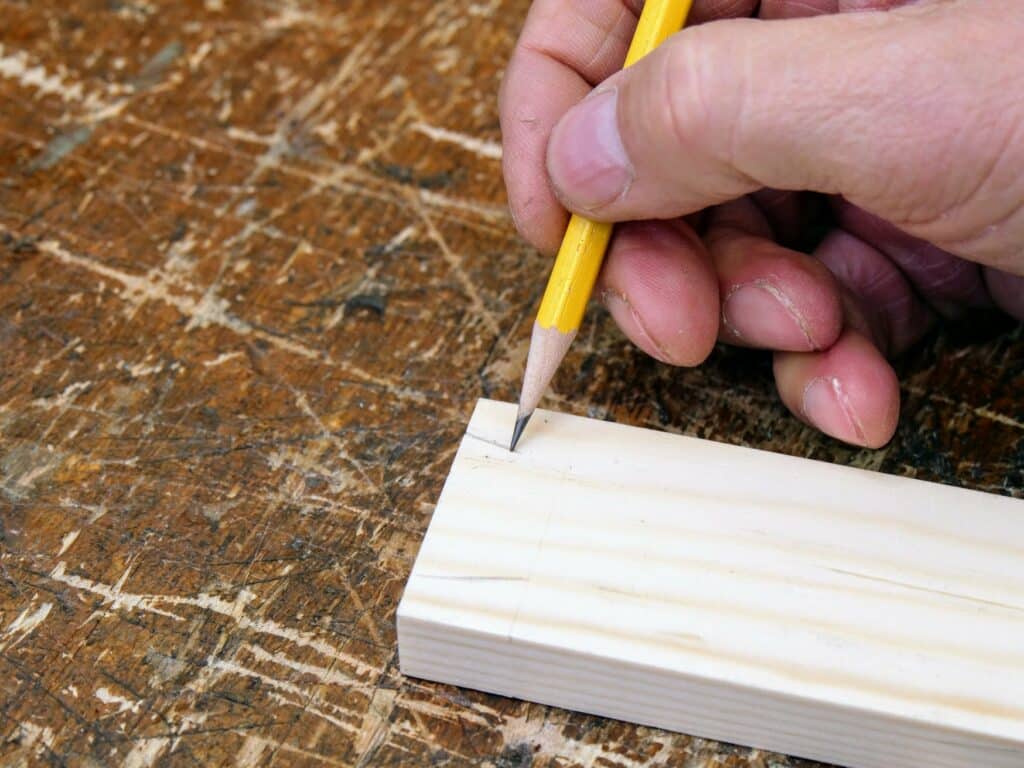
To begin my dovetails I rely frequently on sketching something straight onto the forest. Just to run into how I feel most it. Just so too, often, a sketch drafted out on the wood leads to the section of forest traced out on newspaper or card. Solidity in lines leads me on into the organic spheres I flex to always encompass in all I reach for. It's an aesthetic you encounter, and you lot you lot don't need a MA in physics to get in that location. You never did! Once you set certain parameters, retain a flexible versatility, yous open doors in dovetailing you never dreamed possible. That's what I dear most my work. Without diktats I am free to deliberate and cull. But though the cease advent requires a degree of high self-demand, I am still responsible for discovering my options, choosing sizes and proportioning tails and pins according to drawer sizes and then on as discussed. There is no sway by an private power and then on the other paw no sway of pop opinion either. Information technology's a foreign matter that something like joint making seems to always require those rigid lines of inflexibility we work to in the cut of them nonetheless the hand, the arm, the fingertips all continually flex in the handle to steer the saw. Steer?
I employ the word 'steer' decisively because sawing and tool use can indeed exist a flake like steering a car or a bicycle. If you lot hold the car steering wheel bull-dog rigidly information technology's likely you will crash because you have non got the flex you lot need to steer the car co-ordinate to the nuances of the route and the tolerances in the mechanical linkage of moving parts in the motorcar itself. Anyway, at the end of the day it's about a crafting man and woman relying intuitively on their muscle and tendons to steer and guide. The pocket-size shifts make the big differences to the whole. Linkage needs flex when related to hydraulics, valves, pistons, muscle and sinew. In my world I make my decisions based on a right earned past accepting these early on disciplines in my life. I understand the essentiality of being flexible because I must motility my whole trunk in relation to the hand on the saw handle to brand my cuts in the places of exactness I demand of myself. Aslope this, coupling information technology to me in my ongoing enquiry and report, I find integrity in my working of wood when it comes to every element. I look ever for the hidden skill, skill that then lies deep inside the joints I make. It'due south called integrity. I don't ever await for ease as such, or dumbed-down alternatives in methods that deny me achievement. Woodworkers regularly ask me why I don't gang upwardly the cutting of half a dozen dovetails to be sawn through all at once. It'southward more often than not because I know where the question comes from.
Our being programmed in school carries on through to machismo. It starts early and we are being geared up for fast and mass product. Not a whole lot different than instruction kids to type via gaming on devices so that when school age ends we have programmers. Better to look for what gives the greatest levels of fulfilment and, yeah, enjoyment too. With my struggling came experience. I crossed a line and discovered what I was looking for, that which I never found using methods other than my hands. I realise now that, often, many that criticise my quest to reestablish high levels of skilled workmanship are those that never found what I speak of. For some it's their attachment to the conclusion of the work rather than the process throughout the making. This I found personally to be of much greater importance, adding peachy value before the determination comes. And then it's here where I unite the process with the conclusion knowing that the piece of work I do is indeed mine. I suppose this 'me' in the process is 99% hand piece of work resulting from the skills I have mastered that give a guaranteed outcome. My work is e'er fast and efficient. To depict information technology out and prolong tasks in some etherial spheres would be more a luxury I don't peculiarly want or wait to. Watching someone recently combine automobile methods with some additional hand tool work took two hours for what is essentially 20 minutes very pleasant and rewarding manus work. The event was less than it should accept been for a professional maker, merely I doubtfulness he knew it.
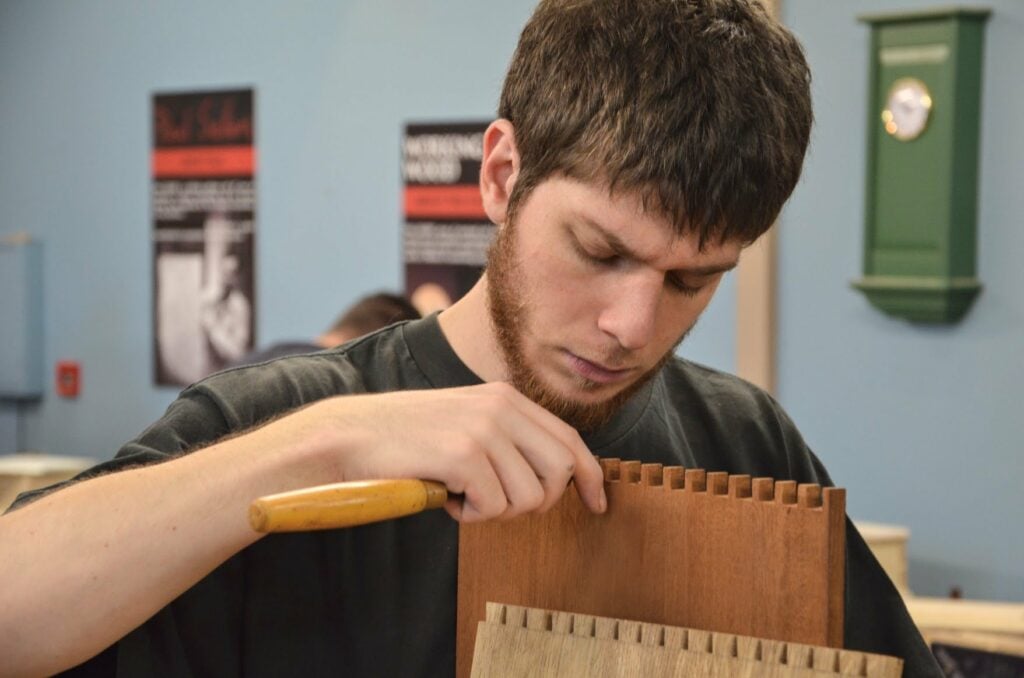
Dovetail proportions
Your task is to decide proportion in relation to your box or drawer, chiffonier or projection role. One, two, three, four—how many should this section of wood accept over this one? Is it pure preference and what choices do I demand to make if any? Wood type? Strength or weight-to-strength ratio in relation to employ? Or is it based on something else? Well, whereas some may claim that there is an industry standard, in reality there really isn't. Peradventure I should say at to the lowest degree at that place has never been one in any of the realms of woodworking I've ventured into. What determines the proportions by and large are the size (superlative) of the corner they will create, the size of the dovetail pins and the size of the dovetails. Across that at that place are variations on the arrangement of the dovetails because yous have half-lap dovetails and hounds-tooth dovetails, progressive sizing and so on. I think for the purpose of simplicity nosotros will stick with through or mutual dovetails. Then from the basic foundation you can adapt the theory for other dovetail types.
In most work yous volition find that dovetailed corners grade the marriage of the four parts to dovetailed boxes. That existence then, only occasionally do they become wider than say around six″. In projects on our woodworking masterclasses we have gone up to 16″ and effectually 12″. This has been for tool chests and the carcass of a wall cupboard. Lets focus on smaller widths up to the 6″ span I mentioned.
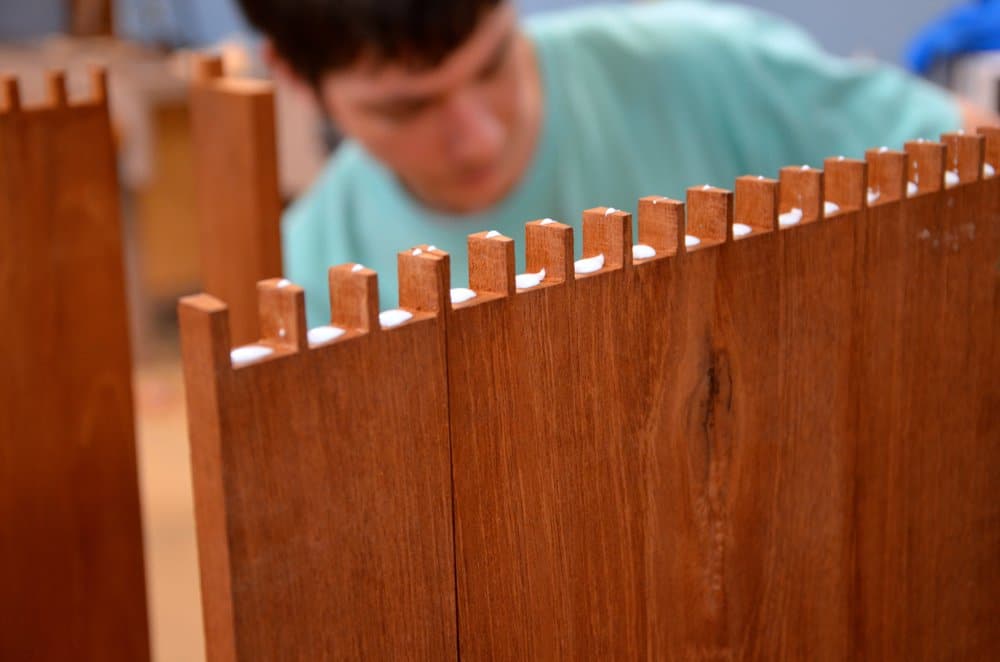
It doesn't take long to realise that there are some variables in sizing but that boxes are usually sized from around 1 1/2″ to 2″, between two″ and three″,between 3″ and four″ and then betwixt five″ and 6″ tall. Over the years I have developed a system to follow that works well enough for me. For drawers, boxes or trays two″ or less I generally like a single dovetail. For three″ to iii 1/2″ and less two dovetails, for 4″ iii dovetails, for 5″ to 6″ four dovetails and for vi″ four or perchance v.
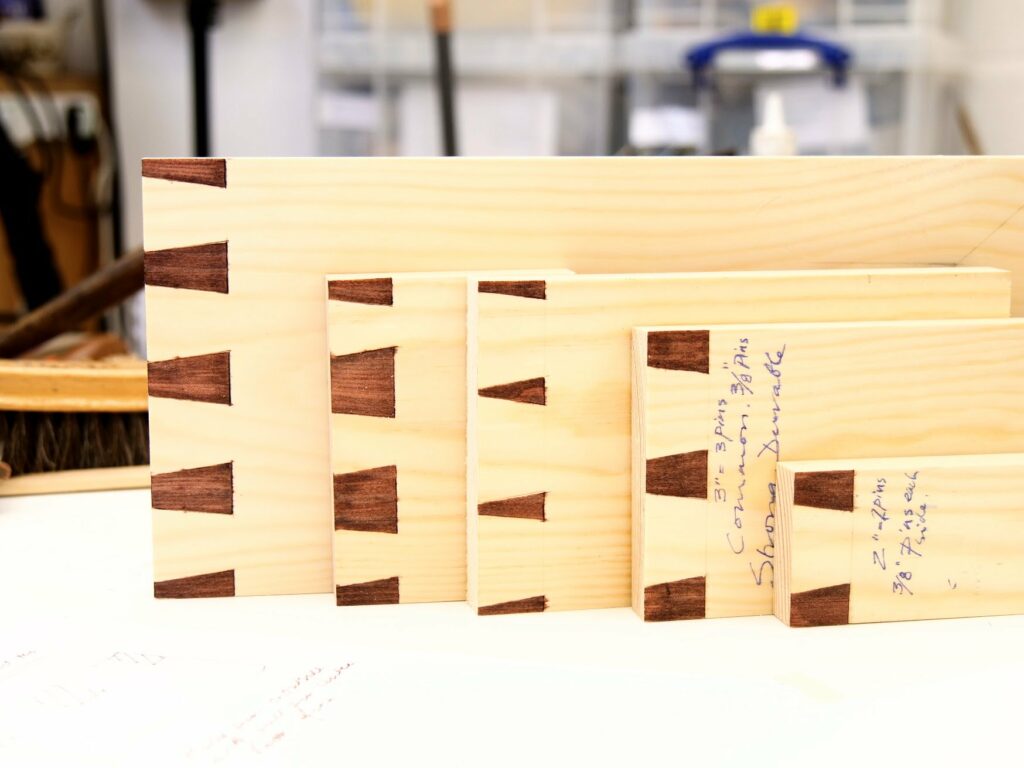
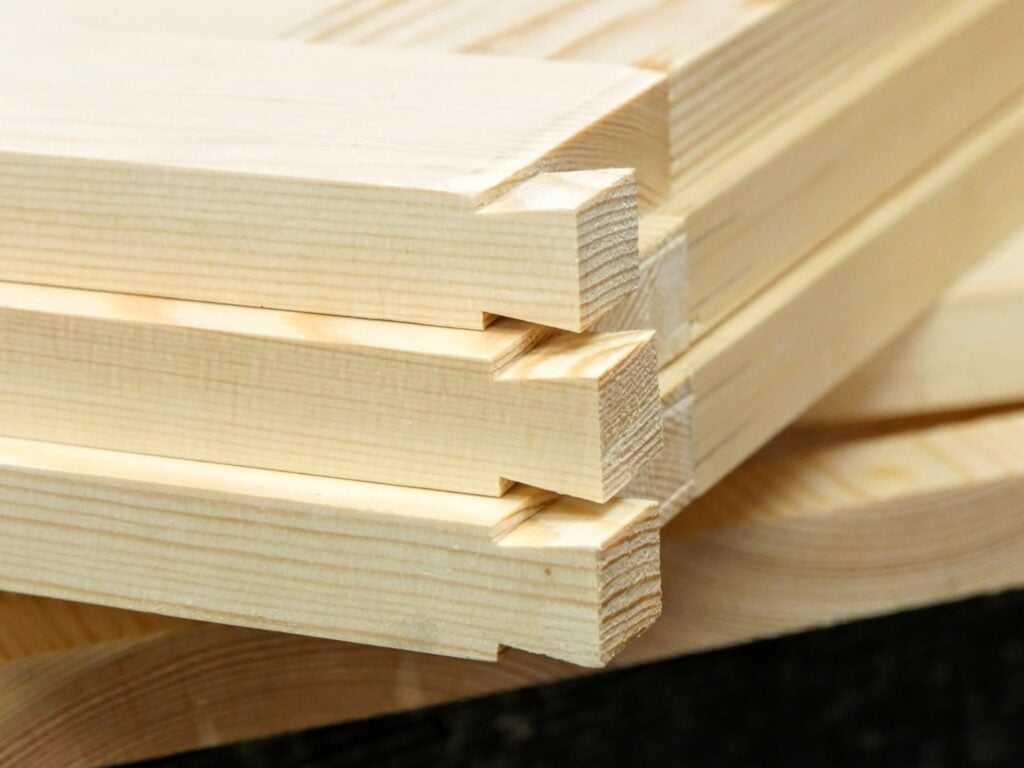
After that the proverb I use for myself is never to have a dovetail wider than 1 one/4″ and not usually narrower than 7/8″. That way I tin work out the size according to the number of tails I desire and then to the sizing of the pins too. Of class you can have more or less dovetails than I take suggested, it'southward upwards to y'all. It's more suggested practices that work that I'k offering here rather than rigid police force!
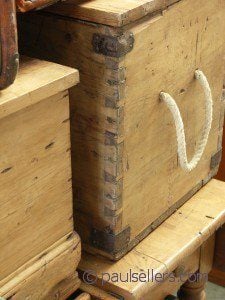
Whether it is snobbism or poncey I am often unsure. Perhaps it's neither, maybe both, but pretentiousness is very real whether nosotros know it or non. It does not accept very long if you examine enough vintage article of furniture to realise that the manufacture standard with regard to tail sizing for fine dovetailing in fine piece of furniture, skinny pins and wider dovetails are the goal. I like this in some measure. What I have seen in my dismantling furniture and shut exam of dovetails is that if the pins are super thin they are also weak. I take besides seen it in my own work where inserting the tails into their recesses resulted in the pin coming out of its socket in the main body of woods with the dovetailed piece. Yous run across some forest are quite breakable, some take short grain and some are quite weak. You lot must consider the woods you are using if you lot programme on using thin pins.
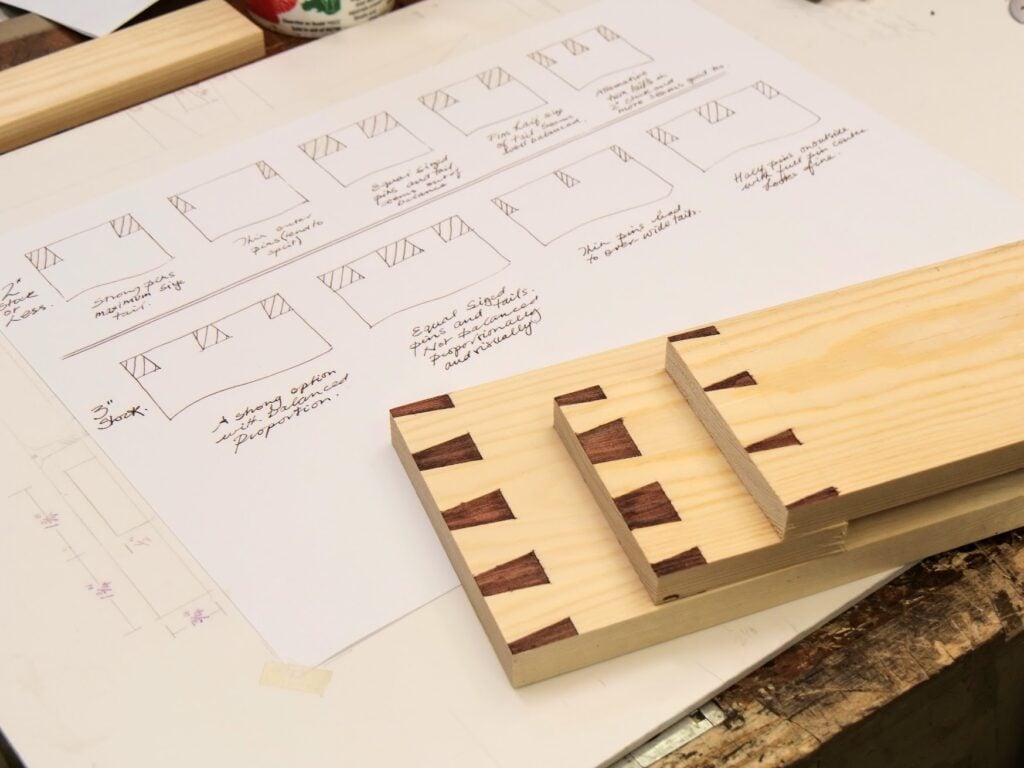
Following the numerical maxim suggested to a higher place simplifies the thought process for subsequent steps. Of course it is not a hard and fast rule, and indeed nosotros have made boxes with twin dovetails in textile less than 2″, but this has been to create an exercise in accuracy for training. So the remaining factor for the unmarried-dovetail-2-pin scenario is what size pins and what size dovetail/south? Is information technology equal thirds? Half pins always? Well generally those of us raised with the advent of the router bit ordinarily shy away from as sizing our pins and tails because in the early days of the router method the pins and tails were always the aforementioned size as each other and half pins come by and large every bit a result of a specific blazon of layout methodology. Often this was generally the first of the telltale signs in detecting merely how a set up of dovetails were cutting. Of course in those days only existent wood was used and non plywood or other engineered boards. Today the industry has shifted and I often see dovetailed MDF and pressed fibreboard.
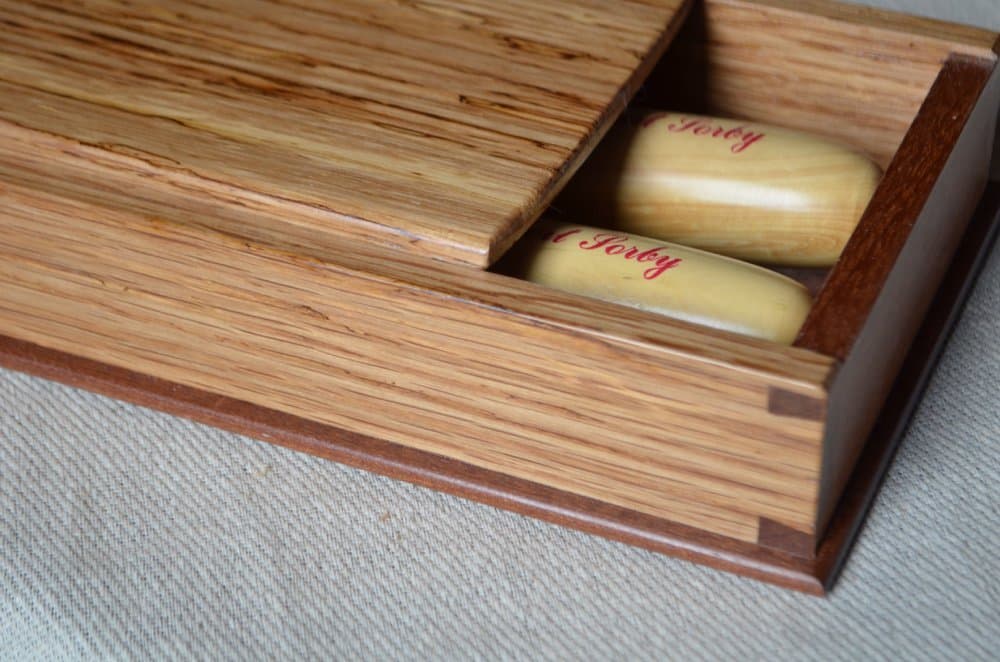
Structurally I accept looked for pin force in dovetails as the dovetailed aspect is always strong because it is always at least equally wide and more often than not wider than the pins. In my own work I aim for a minimum size of 1/4″ and mostly three/8″. At present that doesn't mean I won't become down to less or up besides. Simply that somewhere around 3/8″ has numberless if force without beingness too large and I similar its proportions because, well, it has the appearance of solidity and forcefulness. So let'south bound to multiple dovetails as more often than not speaking there is a predominance of this in our work.
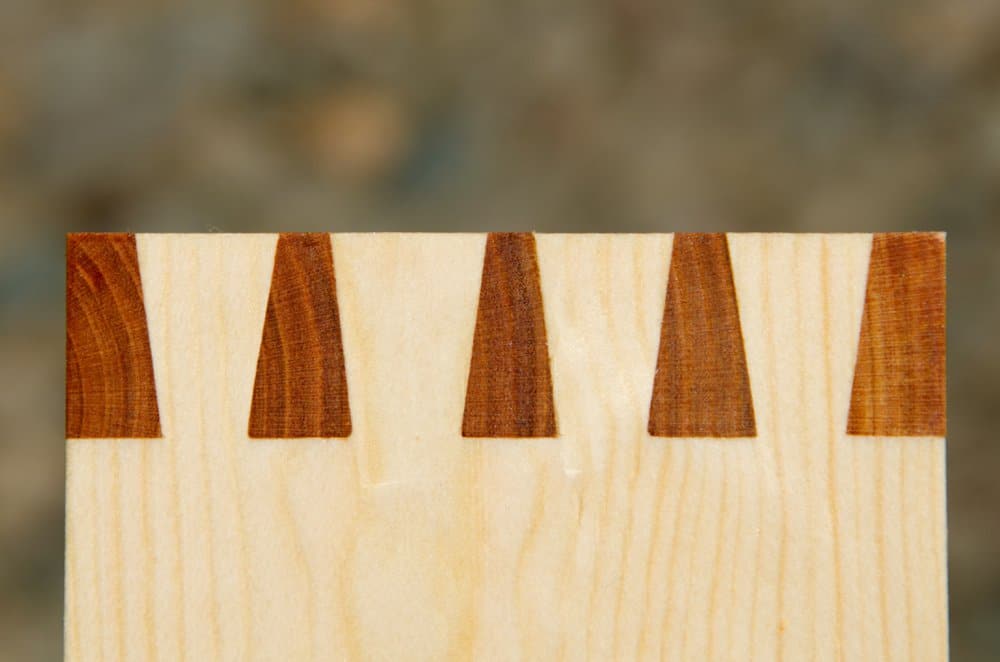
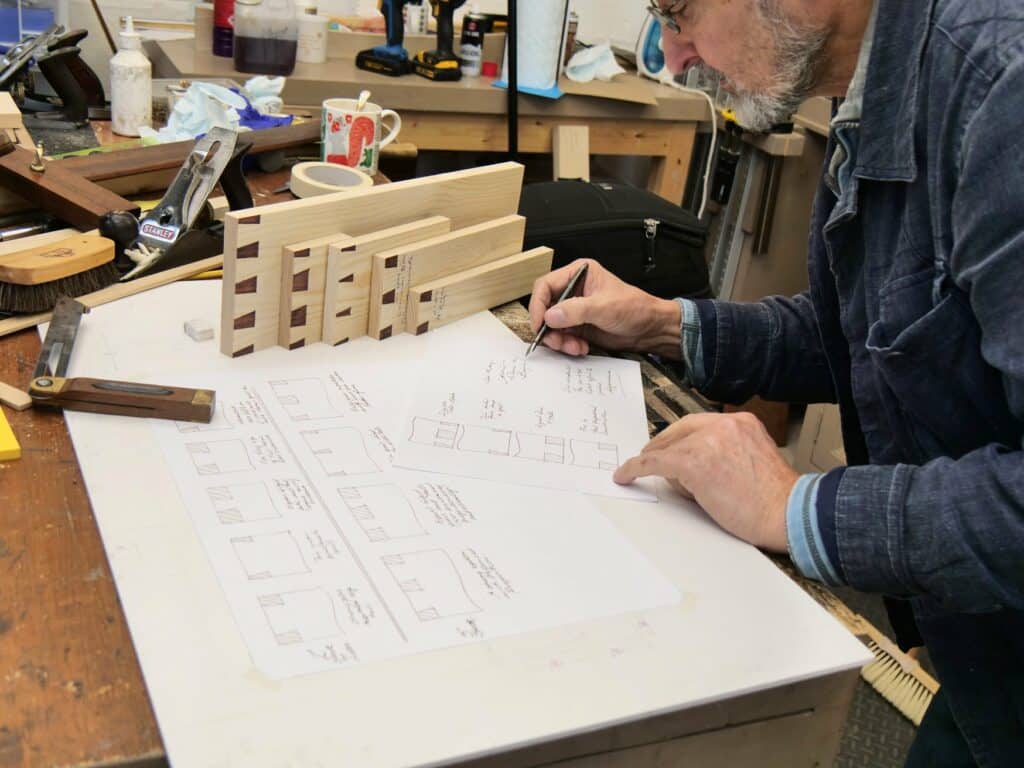
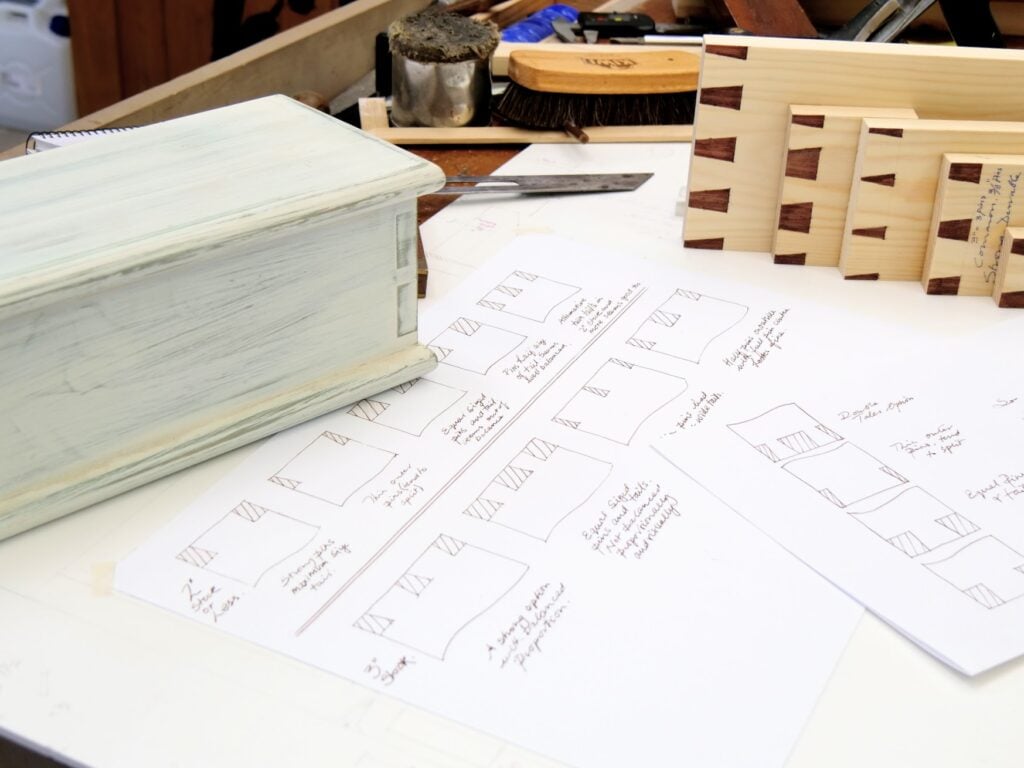
In my piece of work I often lay out my dovetails on a section of wood cut from the stock of my tail pieces. I likewise might use some card stock or if i am working from drawings i will take either full size drawings are scaled drawings to work from. Doing this, shading in the pins, helps me to visualise the proportions meliorate. If you tin can decide that you want a sure size for pins you must then decide whether you lot want full pin sizes or half pins to the outer edges beginning.
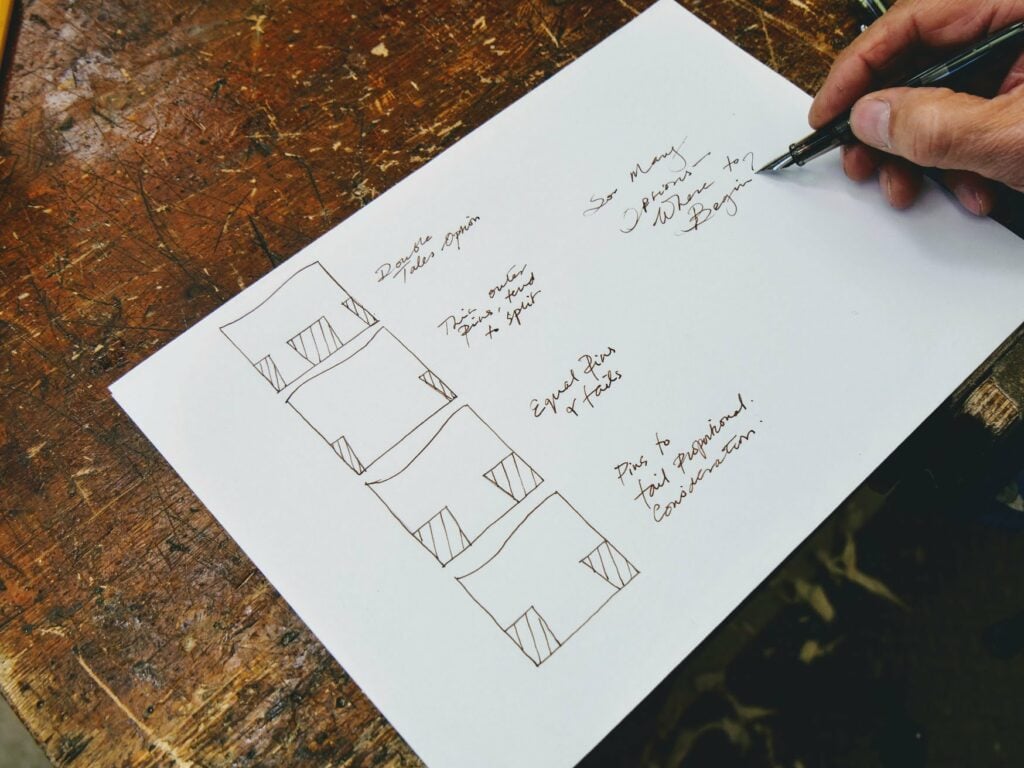
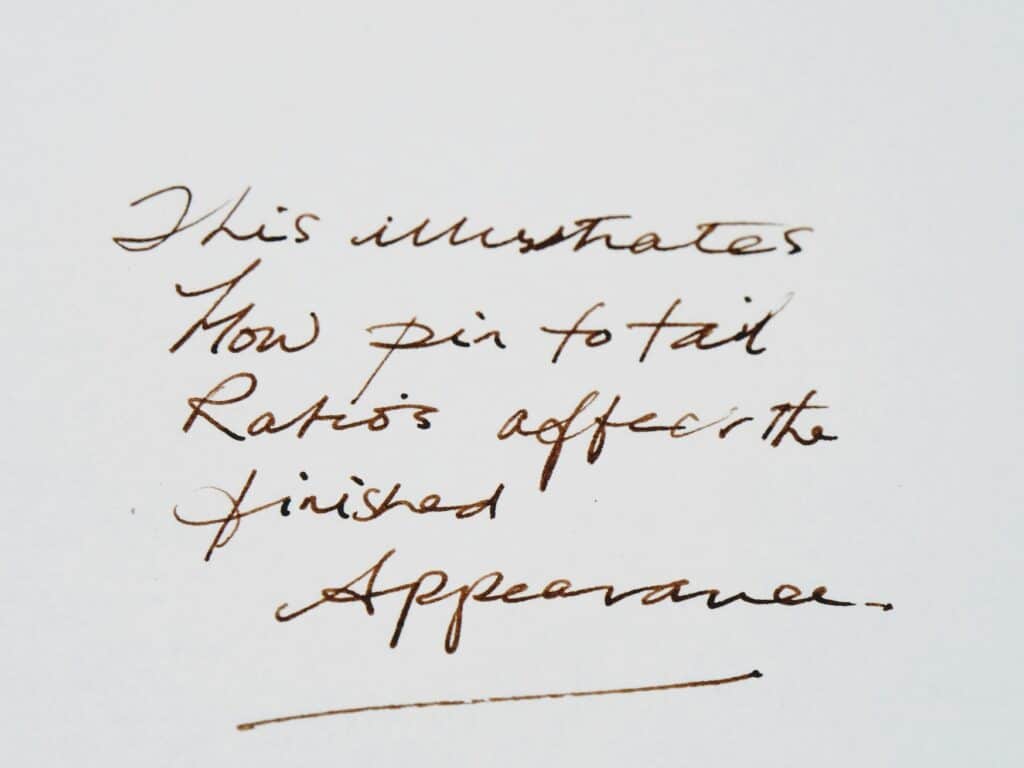
On the double dovetail this is easy because the main decision is the size of the pins. On a 3″ section of woods the pivot total at 3/8″ volition exist one ane/8″. Deduct this from the three″ and you end up with 1 7/8″ so the dovetail width will be xv/16″. You lot tin e'er vary the sizing on boxes where the overall height of the box is not intended to fit into an opening as with a drawer. An manufacture standard in some spheres is to have half pins and full pins. so with our electric current scenario of 3″ we would have ii x iii/16″ = iii/viii″ plus the full pin of iii/eight″ so 3/iv″ pivot accumulation. This then leaves 2 1/4″ for ii tails so ane i/8″ dovetails. Equally I said, for me, generally, I only use iii/8″ equally for all of my pins every bit my standard size in my more full general piece of work. This would exist for kitchen drawers, tool boxes and chest. They are beautifully stiff and attractive too. For a more refined await I might half that size to 3/16″. For the prissier wait I would use my saw kerf alone for sizing pins.
And then at present we will run into that the sizing of the pins gives u.s.a. the overall deductible distance and what's left is simply divided past the number of tails we are aiming to have. Larger pins more often than not give us the smaller tails contrast we aim for. So i the next blog on dovetail layout let'south look at the organization that works well that comes from dividing the tail slice into even divisions. We use this all the time to reduce the demand for complex calculations and measuring and dividing increments mathematically. It'due south a uncomplicated process. This video will aid you lot with this better than the g words above, perhaps, merely the g words dull everything downward to present bite-sized understandability.

Source: https://paulsellers.com/2018/01/dovetail-sizing-keep-simple/
Posted by: hammittlever2000.blogspot.com
0 Response to "How To Draw A 6:1 Dovetail"
Post a Comment