

How To Create Data Studio
Google Data Studio is really like a canvas on which you can create your art with data. It provides you with all the tools you will need to generate an interactive, enticing, and persuasive painting of your data. It looks slightly simple when you first open it but do not be deceived. Google Data Studio Report is amazingly versatile in its ability to present raw data in so many forms.
Its versatility results in it being a multi-purpose reporting tool. You just need to have the data and you can find a way to generate world-class reports for free. In this tutorial, let us build a Google Data Studio Report together from scratch.
By the way, if you have never used Google Data Studio before, first read this blog and quickly get back here. I can wait!
Ok, you are back. Let us make a simple Google Data Studio report for Google Analytics. Later you will see that what works for making a Google Analytics report also works for making a report for the performance of your YouTube channel, your e-commerce website, or really anything under the sun.
Table of Contents
- What is Google Data Studio Report?
- Benefits of Creating Reports Using Google Data Studio
- Best Practices to Create Google Data Studio Report
- Methods to Create a Google Data Studio Report
- Other Google Data Studio Reports
- Adding Pages to a Google Data Studio Report
- Sharing a Google Data Studio Report
- Conclusion
What is Google Data Studio Report?
Google Data Studio Report is a free web-based visualization tool developed by Google to help people easily create sharable reports in a matter of few clicks. It allows users to create customizable dashboards to measure the performance of their business, Marketing, Sales, or other work.
Google Data Studio Reports enables users to create flexible reports by adding their data sources for seamless data flow. Get real-time updates on charts to allow users to identify the hidden insights from data. Google Data Studio Reports comes with pre-built KPIs, visualization and reporting tools, and data segmentation features that help users quickly understand data and trends.
Benefits of Creating Reports Using Google Data Studio
Google Data Studio Reports come very handy when creating flexible dashboards and need regular small changes. Many individuals and Marketers prefer Google Data Studio Reports because it offers many features. A few benefits of Google Data Studio Reports are listed below:
- Integration with data sources: Google Data Studio Reports supports integration with many Google products and services and 100+ other apps for seamless data flow into dashboards.
- Create Sharable Reports: Google Data Studio Reports allow you to create reports and share them with your team members, managers, individuals without downloading any file. It supports sharing through E-Mails, links, and scheduled sharing.
- Drilling-Down Reports: Google Data Studio Reports help users effortlessly drill down into data to get insights. It offers various tools that help quickly do the process.
- Setting Goals and KPIs: It allows users to set their goals and measure performance comparing with goals. It comes with many key performance indicators (KPIs) that help users to understand important metrics.
Best Practices to Create Google Data Studio Report
Google Data Studio Reports is easy to make using drag and drop features. But one should always follow some best practices to create Google data Studio reports for maximum efficiency. Here are some of the best practices listed below:
- Setting up goals and KPIs: It's always suggested to choose the right metrics and key performance indicators that will best reflect the progress for your business or task. Setting up weekly and monthly goals allow companies to compare their performance with some benchmark and motivate them to achieve it.
- Selecting Date Ranges in Reports: It allows companies to customize the view of Google Data Studio Report for any date or timeframe individuals want to visualize data deeply. It makes the reports more flexible to use towards personal preference.
- Configuring Google Data Studio Reports Accessibility: While creating any Google Data Studio Report, one should always know the end-users of the report. Team members or individuals should provide access to reports and dashboards to rightful people.
- Applying Predictive Analytics: Google Data Studio offers Predictive Analytics features that allow users to predict trends and forecast a few results based on their data.
- Distribute Related Charts: Adding more and more widgets on one page increases the complexity of reports. Google Data Studio Reports can be added to another page that allows users to segregate widgets on the same page based on the relation with other widgets.
Hevo offers a faster way to move data from databases or SaaS applications into your data warehouse to be visualized in a BI tool. Hevo is fully automated and hence does not require you to code. In fact, even the maintenance required is minimal.
Check out some of the cool features of Hevo:
- Completely Automated: The Hevo platform can be set up in just a few minutes and requires minimal maintenance.
- Real-time Data Transfer: Hevo provides real-time data migration, so you can have analysis-ready data always.
- 100% Complete & Accurate Data Transfer: Hevo's robust infrastructure ensures reliable data transfer with zero data loss.
- Scalable Infrastructure: Hevo has in-built integrations for 100 plus sources that can help you scale your data infrastructure as required.
- 24/7 Live Support: The Hevo team is available round the clock to extend exceptional support to its customers through chat, email, and support call.
- Schema Management: Hevo takes away the tedious task of schema management & automatically detects schema of incoming data and maps it to the destination schema.
If you want to see for yourself how intuitive and easy it is to use, you can try it for free here.
Methods to Create a Google Data Studio Report
You can make practically any report on Google Data Studio. But to illustrate the process, let us create a Google Data Studio report for Google Analytics.
Once you add your Google Analytics data using the 'Add Data' option on the toolbar, you can start with, using the 'Shapes' on the toolbar. The point of adding shapes to the report is to give a visual boundary for your charts or texts you may add to these shapes.
Google Data Studio has two shapes – Rectangle and Circle.

Step 1. Add a rectangle to the canvas. It will look like this.

Step 2. You can now add a text box to it and enter the info you want. In my case, I want it to be the heading of what follows. My rectangle looks like this.

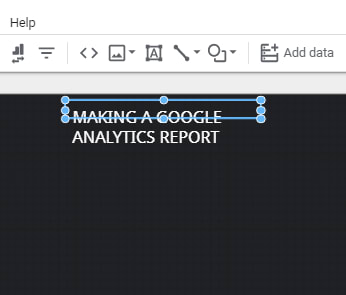
Step 3. You can, of course, add texts and charts without using the shapes too- like the heading in the image below
Step 4. I am going to add three circles below the rectangle. The method is similar. All you need is the 'Add Shape' tool.

Step 5. Inside these shapes, I will add the charts I want. There is a big list of charts in the 'Add charts' option in the toolbar. I am going to pick the Scorecard.

Step 6. Place the scorecard inside one of the circles. It should look like this.

Step 7. Click on your scorecard and look to the Data and Style columns you have next to your canvas. You can decide which metric the scorecard should show. I went with the metric- 'Sessions'. You can pick any metric that can be seen in the drop-down menu in 'Metrics'.

Step 8. Under the style column, you get to modify the shapes, colors, backgrounds, borders, and other appearance-related parameters of the chart to suit your style.

Step 9. Finally, this is how the canvas looks after I add different metrics using the scorecard.

Step 10. Here I have created similar rectangular boxes and added a 'Time Series' chart. Nothing changes except for the fact that you select the time series chart in the 'Add Chart' option.

Step 12. Like you did with the scorecard chart, you can change the appearance of this chart too using the 'Style' column.

Step 13. Similarly, you can play with the 'Data' column too to select your metric, etc. You can also use the 'Comparison Data Range' option to visually check how things have changed with your metric over your defined period of time.

Step 14. If you have gotten the feel for it, you can go ahead and add different types of charts on your canvas. Some of the coolest charts are the Geo chart (my favorite), the Donut chart, the Scatter plot, etc.

Check out the Donut chart too. Looks yummy!

Does the Donut chart seem a little too cluttered to be delicious-looking? You can always change how any chart looks using the 'Style' column. So go to the 'Style' column and reduce the number of slices.

Finally, after making such modifications, this is how the report looks.

Google Data Studio has all the tools you need to make a comprehensive and visually appealing report. You know the fundamentals now and you can explore further on your own to do much more. Remember that there are no rules here and if you are not as aesthetically impaired as I am, you can do a much better job at creating a very attractive canvas.
Other Google Data Studio Reports
Check out this report made for the performance of a YouTube channel. The metrics you measure may be different, but the tools you use are pretty much the same. What you choose to present in the report is up to you and your requirements.

This is another report made for Search Console. You can add texts describing the charts you present too.

Adding Pages to a Google Data Studio Report
The reports don't have to be on one page. You can always add pages and also control what pages viewers can see.

Sharing a Google Data Studio Report
Sharing your Google Data Studio report is easy! You can invite people or groups of people to view your reports, schedule email delivery, create a link, or download it as a PDF.

Conclusion
You have seen that report building is insanely easy with Google Data Studio. It connects seamlessly with all the other Google services and it is easy to access. As long as you have a clear idea of what you want to present, you can practically create a very pretty report in a matter of minutes and head to your meeting. You can add images, external links, and leverage tools like Date Range and Data Control to make your reports more interactive and functional. You can create a link or download as PDF to share it more conveniently. Google Data Studio is also free to use! Basically, it is awesome!
Do you need help consolidating and moving data from various disparate sources into your data warehouse? Things can get really messy with custom scripts. Hevo can help you move data from your databases and Saas applications in real-time. You don't have to code. Hevo has a very intuitive and straight forward interface that requires minimal maintenance. Once you get your data in order, you can gain valuable intelligence from it and build appealing, accurate, and persuasive reports. Give Hevo a try by signing up for the 14-day free trial here.
Share with us how you make reports in the comment section. Also, tell us what you think about Google Data Studio. We would love to hear from you!
How To Create Data Studio
Source: https://hevodata.com/learn/google-data-studio-report/
Posted by: hammittlever2000.blogspot.com
0 Response to "How To Create Data Studio"
Post a Comment